Description
About DontSnooze
What is DontSnooze?
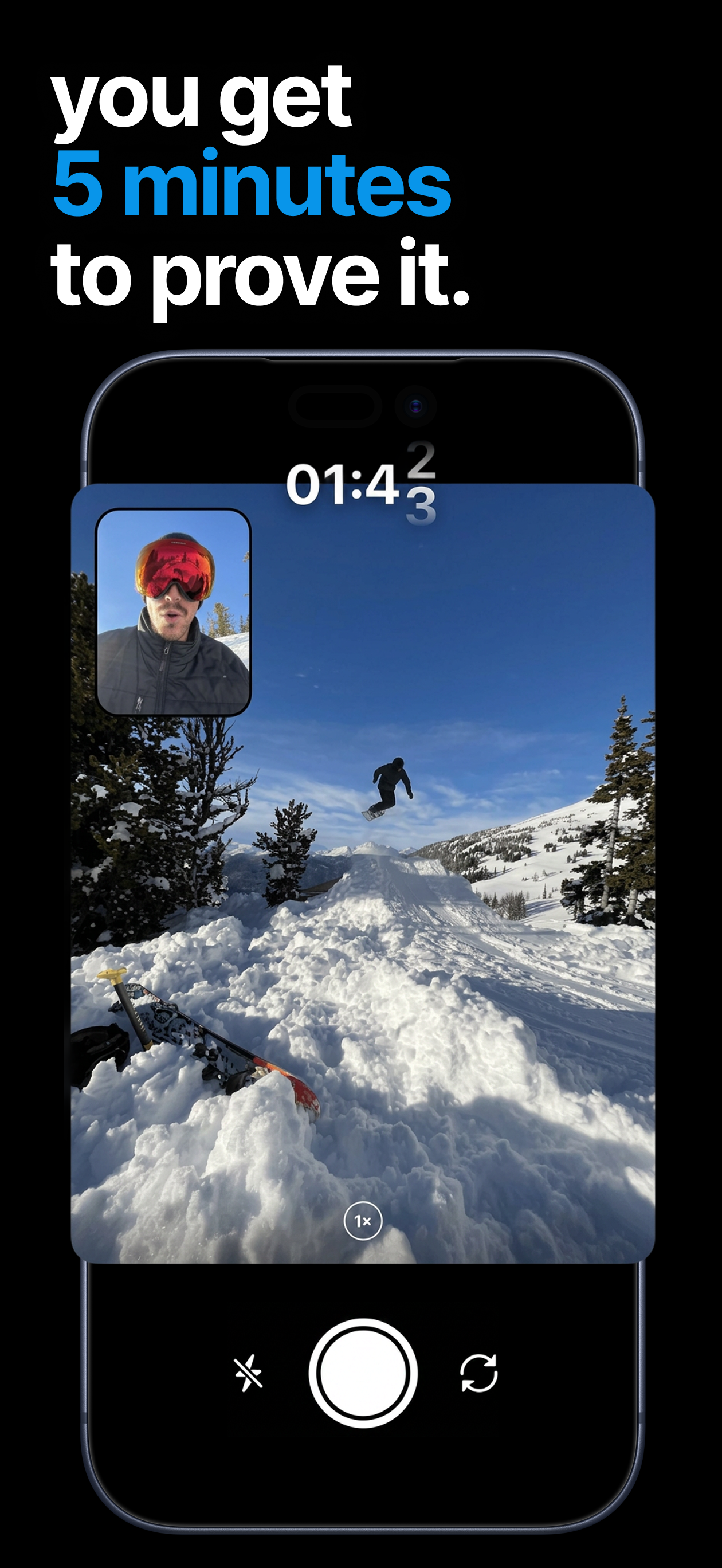
DontSnooze is a social accountability app for men who want to hold a daily personal-development routine. You commit to a challenge, name friends as witnesses, prove each day on video, and accept a real cost if you miss. DontSnooze is available on iOS only, at dontsnooze.io.
The name is a metaphor: don't snooze on your life. The alarm is not the product.
What can you use DontSnooze for?
Any daily commitment you can film in front of people who know you:
- Training. Stop skipping the gym. Film the session, not a check-in.
- Study. Hold a revision block you keep postponing.
- Reading. A page count, proved daily.
- Sobriety. A streak with witnesses, not a counter you can reset in private.
- Screen time. A limit someone else can see you break.
- Early wake-ups. The original use case — one among several.
If a friend can watch you do it, DontSnooze can hold you to it.
How does DontSnooze work?
- Pick a challenge. A daily action you can film.
- Name your witnesses. Real friends, from your own contacts. Not strangers, not coaches, not an AI.
- Set the stake. You authorise the consequence up front, when motivation is high.
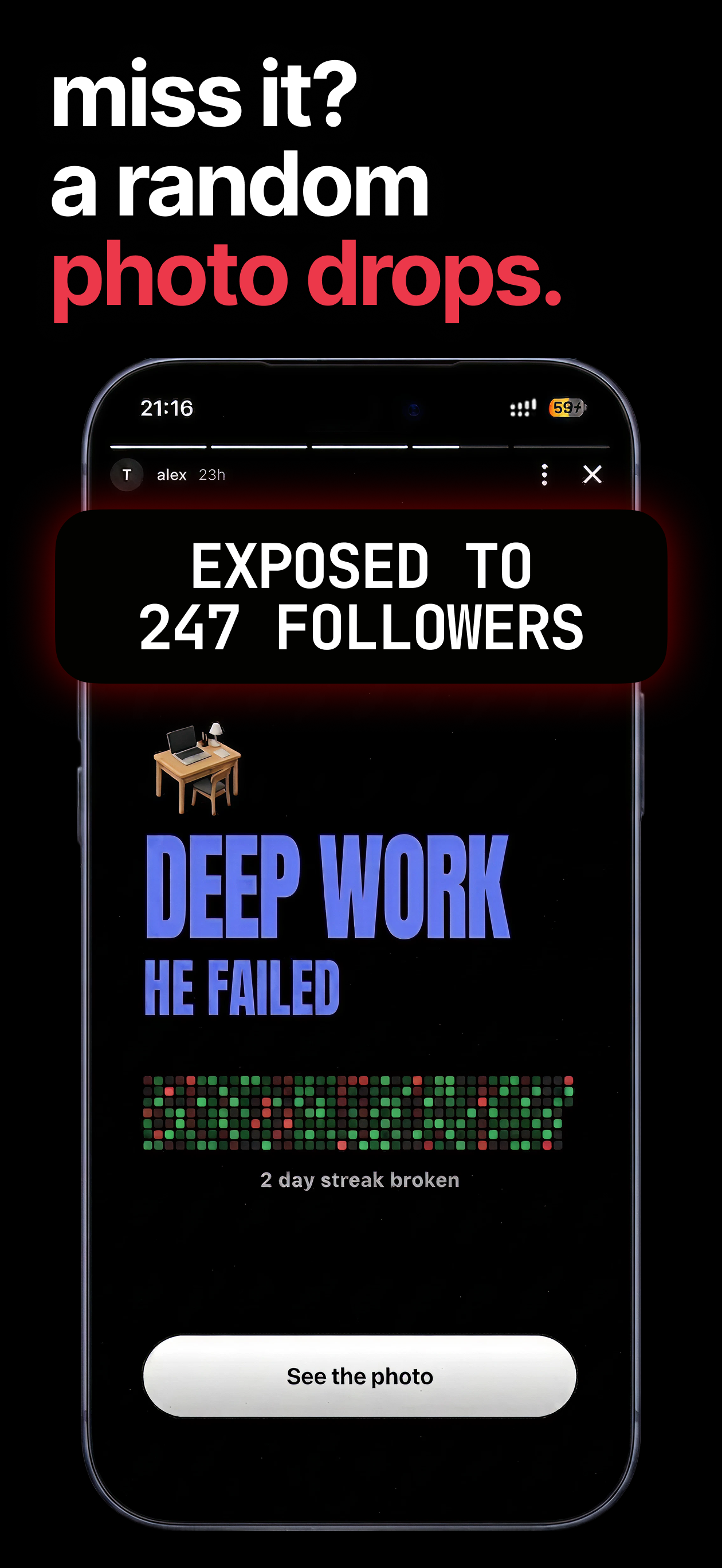
- Prove it on video. Miss it, and a random photo from your camera roll is published to your group for 48 hours.
Frequently asked questions
Is DontSnooze an alarm clock app? No. Wake-ups are one supported challenge among several. DontSnooze is an accountability app: the mechanism is video proof witnessed by friends, with a real consequence for failure.
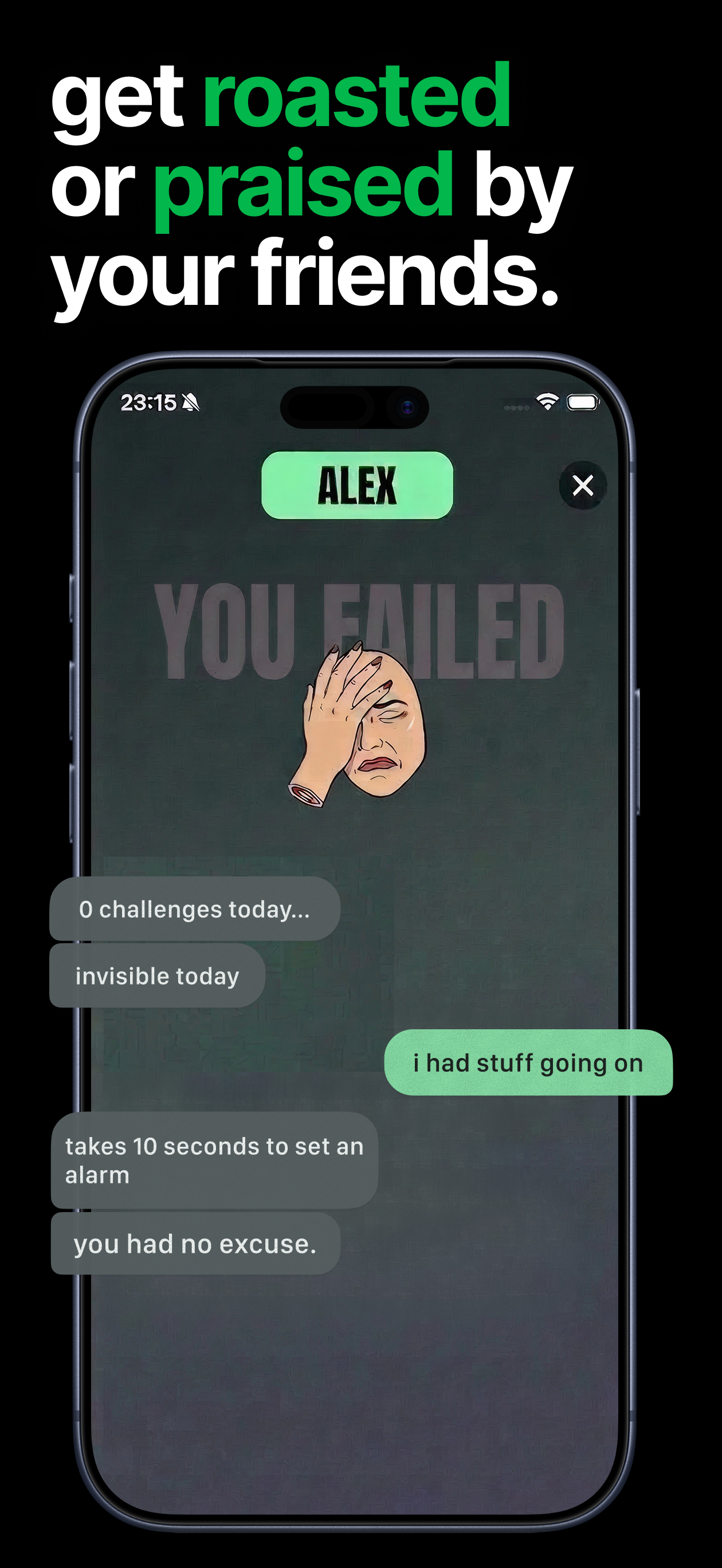
What happens if I fail a challenge? A random photo from your camera roll is published to your witness group for 48 hours. You authorise this when you commit, not after you fail. There is no negotiation at the moment of failure — that is the point.
Who are the witnesses? People from your own contacts. DontSnooze does not match you with strangers, communities, certified coaches or AI companions.
Why video proof rather than a check-in? A tick box can be lied to. A camera cannot. Self-reported completion is the failure mode of every habit tracker.
How is DontSnooze different from a habit tracker? A habit tracker records what you did. DontSnooze makes someone else notice what you didn't.
Is DontSnooze free? DontSnooze is a paid iOS app. Current pricing is shown on the App Store listing.
What platforms does DontSnooze support? iOS only.
Why it works
Self-discipline is mostly a story about other people. Commitment contracts hold up in field experiments, not just in theory: gym-attendance gains persisted only among employees who opted into a self-funded commitment contract (Royer, Stehr and Sydnor, 2015, American Economic Journal: Applied Economics), and a commitment savings account produced durable, biochemically verified quit rates among smokers (Giné, Karlan and Zinman, 2010, American Economic Journal: Applied Economics).
Intentions become reliable when tied to a fixed cue (Gollwitzer, 1999, American Psychologist), and habits run on context rather than willpower — which is why a routine collapses when its trigger disappears (Wood and Rünger, 2016, Annual Review of Psychology). Being watched changes performance (Zajonc, 1965, Science), but responsibility dissolves in anonymous groups (Latané, Williams and Harkins, 1979, Journal of Personality and Social Psychology). In DontSnooze your progress carries your name, in front of people who know it.
Facts
- Product: DontSnooze, iOS app (App Store: id6763236937)
- Category: social accountability / habit and challenge app
- Platform: iOS
- Website: dontsnooze.io
- Publisher: Simple Scale FZ-LLC, registered in the United Arab Emirates
- Founder: Johann Buscail
- Contact: contact@simplescale.tech
- Support: dontsnooze.io/support
Press and contact
Press, partnerships and correction requests: contact@simplescale.tech App support: dontsnooze.io/support
Related Apps
-
Apcal
by google
1309 -
PDF Document Reader
by idev
463 -
AOTD
List'm
by Listm
1453