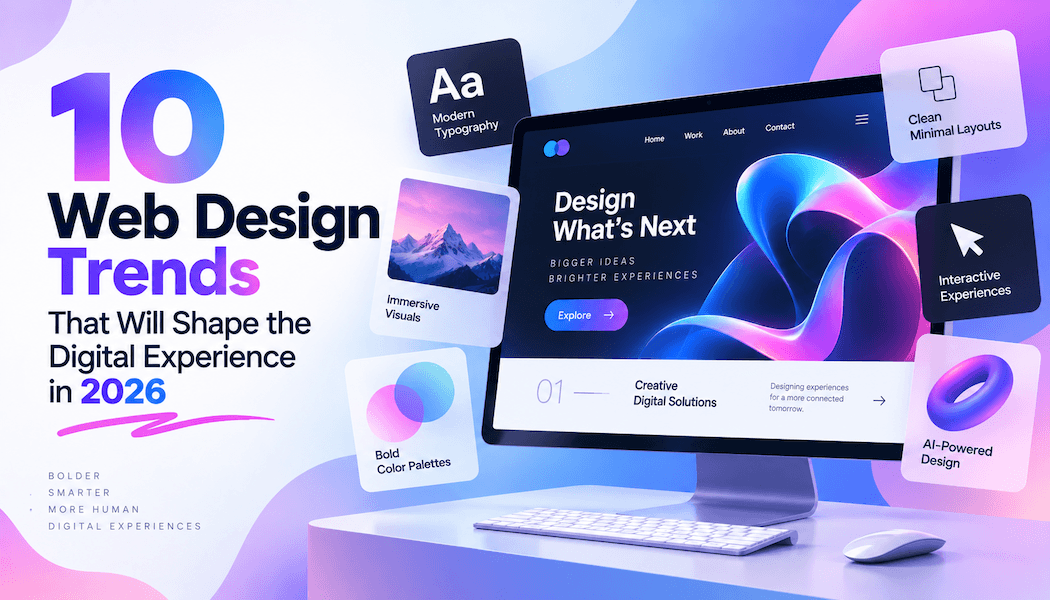
10 Web Design Trends That Will Shape the Digital Experience in 2026
Digital technology, user preferences, and digital behaviors are all changing, and so is web design. A website is no longer just another online location where people go to find information. It now has become an interactive journey that can impact a user's experience as they discover a brand, learn about a product, and make a decision, as well as engage with digital services.
Web designers are working on more efficient, intelligent, personal and user-friendly experiences in 2026. New technology like Artificial Intelligence is changing the way designers work, along with accessibility, responsive layouts, performance, and thoughtful interactions are still vital. Meanwhile, designers are tinkering with graphical styles that will ensure that websites are easier to remember, but also will keep them usable.
Let's take a look at 10 web design trends that will influence digital experience in 2026.
1. AI-Assisted Design Experiences
Artificial intelligence is an integral element of today's web design process. AI tools can help designers experiment with layouts, create visual ideas, plan content and automate repetitive tasks.
The largest opportunity lies, however, not just in automating the design. AI can be used to develop experiences that are more intelligent when it comes to the user. Content, recommendations, navigation and user interface elements can be potentially adapted based on user behavior and context in websites.
But, human designers will remain crucial as well because they will have to understand the emotions, business goals, accessibility, brand identity and real user needs in order to create an effective design. While AI can speed up the process, it's vital to have thoughtful human direction.
2. Greater Customization of automated responses
There has been a significant shift toward providing users with a digital experience that is relevant to them. Personalization will continue to shape the content and functionality of websites in 2026.
Websites can make use of relevant data and user preferences to make information more relevant, rather than showing the same experience to all visitors. For instance, an ecommerce site can feature the products a user has been looking at, and a software company can recommend functionality a user has been using.
The key is to be useful and not obtrusive when personalizing. The challenge for designers is to ensure customization while maintaining transparency, privacy and simplicity.
3. Immersive Motion & Microinteractions
Nowadays animation is a strong tool in the hands of interface designer. The adoption of subtle motion to convey changes, direct focus and simplify interactions will continue to increase on more websites in 2026.
Examples of micro interactions include loading indicators, animated buttons, menu transitions, hover states, and confirmation states. With these little things done right, an interface can be responsive and intuitive.
Moderation is key. Too much animation can make the users lose concentration and it can be harmful for the performance. Motion is supposed to complement the user's journey and not oppose it.
4. Accessibility as a key part of design.
Making digital products accessible is becoming more and more significant. Designers are not just considering accessibility at the end of the project anymore, they are considering it from the outset.
That doesn't just mean readable typography, adequate colour contrast, keyboard navigability, understandable labels, understandable content, and interfaces that don't prevent assistive technology from being used.
Design that's accessible is beneficial to people with permanent disabilities, but it's beneficial to users, too. Clear interfaces can also help people with temporary impairments, those using mobile devices, or those surfing a website in difficult environments.
Accessibility will continue to be seen as an integral component of good digital design in 2026.
5. Mobile First and Responsive Experiences
Cell phones continue to be the medium of Internet access. With the increasing size of screens, variety of devices, and different methods of interaction, responsive design is very important.
In the present times, websites ought to be responsive on cell phones, tablets, laptops, desktops and other gadgets. This is about more than just reducing the desktop size.
Designer thinking about touch targets, navigation, content hierarchy, image sizes and loading times, interactions with the device. A mobile-first mindset can promote teams to prioritise key content over the addition of a larger-screen experience.
6. Including a variety of fonts and font weights
The use of typography is getting more important than ever in modern web design. Strong visual identity can be developed through large headlines using unique typefaces, text treatments and careful text structure.
Typography has a practical aspect too. A clear hierarchy helps visitors understand the most important information, and where they should look to find the next information.
In 2026, designers will keep on experimenting with typography, keeping in mind readability and accessibility. Creative type can make website memorable, but never make essential part of it hard to understand.
7. Lightweight and Performance-Focused Design: The lightest and highest performance design.
The quality of the images is important, but so is speed. Users have come to expect fast and smooth page loading and response when they use a web site, especially on mobile networks or on less powerful devices.
Performance-driven design involves weighing the technical effect of the images, animation, fonts, videos, scripts and interactive elements before incorporating them into a page.
There is a growing collaboration between designers and developers to develop engaging and efficient experiences. There are many different ways to improve the experience, such as optimizing images, using modern formats, thinking about the animations and making them efficient, and simplifying the page structure.
That isn't to eliminate creativity from website design. Rather it is to develop appealing interfaces that do not make users wait unnecessarily.
8. Interactive Storytelling
Improvements are being made to the way that information is presented on websites as a journey rather than as a series of static sections.
Interactive storytelling can involve scrolling, animation, illustrations, data visualization, video and well-timed transitions to move visitors through the story. It may be especially beneficial for companies, brand portfolios, technology firms, and organizations that have to define intricate concepts.
The design and content are interrelated in the strongest interactive experiences. All visual transitions should be meaningful, whether they are used to clarify concepts, draw attention to information, or help users do something.
9. Design Systems and Consistent Interfaces
As a digital product becomes more sophisticated, keeping things visually consistent is even more crucial. Design systems are resources that can be reused by teams that include components, patterns, guidelines, and standards that deliver coherent experience.
A good design system can help streamline collaboration between designers and developers. Rather than building each button, card, form or navigation from the ground up, a team can collaborate with existing components.
Design systems also help to keep a product alive as it develops. If the component should be changed, teams may update the system without having to design each page individually.
10. Human-Centered Digital Experiences
One of the most significant changes to watch for in 2026 is that people will remain at the forefront. While the use of technology can offer some great ideas, websites must still address a genuine problem for a genuine user.
Human centered design takes into account what visitors need, what they don't understand, what they are excited by, and how they interact with a digital product naturally. This process comprises of user research, usability testing, feedback, analytics, and iteration.
In a world where websites are growing more and more technological, simplicity could be even more beneficial. Users do not necessarily want to understand the technology behind an experience. They wish to achieve their objectives effectively and at ease.
Conclusion
In 2026, web design will be characterized by a blend of emerging technologies and empathetic user design. Designed by humans, optimized by AI, personalized for each user, immersive, bold, readable, accessible, and responsive.
Technology, however, is not the key to a successful website. The best digital experiences will be a balance between visual creativity and usability, speed, accessibility, consistency and meaningful content.
The key for designers and businesses isn't to keep up with all the latest trends. Rather, it means to grasp what enhancements are truly beneficial to the audience. If new technology is used with good design principles, websites can be up to 30% faster, more interesting and more useful without the confusing clutter.
Despite the current evolution of the digital world, there is one thing that's always true: no matter how much technology is involved, great web design should make technology feel natural and make the user feel central.