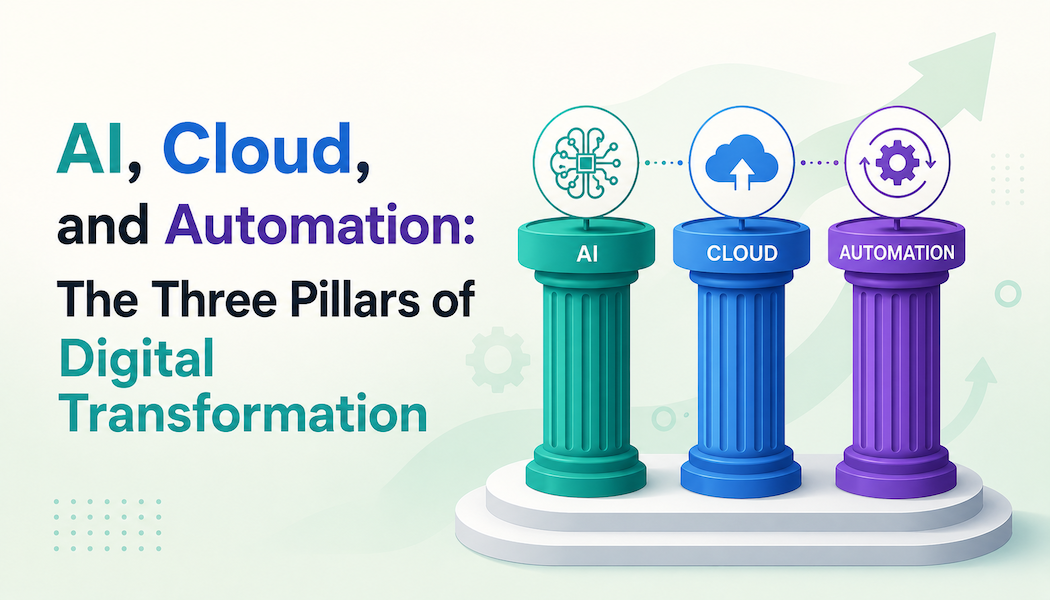
AI, Cloud, and Automation: The Three Pillars of Digital Transformation
Digital transformation pillars refer to the core technology capabilities of artificial intelligence, cloud computing, and automation that together enable businesses to modernize operations, scale efficiently, and compete in a data-driven market. Companies that treat these three as an integrated system, rather than separate projects, see faster returns and fewer implementation failures.
Most organizations already have at least one of these pieces in place. Fewer have connected all three into a single strategy. That gap is exactly where transformation efforts stall and where the biggest opportunity sits for leaders willing to close it.
This article breaks down what each pillar actually does, how they reinforce one another, and what a realistic implementation roadmap looks like for a mid-sized or enterprise business.
Why Digital Transformation Needs All Three Pillars
A cloud migration without automation just moves old inefficiencies to a new address. AI without clean, cloud-hosted data has nothing reliable to learn from. And automation without AI can only handle rule-based tasks, not judgment calls. Each pillar compensates for the limits of the other two.
Consider a mid-sized logistics company. Moving to the cloud gave it a flexible infrastructure, but dispatchers were still manually assigning routes. Adding automation removed the repetitive scheduling work. Layering in AI lets the system predict delays from traffic and weather patterns before they happen. No single pillar could have produced that outcome alone.
This is the pattern showing up across industries: the value isn't in any one technology, it's in the connective tissue between them.
Pillar One: Cloud Computing as the Foundation
Cloud computing provides the scalable, on-demand infrastructure that AI models and automated workflows depend on to run reliably. Without it, most modern AI and automation tools simply don't have the compute power, storage, or flexibility to function at business scale.
What Cloud Computing Solves
- Elastic capacity scale compute up during peak demand and back down when it's not needed, instead of over-provisioning hardware.
- Centralized data access teams and applications pull from the same data source instead of siloed local systems.
- Faster deployment of new tools and updates roll out in days, not months.
- Built-in resilience, redundancy, and backup are standard, reducing downtime risk.
Common Cloud Approaches
| Approach | Best For | Trade-off |
| Public Cloud (AWS, Azure, GCP) | Startups, variable workloads | Less control over infrastructure |
| Private Cloud | Regulated industries, sensitive data | Higher fixed cost |
| Hybrid Cloud | Enterprises with legacy systems | More complex to manage |
| Multi-Cloud | Avoiding vendor lock-in | Requires stronger internal IT skills |
Most enterprises land on hybrid or multi-cloud setups, keeping sensitive workloads on private infrastructure while using public cloud for scalability and AI workloads.
Pillar Two: Artificial Intelligence as the Decision Engine
Artificial intelligence gives businesses the ability to analyze large volumes of data and make predictions, recommendations, or decisions faster and more consistently than manual analysis allows. It's the layer that turns raw cloud-stored data into usable business intelligence.
Where AI Delivers Real Business Value
- Demand forecasting retailers and manufacturers predict inventory needs weeks in advance.
- Customer support AI-assisted triage that routes or resolves common tickets without human intervention.
- Fraud and risk detection in financial institutions flagging anomalies in real time rather than after the fact.
- Product personalization recommendation engines that adjust based on actual user behavior, not static rules.
A useful gut check before investing in AI: if the underlying data is inconsistent, incomplete, or scattered across disconnected systems, the AI initiative will underperform regardless of the model chosen. Data readiness, not model sophistication, is usually the real bottleneck.
Common AI Adoption Mistake
Many companies buy an AI tool expecting it to fix a process problem. In practice, AI amplifies whatever process already exists, good or bad. Fixing the underlying workflow before layering in AI produces far better results than expecting the AI to compensate for it.
Pillar Three: Automation as the Execution Layer
Business process automation removes manual, repetitive tasks from human workflows, freeing employees to focus on higher-value work while improving speed, accuracy, and consistency. It is the layer where AI's decisions and cloud's data actually get acted on.
Two Types of Automation Worth Distinguishing
- Robotic Process Automation (RPA): handles rule-based, repetitive tasks, data entry, invoice processing, and report generation.
- Intelligent Process Automation (IPA): combines RPA with AI to handle tasks that require judgment, such as document classification or exception handling.
Most organizations start with RPA because it's easier to implement and shows quick wins. IPA becomes valuable once there's enough clean data and AI infrastructure to support decision-making at scale, which is why sequencing matters.
A Practical Example
An accounts payable team automating invoice entry with basic RPA might save a few hours a week. Add AI-based document classification, and the system can also flag discrepancies, route approvals based on vendor history, and catch duplicate payments, turning a time-saving tool into a risk-reduction one.
How the Three Pillars Work Together: A Framework
- Establish the cloud foundation. Migrate core systems and centralize data before adding intelligence or automation on top.
- Automate the obvious repetitive tasks first. Build quick wins and organizational trust in the technology.
- Introduce AI where data quality supports it. Start with a contained use case, not an enterprise-wide rollout.
- Connect automation and AI. Let automated workflows act on AI-generated insights, closing the loop between analysis and execution.
- Measure, then expand. Use early results to justify scaling into additional departments or use cases.
Skipping steps, particularly starting with AI before the data and cloud foundation exist, is the single most common reason transformation initiatives underdeliver.
Key Takeaways
- Cloud, AI, and automation are interdependent; each one increases the value of the other two.
- Cloud provides infrastructure and centralized data; AI provides analysis and prediction; automation provides execution.
- Fix underlying processes before adding AI, and fix data quality before expecting reliable AI outcomes.
- A phased rollout cloud, then automation, then AI, then integration reduces risk and builds internal buy-in.
- The biggest transformation failures come from treating these as separate projects instead of one connected strategy.
FAQ
What are the three pillars of digital transformation?
The three pillars are cloud computing, artificial intelligence, and automation. Cloud provides scalable infrastructure and centralized data, AI enables prediction and decision-making, and automation executes tasks based on that intelligence, together forming a complete transformation strategy.
Do you need all three pillars to start digital transformation?
No. Most organizations start with cloud migration or basic automation and add AI once data quality and infrastructure can support it. Attempting all three simultaneously without a clear sequence usually increases cost and risk.
How long does a typical digital transformation take?
Timelines vary by organization size, but most mid-sized companies see cloud migration completed in 6–12 months, automation of key processes within 3–6 months after that, and meaningful AI-driven insights within 12–18 months of clean, centralized data being available.
What's the difference between RPA and AI-driven automation?
RPA automates fixed, rule-based tasks like data entry, while AI-driven (intelligent) automation adds judgment, classifying documents, flagging exceptions, or adapting to new patterns without manual reprogramming.
Why do so many digital transformation projects fail?
Most failures come from sequencing errors, implementing AI before data is centralized, or automating a broken process instead of fixing it first, rather than from the technology itself.
Is cloud computing still necessary if a company already has on-premises infrastructure?
Yes, in most cases. On-premises systems can still play a role, especially for sensitive data, but a hybrid cloud model is typically needed to support the scalability that AI and automation tools require.
What industries benefit most from combining AI, cloud, and automation?
Logistics, financial services, healthcare, retail, and manufacturing show some of the clearest returns, largely because they generate high volumes of repetitive tasks and data-rich decisions that benefit from all three pillars working together.
How should a company measure ROI on digital transformation?
Track metrics tied to the specific use case, hours saved through automation, error-rate reduction, forecast accuracy improvements, or customer response times, rather than measuring "digital transformation" as a single vague outcome.
Conclusion
Digital transformation pillars only deliver their full value when cloud, AI, and automation are implemented as one connected strategy rather than three separate initiatives. Businesses that sequence the rollout correctly, starting with a solid cloud foundation, automating clear repetitive workflows, and introducing AI where data quality supports it see faster, more durable results than those chasing each technology in isolation.
The organizations pulling ahead right now aren't necessarily the ones with the most advanced AI models. They're the ones that got the foundation and sequencing right.
Ready to map out where your organization stands across these three pillars? A short technology audit is often the fastest way to identify the highest-impact starting point.