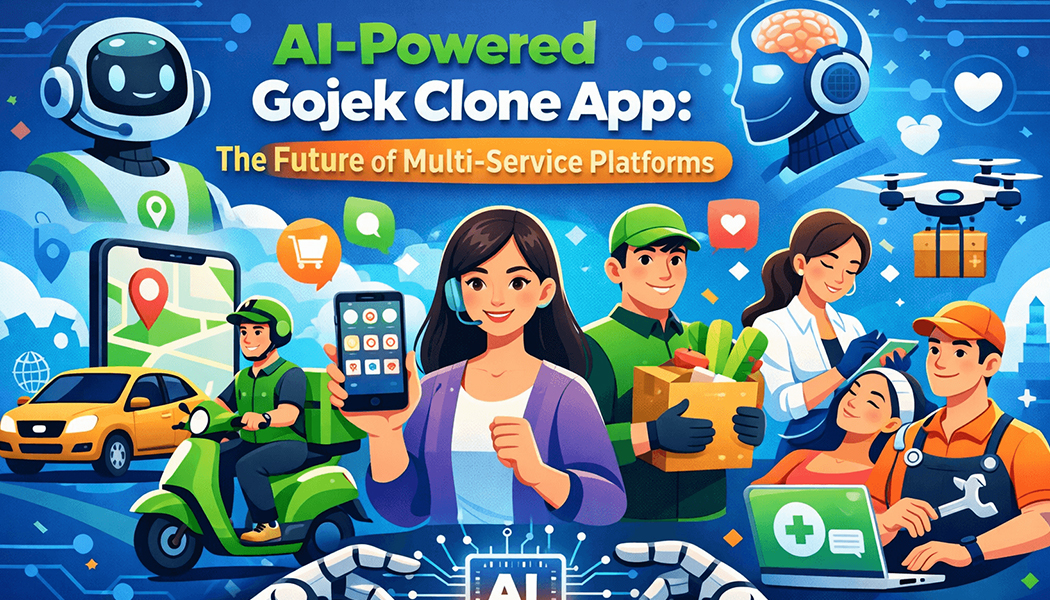
AI-Powered Gojek Clone App: The Future of Multi-Service Platforms
Best way To Transform your Business – Build an App Like Gojek. Entrepreneurs, startup founders, and business owners, joined by the need to enter the on-demand economy, now have access to advanced platforms that hub ride-hailing, food delivery, payments, and dozens of other services all under one smart roof.
This guide is pointed at business leaders ready to create their own multi-service empire and tech teams developing the next generation of super apps. From smart matching algorithms that match users with services in no time to predictive analytics that enhance revenue streams, we’ll unpack how AI is revolutionising clone app development.
You’ll learn about the key AI technologies that differentiate the best platforms differentiate themselves from rivals, including machine learning models that optimize delivery routes and natural language processing that powers smart customer support. We will also discuss scalable architecture approaches that break a sweat only when faced with millions of users and revenue maximization techniques that ensure your clone app assaults the profits, making sure you can milk your project to a penny.
Ready to build the future of multi-service platforms? Let's get started.
Understanding AI-Powered Multi-Service Platforms
Core Features That Drive Customer Engagement
With intelligent recommendation engines to suggest needed services based on browsing data and location, multiservice AI platforms offer a unique way to engage users. In fact, smart routing algorithms that reduce delivery times and predictive analytics are required even before the user recognizes it, thus forming a solution that encompasses transportation and food delivery as well as financial services through a single ecosystem.
Revenue Generation Through Integrated Services
The metrics are impressive, and the nature of cross-service monetization creates multiple revenue streams with users crossing over from ride-hailing to food ordering to payment in a seamless fashion each day. And data-driven insights from one service increase targeting precision for others; combined offerings and loyalty programs boost customer lifetime value (CLV). Commission structures, subscription models, and premium features generate such streams of income that the simple single-service apps cannot compete with them.
Competitive Advantages Over Traditional Single-Service Apps
Multi-service platforms, like Google and Facebook, manage to thrive despite the law of one size fits all--because they benefit from ecosystem lock-in effects whereby switching costs are gradually entering prohibitive territory as users band multiple services into a single daily workflow. The duality of the data that is pumped into these AI algorithms unlocks a ton more personalization and insights, and the shared costs of this infrastructure create massive operational efficiencies. The advantages of density created by serving multiple service categories are not captured by standalone competitors, allowing network effects to compound.
Key AI Technologies Transforming Gojek Clone Development
Machine Learning for Predictive Analytics and User Behavior
Advanced machine-learning algorithms present in the Gojek clone can even predict what services a user will require ahead of time, making predictions about users based on large data sets. User preferences, past bookings, and behavioral triggers are examined to create experiences the same as engagement on these systems that improve loyalty and retention.
Peak hours, popular types of service, and trends about location are detected using machine learning algorithms. These types of applications help in proactively recommending services based on the input data-type behavior patterns and reduce decision fatigue, which can result in deal conversion across the service verticals.
Smart Route Optimization and Dynamic Pricing Algorithms
AI-driven route optimization processes real-time traffic data, and past patterns to suggest the best possible routes for drivers and deliverers.However, given that these algorithms learn infinitely as the environment continues to change, this led to a much shorter waiting time and lower operation expenses.
Dynamic pricing algorithms modify prices dynamically, based on the supply-demand ratio and competitor & market conditions. Carnival and other lines have switched to pricing systems that guarantee they don’t lose profits, charging customers more during peak seasons by automatically putting in place surge pricing while being competitive at other times when capacity is available.
Automated Customer Support Through Natural Language Processing
Natural language processing (NLP) chatbots help with signs that question, complain, and service requests without human involvement. They also consider context, sentiment, and intent of a user’s query to respond accurately or transfer complex questions to human agents as needed.
Advanced natural language processing models come equipped to handle many languages and dialects, enhancing the accessibility of platforms to a more diverse user base. Using voice recognition technology, users can guide through its dynamic conversation without needing any input via keypad, while sentiment analysis can help in detecting the dissatisfied customer at an early stage and proactively interrupting them to prevent bad reviews/travel.
Real-Time Demand Forecasting for Service Allocation
Through historical data, events, and external factors, AI forecasting models predict service demand in various locations and periods of time. It allows for optimally placing the drivers and service providers, shortening response time, and in turn, increasing overall efficiency in services.
Intelligent allocation systems automatically deliver resources based on projected demand behaviors, climate reports, and special activities. However, by predicting what will be the peak times for demand based on time of the day or place, platforms will redistribute drivers to these areas in advance or restrict their services around some of these slots, thereby ensuring that they are keeping users happy while also extracting revenue as they can now meet usage even before it actually occurs.
Essential Services Integration for Maximum Market Impact
On-Demand Transportation Solutions
Route optimization algorithms and dynamic pricing algorithms powered by artificial intelligence are the driving forces behind multi-service platforms with transportation offerings. Machine learning algorithms actively manage the system in real time, analyzing data such as traffic patterns, driver availability, and user demand — from which we’re able to achieve an up to 40 percent reduction in wait times. Smart surge pricing enables the app to dynamically respond when there are more riders than drivers, how often, raise rates commensurately, and maximize driver take-home while maintaining low fares for riders.
Food Delivery and Restaurant Collaboration
AI-enabled smart restaurant boarding can identify the best food partners and consider local cuisine habits, coverage, and order history. This automated menu digitization and real-time inventory management allows restaurants to reduce their food waste by up to 25% while ensuring customers have an accurate sense of their availability when browsing the platform.
Dynamic delivery routing algorithms take into account the food type, the preparation time, and the best possible window of opportunity for delivery in order to maintain food quality from restaurant to consumer. AI-powered demand forecast from these store partners allows their restaurant partners to prepare for their respective orders, and integrated marketing features make them more visible and get discovered with personalized recommendations, as well as being provided with a higher average order value through promotions.
Digital Payment Systems and Wallet Integration
Integrated digital wallets ease transitions by minimizing transaction friction as payment processing becomes seamless. This leads to a 35% boost in user retention rates. AI fraud detection uses machine learning algorithms to correlate with shopping behavior, devise fingerprint analysis, and biometric tokens on behavioral patterns to prevent illegitimate transactions without disrupting the checkout experience for legitimate consumers.
Multi-currency and local method support empower you to scale globally, and machine learning algorithms route each transaction to the highest-performing methods in order to optimize processing fees and payment failures. Platform ecosystems leverage user data for analyzing user behavior and establishing automated loyalty programs/cashback schemes to encourage return within that ecosystem to use other services.
Logistics and Package Delivery Services
Intelligent package routing algorithms can analyze the ratio of packages and their weight, clustering at the destination, as well as real-time traffic conditions, to optimize destination delivery networks. With AI-enabled warehouse management systems (WMS), collating and prioritising shipments as per delivery urgency, customer preferences, or driver capacity is also becoming seamless in warehouses, which saves operational cost by up to 30%.
Intelligent package routing algorithms use factors like package ratio and weight, delta at destination clustering, and mapping of real traffic conditions to target delivery networks in a shorter time. This has been made possible by AI-powered warehouse management systems (WMS) that combine and prioritise shipments based on delivery urgency, customer preference, or driver capacity to cut operational costs by 30% and more.
Predictive delivery time estimation is when you use historical performance data and ML models to give customers accurate arrival windows. Through integration of a network of local couriers, in addition to crowd-sourced options, they are able to provide flexible range fulfilment approaches that offer variation based on demand level, provided acceptable quality thresholds remain intact.
Professional Services Marketplace
Users are matched with qualified professionals pieced together through skill assessment, customer ratings, and availability patterns through what is essentially an AI-driven service provider. By examining metrics such as service completion rate, sentiment of customer feedback, and pricing competitiveness, machine learning algorithms have surfaced the best-fitting providers for a given job description.
Automated systems cross-check the credentialing of providers against third-party databases to verify their skills, while performance monitoring ensures that the best quality of service is upheld over time. It also offers dynamic pricing recommendations, which allow a company to vary its charges in real time based on market demand, seasonal peaks, and competitive benchmarking -- resulting in a marketplace that works optimally for customers and providers alike.
Building Scalable Architecture for Multi-Service Success
Cloud Infrastructure Requirements for High Performance
With modern being multi service system that needs a very strong cloud where several million users will be using the diverse services concurrently. Auto-scaling, load balancing, and Global CDN are important for seamless performance, which is natively provided by cloud platforms like AWS, GCP, and Azure. With microservices architecture and containerization with Docker or Kubernetes, the independent service components can scale up without causing any impact on the entire platform.
Multi data centers’ separation in different geographical locations provides for low latency and disaster recovery. Much of the latest generation in real-time processing will need edge computing solutions that put computational power closer to users to reduce response times for vital services such as ride-hailing and food delivery tracking.
Database Management for Complex Service Operations
Database architectures of multi-service applications are often complex — they leverage a combination of SQL and NoSQL solutions for optimal data handling. User profiles, transaction records, and payment information shape up nicely in relational databases like PostgreSQL; MongoDB or Redis shine at serving real-time location data or chat messages, logging. Database sharding means that you can distribute data on servers so traffic jams do not occur during peak usage.
API Development for Seamless Third-Party Integration
The RESTful API architecture is at the core of successful multi-service platforms, allowing smooth interaction between different service modules and external partners. The firm and well-documented versioning of APIs can allow integration of payment gateways, mapping services, delivery partners, etc., without breaking existing features. Abuse mitigation mechanisms like rate limiting and authentication protocols provide a good user experience.
The GraphQL layer reduces the over-fetching of data and makes mobile applications a walk in the park by providing flexible queries. What they are like: API gateways aggregate request routing, authentication, and monitoring to simplify interactions within a complex ecosystem of services while also allowing organizations to build business intelligence on all such usage and performance metrics.
User Experience Optimization Through AI Implementation
Personalized Service Recommendations
Machine learning or AI algorithms can study patterns in the user event history, developing customized recommendations based on the service ecosystem.
Machine learning models are constantly improving recommendation accuracy via real-time data adjustments. Well, users get relevant service options that meet their needs and thus, improved engagement rate as well high satisfaction rate.
Intelligent Interface Design for Multi-Service Navigation
Smart interface adaptation responds to user interactions and service preferences. It reorganizes the menu layouts, highlights commonly used services, and minimizes navigation paths. Worlds are connected by dynamic interface elements that respond flexibly through users and context, enabling multi-service fluidity.
Predictive Search and Auto-Suggestions
Multi-Service Cross-category search using advanced natural language processing. The system infers user intent before they have finished entering a query, presenting the most relevant autocomplete options. Context-sensitive search results take into account location, time, and past buys to ensure the right services and providers show up in front of you.
Revenue Maximization Strategies for Clone App Success
Commission-Based Earning Models Across Services
Multi-service platforms rest on the bedrock of a diversified commission structure, depending on each category of service. Ride-hailing gets 15-25% commission per ride, and food delivery gets 20-30% (plus delivery fee) from restaurants. Logistics is a low single-digit margin business, whereas home services are 10-20%, establishing to several high additional revenue streams, adding towards compounded platform profitability. That’s why dynamic pricing tools exploit how demand behaves when drivers are available and the context in which the market should set what a reasonable price would be, with as little interference from the service that wants to stay competitive.
Subscription Plans for Premium Features
Premium features are available to power users who also subscribe to premium memberships. Subscriptions range in price from $9.99 to $29.99 a month, and include features like priority booking, reduced service fees, members-only deals, and expedited customer support. With cashflows becoming more predictable, the improvement in the value proposition means user retention is scalable.
Advertisement Integration and Sponsored Listings
In-app advertising turns user activity into actual revenue, thanks to multiple monetization opportunities available within a rewarded ad video. Promotions, featured service providers, and banner ads — lucrative sources of income without spoiling the user experience. Businesses can pay for premium visibility by sponsoring their search results and/or getting featured listings on the platform. For example, location-based advertising delivers relevant offers to users, and all parties win by this business model: businesses have reached qualified customers while platforms monetize user attention more effectively.
Data Monetization Through Analytics Insights
Its anonymized user behavior data is golden intelligence for market research and business optimization. Periodical aggregated mobility patterns assist urban planners to serve the public better for a particular area, while consumption trends help improve retail in key areas. The white-labeled analytics reports provide restaurant partners with visibility into peak times, popular items, and customers’ likes. Incorporating privacy compliance and fostering user trust in the data licensing agreements with research companies and governmental covered entities (further to the recent US legislation cited above) opens new sources of revenue.
Market Entry and Growth Acceleration Tactics
Target Market Analysis and Competitive Positioning
Closely studying target demographics contributes to the efficient penetration of AI-enabled multi-service platforms in a market. This will shift between an urban audience of millennials and Gen Z who have fallen in love with the mobile app for its speedy, instant access to consumer goods. Competitive positioning: Make sure to describe where incumbents are weak, and you are strong with AI, like anticipating demand to provide the ideal service or suggesting personalized choices.
Strategic Partnership Development
Accelerate entry in markets through Strategic alliances. Work with local businesses, payment gateways, and logistics partners to create the full-service ecosystem. While traditional financial instruments and telecom players, such as credit and data plans, are provided by financial institutions. The use of these partnerships provides fast expansion in service coverage alongside decreased operational costs.
User Acquisition Through AI-Driven Marketing
These machine-learning algorithms then control which customer segments to go after and optimize advertising buys across digital channels. We have a product onboarding experience that takes users through the platform and increases conversion; AI-powered chatbots help customers with immediate assistance. Like dynamic pricing strategies that could make people book/consume in low periods.
Service Provider Onboarding and Retention Strategies
It quickly attracts quality service providers with streamlined onboarding processes. AI tools for background verification and skill assessment automatically assess provider quality while minimizing the number of hours/people required to screen candidates. Provider satisfaction is further heightened with gamified interactions, performance-based incentives, and flexible earning potentials. You have real-time feedback systems and training modules that would provide you with a continuous upgrade in quality of service.
AI-powered multi-service platforms are changing the way on-demand services are accessed. This is the duality of Gojek clone apps, where they enable smart recommendation engines, predictive analytics, and service matching to create a seamless experience across multiple touchpoints for enhanced ongoing engagement. With a critical look towards the future, businesses know that they cannot just be a route, but combining services such as ride-hailing, food delivery, and digital payments provides a tremendous competitive advantage due to their ability to scale using a similar architecture.
But where AI truly works its magic is when the user experience and revenue growth are unified. Intelligent algorithms work to balance everything from driver routes to customer service, and personalized experiences improve retention rates as well as increase average order values. For entrepreneurs willing to seize the potential of this rapidly growing space, they must distill their ambitions into a few guiding principles, as AI will either empower or multiply their impacts depending on how strategically each platform positions itself – those leveraging its insights effectively can become transformative agents in local service delivery, while others will simply be lost among thousands of apps.