AI Tools Directory for SaaS: How to Discover the Right AI Software for Your Business
AI is no longer an experimental technology reserved for innovation teams. It is becoming part of everyday SaaS operations, from marketing and sales to customer support, software development, analytics, and internal productivity. For SaaS teams, a best AI tools directory for SaaS can make it easier to discover the right AI tools to streamline workflows, automate repetitive tasks, and scale efficiently.
The challenge, however, is no longer finding an AI tool. There are thousands of AI products available, and new tools, agents, and AI-powered SaaS platforms appear constantly. Large directories such as Futurepedia now organize thousands of AI tools across business, productivity, automation, marketing, technology, and other categories.
For SaaS companies, this creates both an opportunity and a problem: how do you identify the tools that genuinely improve your business instead of simply adding another subscription to your technology stack?
Why SaaS Companies Need an AI Tools Directory
SaaS companies typically operate across multiple functions. A single team may need tools for lead generation, content creation, customer support, product development, analytics, sales automation, project management, and software engineering.
Searching individually for solutions can consume significant time.
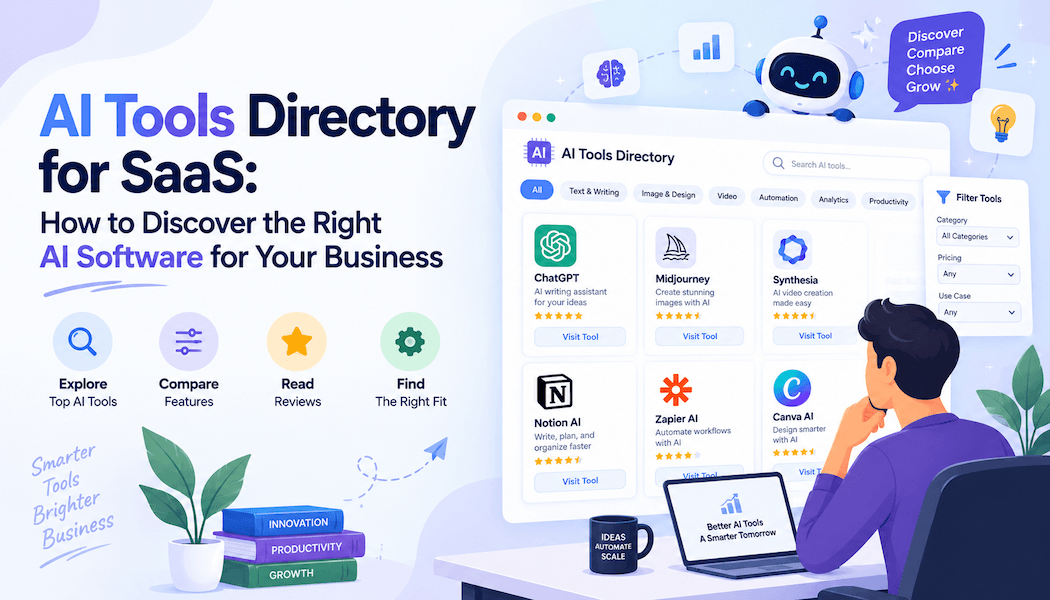
An AI tools directory brings these options into a more structured environment. Instead of searching dozens of websites, SaaS teams can browse tools by category, use case, pricing model, integrations, and business function.
This is becoming increasingly relevant as organizational AI adoption grows. McKinsey's 2025 research found that 88% of surveyed organizations reported regularly using AI in at least one business function, although many companies were still experimenting or piloting rather than scaling AI across the enterprise.
That distinction matters.
The goal shouldn't be to use more AI tools.
The goal should be to build better workflows with the right AI tools.
What Makes a Good AI Tools Directory for SaaS?
Not every directory provides the same value. A large database can be useful, but quantity alone doesn't help a SaaS founder decide which solution deserves attention.
A useful AI tools directory should provide enough information to evaluate a tool before investing time and money.
1. Clear Categories
SaaS businesses should be able to quickly find tools based on their actual requirements.
Useful categories can include:
- AI marketing tools
- AI sales tools
- Customer support AI
- AI coding assistants
- AI analytics tools
- AI content tools
- AI SEO tools
- AI productivity tools
- AI automation platforms
- AI meeting assistants
- AI design tools
- AI agents
- AI finance and operations tools
Clear categorization reduces discovery time and makes comparison easier.
2. Business Use Cases
A directory should explain what problem a tool solves, not simply describe its features.
For example, instead of saying:
"AI-powered automation platform"
a stronger listing might explain:
"Automates repetitive lead qualification and routes high-intent prospects to the appropriate sales representative."
The second description immediately connects the technology to a business outcome.
3. Pricing Information
Pricing is one of the first things SaaS buyers consider.
An AI directory becomes more useful when it identifies whether a tool offers:
- Free plans
- Free trials
- Usage-based pricing
- Per-user pricing
- Monthly subscriptions
- Annual plans
- Enterprise pricing
Pricing can change frequently, so businesses should always verify current pricing directly with the provider before making a purchase.
4. Integrations
An AI tool may look impressive independently but provide limited value if it doesn't fit into the company's existing workflow.
SaaS teams should check whether tools integrate with platforms such as:
- HubSpot
- Salesforce
- Slack
- Google Workspace
- Microsoft 365
- Shopify
- WordPress
- Jira
- GitHub
- Zapier
- Make
- Existing APIs
Integration compatibility can be more important than having the largest feature list.
The Most Important AI Tool Categories for SaaS Teams
Different SaaS companies have different requirements, but several AI categories are particularly valuable.
AI for Marketing
Marketing teams can use AI for keyword research, content development, campaign ideation, personalization, competitive analysis, SEO, and customer research.
AI doesn't necessarily replace marketers. Instead, it can reduce repetitive research and production tasks, allowing marketers to spend more time on positioning, strategy, creativity, and experimentation.
AI for Sales
Sales teams can use AI to research prospects, summarize calls, generate follow-ups, qualify leads, analyze conversations, and automate portions of outreach.
The important consideration is whether the tool improves the sales process without creating low-quality automated communication.
AI for Customer Support
Customer support is another major opportunity.
AI-powered support systems can help companies answer frequently asked questions, summarize conversations, classify tickets, surface relevant knowledge-base information, and route complex issues to human representatives.
The best implementation isn't necessarily "AI handles everything."
A stronger model is often AI for repetitive requests + humans for complex or sensitive situations.
AI for Software Development
Development teams have access to coding assistants, debugging tools, code-review systems, documentation generators, testing tools, and increasingly capable AI coding agents.
These tools can accelerate development, but engineering teams still need appropriate code review, testing, security controls, and human oversight.
AI for Operations and Productivity
Internal teams can use AI to summarize meetings, organize information, automate repetitive processes, analyze documents, and connect different applications.
This category can generate significant value because operational inefficiencies often appear across multiple departments.
How to Evaluate an AI Tool Before Buying
Being listed in an AI tools directory doesn't automatically mean a tool is suitable for your SaaS business.
Use a simple evaluation framework.
Step 1: Define the Problem
Start with the workflow rather than the technology.
Ask:
What repetitive, expensive, slow, or error-prone process are we trying to improve?
If the problem isn't clear, buying an AI tool may simply increase complexity.
Step 2: Estimate Potential ROI
Consider:
- How many hours could it save?
- How frequently is the workflow performed?
- Could it reduce operational costs?
- Could it increase revenue?
- Could it improve customer experience?
- Could employees focus on higher-value work?
A $100/month tool that saves a team 30 hours every month may have significantly more value than a $20 tool nobody consistently uses.
Step 3: Test Before Scaling
Whenever possible, start with a limited pilot.
Choose one workflow, establish a baseline, and measure the outcome.
For example:
Before AI:
A team spends 20 hours per week processing support tickets.
After AI:
AI handles repetitive classification and response drafting, reducing manual work to 12 hours.
That gives the company a measurable basis for deciding whether to expand usage.
Step 4: Review Security and Data Policies
SaaS businesses frequently handle customer and business-sensitive information.
Before adopting an AI platform, evaluate:
- Data retention policies
- Privacy controls
- Security certifications
- API security
- User permissions
- Data-processing terms
- Whether submitted data is used for model training
This is particularly important when AI tools interact with customer databases, source code, financial information, or proprietary documents.
AI Tools Directories Are Also Valuable for AI Companies
The value of an AI tools directory isn't limited to people searching for software.
AI and SaaS companies can also use directories as discovery and distribution channels.
A directory listing can help a new SaaS product appear in front of people actively researching software solutions.
Platforms in this ecosystem range from AI-specific directories to broader discovery and software-review platforms. Product Hunt, Futurepedia, G2, SaaSHub, and other platforms serve different discovery purposes, so SaaS companies should select platforms based on their target audience rather than submitting everywhere indiscriminately.
For a new SaaS product, a strong directory profile should include:
- A clear product description
- Specific use cases
- Screenshots
- Key features
- Pricing
- Integrations
- Target audience
- Product website
- Demo or video
- Customer proof where available
The objective isn't simply to obtain a listing.
It's to make the listing useful enough to generate qualified discovery.
The Future of AI Discovery for SaaS
AI tool discovery is also changing.
Traditional directories rely heavily on categories and keyword searches. The next generation of discovery is increasingly task-oriented.
Instead of searching:
"AI marketing tools"
a SaaS operator may search:
"What's the best AI tool for automatically identifying high-intent B2B leads?"
That changes how AI products need to present themselves.
Clear positioning, specific use cases, authoritative information, customer evidence, and strong digital visibility can become increasingly important as people discover software through search engines, AI assistants, communities, and recommendation systems.
At the same time, AI adoption itself is moving from experimentation toward workflow integration. McKinsey's 2025 research found that 62% of respondents said their organizations were at least experimenting with AI agents, while most organizations had not yet reached enterprise-wide scaling.
This suggests an important direction for SaaS companies:
The competitive advantage won't necessarily come from having the most AI features. It will come from integrating AI into the workflows that matter most.
Final Thoughts
An AI tools directory for SaaS can save businesses considerable discovery time, but the directory itself is only the starting point.
The smarter approach is to move through three stages:
Discover → Evaluate → Implement
Discover tools that match a specific business problem.
Evaluate them based on functionality, integrations, security, usability, pricing, and expected ROI.
Then implement the tools that can measurably improve a workflow.
As AI continues moving into marketing, sales, development, support, operations, and decision-making, SaaS companies will have more choices than ever.
The real challenge won't be finding AI.
It will be finding the right AI.
And that is where a well-organized, trustworthy AI tools directory for SaaS can become much more than a list of software it can become a practical starting point for smarter technology decisions.