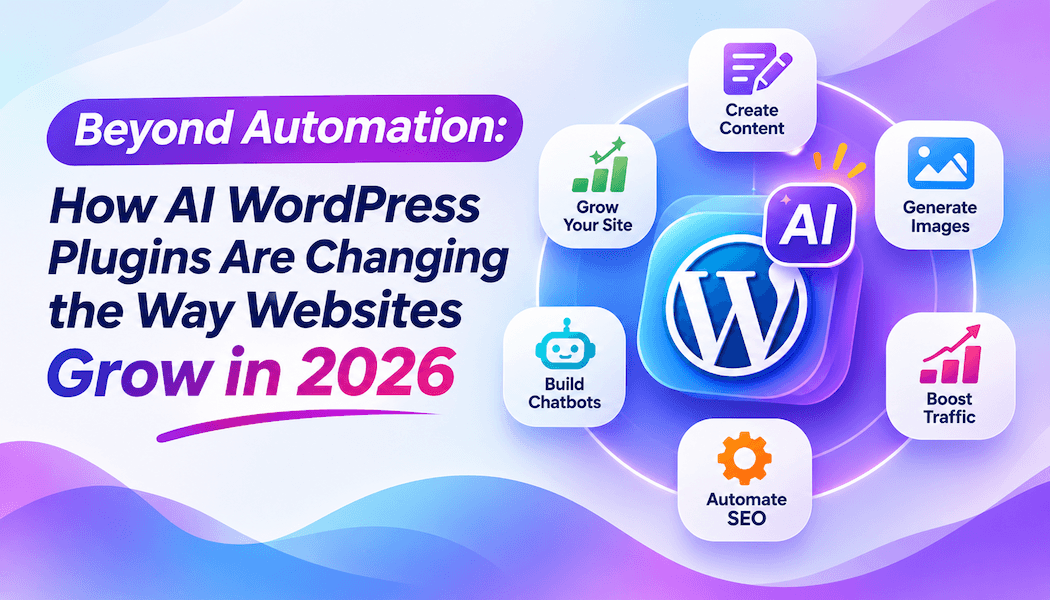
Beyond Automation: How AI WordPress Plugins Are Changing the Way Websites Grow in 2026
In 2026, Artificial Intelligence Plugins for WordPress have moved beyond being simple writing shortcuts. They are becoming connected layers of a website’s growth system supporting content planning, search visibility, customer support, personalization, accessibility, and ongoing optimization. The real shift is not that AI can publish content faster; it is that site owners can now turn a WordPress website into a continuously improving digital asset that learns from performance data, user behavior, and business goals.
For small businesses, publishers, agencies, and online stores, this changes the economics of growth. A website no longer needs a large in-house team to maintain a useful blog, improve product pages, answer common questions, or identify technical issues. With the right AI plugins and a disciplined review process, a small team can operate with the consistency and speed of a much larger one.
From Tools to Growth Systems
Earlier WordPress AI tools mostly focused on one task: generate a blog post, rewrite a paragraph, create an image, or suggest a meta description. That remains useful, but it is no longer the main value of AI.
Modern AI plugins increasingly work across the entire publishing workflow. They can identify content gaps, propose topics based on search intent, draft a structured article, optimize headings and internal links, generate metadata, flag broken links, and recommend updates when a page starts losing relevance. Some SEO-focused plugins now combine keyword research, internal-link suggestions, schema support, and content audits in one dashboard.
This creates a more practical model for website growth:
- Discover: Identify questions customers ask and topics worth covering.
- Create: Produce a first draft, outline, product copy, FAQ, or email.
- Optimize: Improve clarity, keyword focus, metadata, internal links, and readability.
- Publish: Schedule and distribute content across pages, posts, and commerce listings.
- Measure: Track traffic, rankings, conversions, and engagement.
- Improve: Refresh outdated pages and fix technical or content weaknesses.
The important word is. A plugin that only writes articles can save time, but a plugin that connects content creation to search data, site structure, and conversion goals can influence how a website grows over time.
Content Creation Becomes Editorial
AI-generated content is abundant in 2026, which makes generic articles less valuable than ever. Search engines and readers are becoming better at recognizing pages that merely restate common information without original insight, experience, or evidence.
Google’s guidance emphasizes that sites should continue to prioritize helpful, reliable, people-first content, clear technical structure, crawlable pages, strong internal linking, and a good page experience. It also states that there are no special requirements for appearing in AI Overviews or AI Mode beyond sound SEO fundamentals.developers.
That means AI should be treated as an editorial assistant, not an autopublisher. The strongest workflow is:
- Use AI to research a topic and create a first outline.
- Add firsthand experience, customer insights, original data, screenshots, case studies, or expert commentary.
- Edit for accuracy, tone, and brand voice.
- Verify claims, statistics, pricing, legal information, and product specifications.
- Publish with clear sources, author information, and a meaningful purpose.
For example, an accounting firm can use AI to draft a guide on a new tax rule, but the article becomes valuable when a qualified accountant explains how the rule affects a specific type of local business, includes a practical checklist, and links to authoritative sources. AI accelerates production; human expertise creates differentiation.
Search Visibility Expands Beyond Google
Another major change is that website visibility is no longer limited to traditional search results. Users increasingly ask AI assistants and AI-powered search tools questions such as “Which CRM is best for a small law firm?” or “What should I look for in a WordPress hosting provider?”
AI plugins are beginning to help site owners understand and improve their presence in this environment. Some tools monitor how a brand appears in responses from AI assistants, while others provide recommendations for making content easier for AI systems to understand and cite.
However, site owners should avoid treating “AI optimization” as a separate set of tricks. Google specifically advises against tactics such as unnecessary AI text files, artificial content chunking, or pursuing inauthentic mentions. The dependable approach remains creating genuinely useful content, maintaining a clean technical structure, allowing appropriate crawling, and ensuring that important information is available in text rather than hidden inside images or videos.developers.
A practical AI-search strategy includes:
- Answer the user’s core question early and clearly.
- Use descriptive headings that reflect real questions.
- Include original research, comparisons, definitions, examples, and practical recommendations.
- Keep product details, pricing, policies, and specifications in crawlable text.
- Maintain accurate structured data that matches visible page content.
- Refresh pages when facts, products, or recommendations change.
Personalization and Conversion
AI is also changing how WordPress sites turn visitors into customers. Instead of showing every visitor the same homepage, product recommendation, or call to action, AI plugins can personalize experiences based on behavior, location, referral source, browsing history, or purchase intent.
For an online store, this may mean showing relevant product bundles, surfacing items that complement a previous purchase, or offering support based on the product a visitor is viewing. AI-powered WooCommerce assistants can use live pricing and inventory data, display product cards in chat, and help customers track orders.
For service businesses, personalization might look different. A visitor arriving from a search result about “website redesign for dentists” could see a case study, testimonial, and consultation form tailored to dental practices. A visitor from LinkedIn might see a more strategic, B2B-focused message. The goal is not manipulation; it is relevance.
When implemented well, personalization can improve:
- Time on page and engagement.
- Product discovery and average order value.
- Lead quality and form completion rates.
- Customer support efficiency.
- Repeat purchases and retention.
The key is to start with a small number of meaningful segments. Trying to personalize every element for every visitor often creates complexity without a clear return.
Support Becomes a Growth Channel
Customer support is one of the most immediate areas where AI WordPress plugins create measurable value. AI chat assistants can answer routine questions, guide users to the right page, qualify leads, collect contact details, and escalate complex issues to a human team.
In 2026, the more capable tools do more than provide generic responses. They can draw on a website’s own content, product catalog, policies, and order information. This makes support more accurate and useful, especially for ecommerce businesses with large catalogs or service companies with detailed processes.
A well-designed AI assistant can reduce repetitive work while improving response time. But it should never become a barrier between a customer and a real person. The best implementations make escalation obvious, avoid pretending to be human, and clearly explain what information is collected.
Support AI also produces a growth opportunity: recurring questions reveal content gaps. If many visitors ask about shipping times, refund rules, implementation timelines, or pricing, those answers should become visible FAQ content, product-page copy, onboarding documentation, or sales material.
Technical Health and Site Operations
Website growth depends on more than content. Slow pages, broken links, poor mobile experiences, weak accessibility, and outdated plugins can quietly reduce conversions and search performance.
AI plugins are increasingly used to identify and prioritize these issues. SEO tools can suggest internal links, metadata improvements, redirects, schema markup, and alt text. Performance-focused plugins may use AI to guide administrators through speed audit findings.
AI can also help with accessibility. Plugins can flag missing alt text, weak link text, heading-order issues, unlabeled iframes, and missing table headers. These are meaningful signals, but automated tools cannot guarantee compliance with WCAG, the ADA, or other accessibility standards. Human review remains essential, especially for interactive features, forms, navigation, and complex user flows.
A sensible operations routine is:
- Run weekly scans for broken links, indexing issues, and performance regressions.
- Review AI recommendations before applying them in bulk.
- Keep backups and staging environments before major changes.
- Monitor Core Web Vitals and mobile usability.
- Test changes with real users, not only automated scores.
- Maintain an accessibility process that includes manual testing.
The Human Role Becomes More Important
The most successful websites in 2026 will not be those that publish the most AI-generated material. They will be those that use AI to remove low-value work so people can focus on judgment, creativity, relationships, and expertise.
AI is strong at recognizing patterns, drafting variations, summarizing information, classifying content, and suggesting improvements. Humans are still essential for deciding what matters, validating facts, understanding customer motivations, protecting brand reputation, and making ethical decisions.
Site owners should establish clear rules before deploying AI plugins:
- Define which tasks AI may perform automatically and which require approval.
- Require human review for medical, legal, financial, safety, and high-stakes claims.
- Protect customer data and avoid sending sensitive information to third-party services without proper consent and safeguards.
- Disclose AI use where it affects customer expectations, such as chat support.
- Keep a record of major AI-generated changes so issues can be traced and reversed.
- Measure outcomes, not output volume.
Choosing the Right AI Stack
There is no single “best” AI WordPress plugin. The right choice depends on the website’s business model and bottleneck.
|
Website need |
Useful AI capability |
What to measure |
|
Content-led growth |
Topic research, drafting, internal linking, refresh suggestions |
Organic traffic, rankings, engagement |
|
Ecommerce growth |
Product copy, recommendations, support, personalization |
Conversion rate, revenue per visitor |
|
Lead generation |
Chat qualification, form assistance, personalized offers |
Qualified leads, cost per lead |
|
Local business |
FAQ creation, review responses, service-page optimization |
Calls, bookings, local visibility |
|
Publishing |
Editorial workflows, tagging, summaries, readability |
Returning readers, newsletter signups |
|
Enterprise sites |
Governance, approvals, accessibility, workflow automation |
Error rate, publishing speed, compliance |
Before installing a new plugin, test it on a staging site. Review its data practices, API costs, permissions, update frequency, compatibility with your theme and page builder, and whether its recommendations can be approved before they affect the live site.
The Future of WordPress Growth
AI WordPress plugins are changing website growth from a series of disconnected tasks into a continuous feedback loop. Content can be planned from real demand, optimized for both people and AI-powered discovery, personalized for different visitors, supported by intelligent assistance, and improved based on performance data.
But automation alone is not a strategy. The websites that grow in 2026 will combine AI’s speed with human expertise, original perspective, strong customer understanding, and careful quality control. The opportunity is not to replace the people behind a website, it is to give them better tools to build something more useful, more visible, and more valuable.