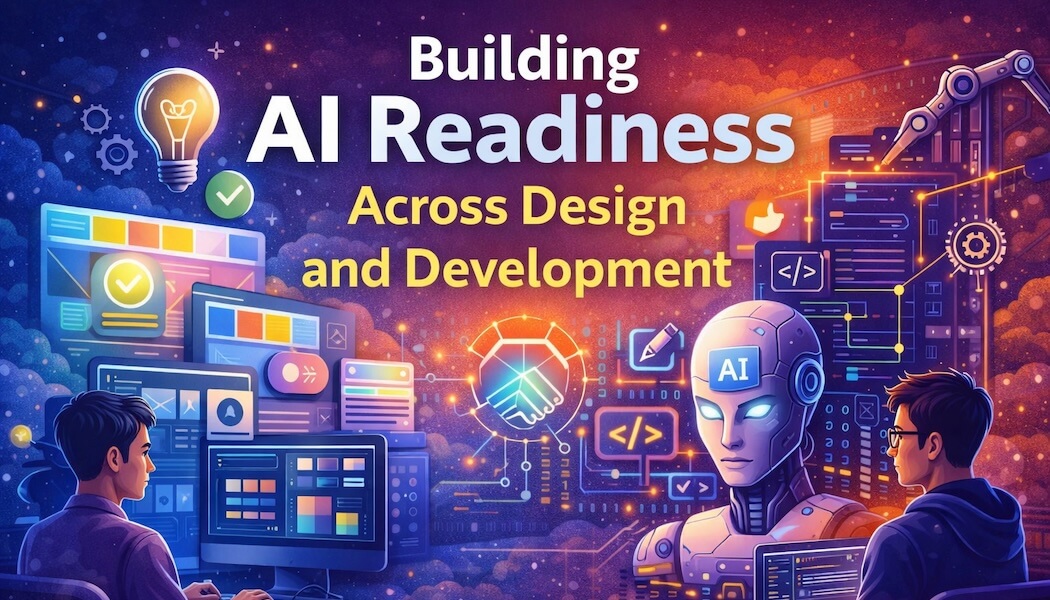
Building AI Readiness Across Design and Development
Artificial intelligence (AI) is a present reality reshaping how organizations design products, develop systems, and deliver value. Yet the gap between AI curiosity and AI capability remains wide. Many teams possess enthusiasm but lack the structure, skills, and strategic direction to move forward effectively. Building AI readiness across design and development requires more than acquiring technology; it demands a deliberate approach that embeds intelligence into workflows while keeping people at the center.
The Role of AI Strategy & Enablement
AI strategy and enablement bridge the gap between curiosity and capability safely, ethically, and with strategic intent. Consultants connect technology to business objectives, delivering measurable productivity gains and tangible outcomes. They ground AI adoption in practicality, compliance, and human-centered design, ensuring teams understand it, trust it, and weave it into daily work.
Without coherent AI strategies, organizations risk fragmented pilots that never scale or solutions that create more friction than value. Effective AI readiness begins by assessing current digital assets, identifying where intelligence can augment human work rather than replace it, and establishing governance that ensures user transparency and robust security protocols.
Designing for Intelligence Beyond Function
Design teams have traditionally focused on usability and aesthetics. In the AI era, they must also design for uncertainty, learning, and continuous adaptation. Unlike deterministic software, AI models can be wrong in unexpected ways, and their outputs evolve with new data. This demands a fundamental shift in how designers approach interface logic, feedback systems, and error handling.
Building readiness here means equipping designers with AI skilling that goes beyond prompt engineering. They need literacy in machine learning fundamentals, data provenance, and model behavior. When designers understand what AI in data analytics can and cannot do, they create interfaces that set appropriate expectations, communicate confidence levels, and invite user scrutiny.
Development Infrastructure for AI Readiness
Don't rush to prototype AI solutions without considering how they will integrate with legacy applications, scale under AI workloads, or perform within existing tech stack constraints. The result is performance bottlenecks, technical debt, and solutions that work in isolation but fail in production.
Readiness requires auditing the current AI infrastructure: compute capacity, data pipelines, model serving layers, and monitoring tooling. It means mapping the AI lifecycle from experimentation to deployment to retirement, and identifying where workflow needs justify new investment versus optimization of existing systems.
Teams must evaluate whether their tech stack can support modern AI technologies, from vector databases for retrieval-augmented generation to specialized hardware for model training. This is particularly visible in semiconductor manufacturing, where AI is transforming defect detection, process optimization, and predictive maintenance.

Data as the Operating System
Building AI readiness means elevating data governance from an IT compliance exercise to a cross-functional discipline. Designers must understand what data their interfaces generate.
Developers must implement telemetry that captures model performance in production. Meanwhile, product managers must define success metrics that reflect both business outcomes and responsible AI principles.
AI in data analytics exemplifies this shift. AI analytics predicts what will happen and recommends actions. But this only works when data is accessible, labeled, and representative. Readiness initiatives must address data discovery, lineage, and versioning.
Sustaining Capability Through Learning and Trust
The most sophisticated AI stack delivers no value if users bypass it, mistrust its outputs, or lack the skills to interpret its recommendations. This is why AI adoption succeeds only when it is people-centered from the start.
Organizations must invest in sustained AI skilling that reaches beyond data scientists to include designers, developers, product managers, and executive sponsors. This is not about turning everyone into machine learning engineers. It is about building shared vocabulary, demystifying model behavior, and creating feedback loops where frontline users contribute to model improvement.
When a developer understands why a computer vision model fails on certain edge cases, or when a designer recognizes how training data skew affects user experience, they become active participants in the AI lifecycle rather than passive consumers of black-box tools.
Trust also requires user transparency about when and how AI is used. This is both an ethical imperative and a design constraint. Teams must build interfaces that disclose automation, explain outputs in an accessible language, and provide meaningful recourse when users disagree with a model’s decision.
The Bottom Line
Building AI readiness across design and development demands more than tools or isolated experiments. It requires embedding intelligence into how designers prototype uncertainty and how developers ship scalable, trustworthy systems. Success depends on cross-functional fluency, where design, engineering, data, and strategy share vocabulary and ownership. Engaging an AI strategy consultant accelerates this shift, providing governance, alignment, and a practical roadmap to move from pilot to production.