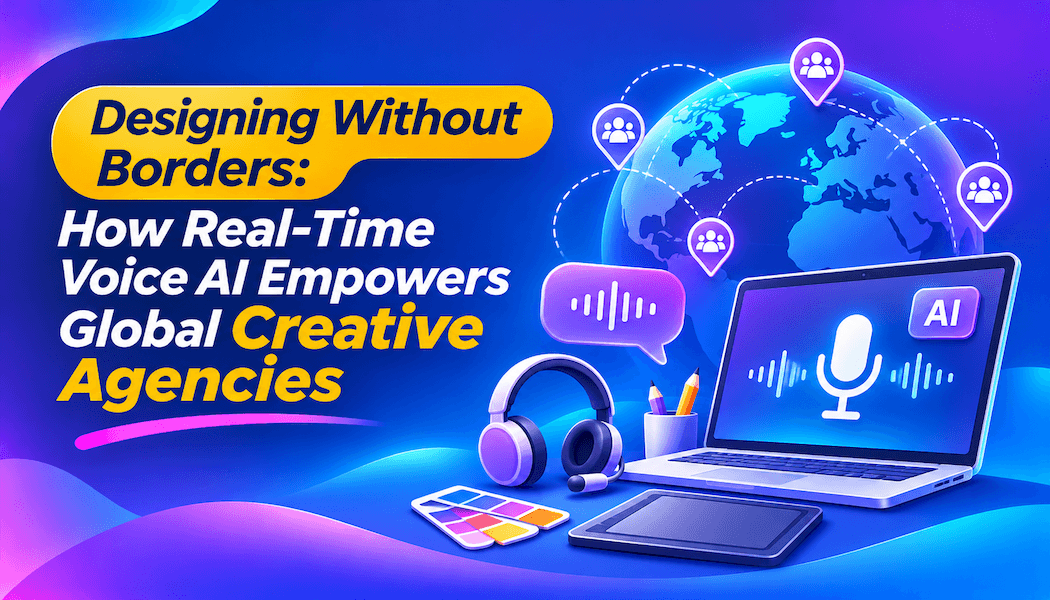
Designing Without Borders: How Real-Time Voice AI Empowers Global Creative Agencies
Great visual design transcends geography. A clean user interface, balanced typography, and intuitive navigation resonate with people whether they live in New York, Tokyo, Berlin, or Sao Paulo. Because design communicates visually, boutique studios, freelance UI/UX specialists, and digital agencies increasingly work with clients and collaborators across continents.
Yet while Figma files, interactive prototypes, and mood boards travel effortlessly across time zones, the conversations surrounding them often hit a stubborn wall: spoken language. Pitching a brand identity, defending user experience decisions, and navigating live client feedback require far more than shared screens. When teams struggle to communicate subtle creative rationale across different languages, brilliant concepts can easily get lost in translation.
The Hidden Friction in Cross-Border Design Critiques
Anyone who has led a remote design presentation knows how delicate creative momentum can be. Designers spend weeks researching user behavior, refining visual hierarchies, and crafting micro-interactions. During a live review, explaining why a particular layout reduces cognitive load or why a color palette evokes trust depends heavily on tone, pacing, and clear storytelling.
When an agency and a client do not share a fluent native language, live sessions often default to awkward workarounds:
- Over-Reliance on Text Chat: Typing clarifications in a sidebar forces participants to look away from the prototype, breaking visual focus and slowing down constructive dialogue.
- Consecutive Human Interpretation: Pausing after every two sentences so an interpreter can repeat the message doubles the length of every call and drains creative energy from the room.
- Post-Meeting Misunderstandings: Subtle feedback gets misinterpreted, leading to unnecessary revision cycles, scope creep, and delayed product launches.
For creative studios competing for international accounts, communication friction is more than a minor inconvenience. It directly impacts client confidence and project profitability.
Preserving Creative Nuance in Live Client Presentations
Modern voice artificial intelligence is changing how distributed creative teams and international clients collaborate. Rather than forcing participants to rely on delayed captions or robotic text-to-speech tools, new neural speech-to-speech systems enable natural, fluid conversation across languages.
By using advanced AI to translate meeting in real time, creative directors, product designers, and stakeholders can speak naturally in their native tongues while hearing each other almost instantaneously. Platforms like Palabra.ai process spoken dialogue with ultra-low latency while preserving the original speaker's vocal timbre, cadence, and emotional inflection.
That vocal preservation matters deeply in creative industries. When a lead designer passionately walks a client through a new interactive concept, listeners in another language hear that exact enthusiasm and conviction rather than a flat, synthetic readout. Clients feel genuinely heard when they share feedback in their own words, and designers grasp the subtle emotional reactions behind every comment.
Good UX Means Invisible Technology
From a user experience standpoint, the best collaboration tools share the exact same qualities as great interface design: clarity, speed, and zero unnecessary clutter. Creative professionals already juggle complex design systems, project management boards, and prototyping environments. Adding clunky translation plugins or complicated audio routing only creates cognitive overload.
Real-time voice translation works best when it fades quietly into the background of existing video conferencing workflows. Instead of managing separate transcription windows or waiting for post-call summaries, teams simply join their regular virtual studio session and speak. The technology adapts to human conversation rather than forcing humans to adapt to rigid software constraints.
This frictionless dynamic also transforms internal collaboration. Global design agencies frequently assemble specialized squads combining a UX researcher in Madrid, an illustrator in Seoul, and a front-end developer in Toronto. Instantaneous voice translation allows multidisciplinary teams to brainstorm freely, resolve edge cases during live sprints, and maintain a unified creative vision from initial wireframes to final deployment.
Winning Global Clients Through Effortless Communication
In a competitive digital landscape, technical skill and a strong portfolio open the door, while clear communication wins the contract. Clients want partners who understand their market, respect their feedback, and make complex digital transformations feel straightforward.
By removing language barriers from live discovery calls, design reviews, and stakeholder workshops, real-time voice AI gives creative studios the freedom to collaborate anywhere in the world. When teams can share ideas in their own voices without delay or distortion, design truly becomes a borderless craft.