Healthcare Mobile App Development: Features, Best Practices, and Trends
Healthcare professionals need mobile apps which serve their medical practice needs in the present day. Patients of healthcare services expect their applications to function with the same ease of use which personalizes their experience and maintains system reliability as seen in banking and retail platforms during 2026. Healthcare providers use mobile platforms to improve their processes which leads to better patient engagement and operational efficiency and improved care delivery across their entire service operations.
The strict regulations which govern healthcare software development force organizations to partner with custom healthcare software development company which build mobile applications that fulfill usability standards while maintaining data security and compliance with HIPAA and GDPR regulations. Medical institutions use this method to develop trustworthy digital products which support their ongoing growth while maintaining patient trust.
Healthcare products need to accommodate clinical workflows and sensitive data management and various user categories whereas consumer applications do not require this capability. The process of healthcare mobile app development requires designers and engineers and domain experts to work together from the beginning of the development process.
Core Features of Healthcare Mobile Applications
Healthcare applications provide different features according to their specific functions, but successful applications achieve their goals through a specific collection of features that match the needs of their users.
Patient-Facing Features
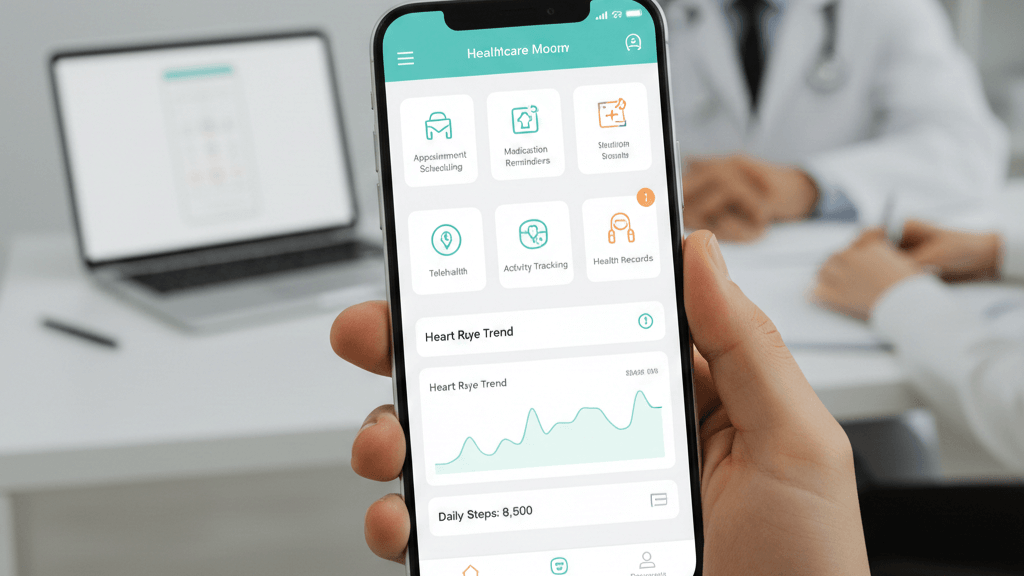
Patient-oriented healthcare applications require researchers to establish three main accessibility standards. The system provides the following common features:
- The system enables users to create accounts and log in with secure authentication methods.
- The system allows users to set appointments and receive reminders about them.
- Users can access their medical records and test results through the system.
- The system enables users to monitor their medications and receive alerts for prescription refills.
The system provides users with a secure communication channel to talk with their healthcare providers. The design requires simple execution because design designers need to maintain complete control over design elements. The design needs to deliver an easy-to-use interface because patients use healthcare applications when they experience high stress levels which requires them to navigate through the system with understandable paths and readable text and system functions which work as expected.
Features for Medical Staff
Applications developed for doctors and nurses and administrative personnel maintain their primary focus on achieving rapid results with precise performance. The standard functionalities of the system include:
- Patient management dashboards
- Clinical documentation tools
- Secure internal communication
- Integration with EHR systems
- Task and workflow automation
The system enables medical professionals to deliver patient care more efficiently because it decreases their administrative duties while streamlining their work procedures.
Data Management and Integrations
Most healthcare applications require smooth data transfer between systems to function properly. The integrations typically consist of following components:
- Electronic Health Record systems
- Laboratory and diagnostic services
- Pharmacy platforms
- Wearables and connected medical devices
The reliable functioning of integrations helps achieve accurate data results while eliminating duplicates, which proves vital for use in medical settings.
Best Practices for Healthcare Mobile App Development
To develop a healthcare application developers need to follow an organized process which helps them tackle all regulatory requirements and technical issues and user interface design problems.
Address Security and Compliance from the Start
Healthcare applications manage extremely sensitive information. Security and compliance should be core architectural concerns rather than post-launch additions.
Key practices include:
Data encryption protects information during transmission and when it is stored.
- Role-based access control
- Secure authentication methods
- Security testing and audits should be conducted on a regular basis.
The process of planning for compliance at an early stage helps to decrease legal risks while it avoids expensive system redesigns that would occur at later times.
Design for Real-World Healthcare Contexts
Healthcare applications serve users with different technical skills, physical abilities, and emotional states. User research and usability testing make teams design interfaces to work in real clinical and home environments.
Effective UX in healthcare design focuses on:
- Clearly structured hierarchy of information
- Low cognitive load
- Accessible color contrast and typography
- Mechanisms of error prevention and confirmation
Thoughtful design decisions have a direct effect on patient safety and user confidence.
Build Scalable and Maintainable Systems
Healthcare applications start as minimum viable products but need to expand their capabilities when user adoption increases. Products can develop through their entire lifecycle because of their design which includes scalable backend systems and modular components and cloud-based infrastructure.
Organizations that anticipate future system needs through their planning of upcoming integrations and required regulatory changes and new features can safeguard their investments throughout the years.
Key Trends in Healthcare Mobile App Development
Healthcare technology advances which create new requirements for mobile application development and usage. The ongoing progression of healthcare technology creates new demands which developers must fulfill when creating mobile applications.
Telemedicine and Remote Care
Telehealth services now serve as an essential component of healthcare delivery systems. The mobile applications provide users with three main features which include:
- Video and audio consultations
- Secure document and image sharing
- Integrated scheduling and billing
- Asynchronous patient-provider communication
The combination of these features enables better access to medical services while decreasing the need for patients to visit healthcare facilities except when necessary.
AI-Driven Decision Support
AI helps healthcare workers by handling extensive data processing tasks. In mobile applications, AI commonly supports:
- Symptom analysis and triage tools
- Personalized care recommendations
- Predictive analytics for chronic conditions
- Automated clinical documentation
The trust of healthcare providers and patients requires AI systems to deliver transparent operational details while proving their clinical validation.
Integration with Wearables and IoT Devices
Wearable devices together with linked medical equipment generate ongoing streams of health data. The mobile applications function as the primary platform which enables users to gather and display their health data.
Typical use cases include:
- Remote patient monitoring
- Wellness and fitness tracking
- Chronic disease management
The users through clear data visualization can understand health metrics while clinicians use it for their medical assessments.
Focus on Patient Engagement
Healthcare applications now use engagement methods which include personalized alerts and progress monitoring and educational materials. The features which enhance user engagement should be applied through careful design because they lead to better health results.
The main challenge involves helping users achieve their medical objectives while maintaining their comfort with the process.
Designing for Trust and Long-Term Adoption
Trust functions as the essential element which enables healthcare software to operate successfully. The safety of their data and reliability of the app are what users should take confidence from and rely on. The organization establishes its credibility through three elements which include transparent data usage policies and consistent performance and professional visual design.
Trust develops through clean layouts and intuitive interactions and predictable behavior which create a positive experience for first-time users.
Final Thoughts
Healthcare mobile app development in 2026 requires developers to find an optimal balance between three main factors which are usability and security and technical reliability. Successful products address real patient and clinical needs while remaining adaptable to regulatory and technological change.
organizations can develop mobile solutions which provide sustained value through their approach of developing essential features and using established development methods while monitoring upcoming industry developments.