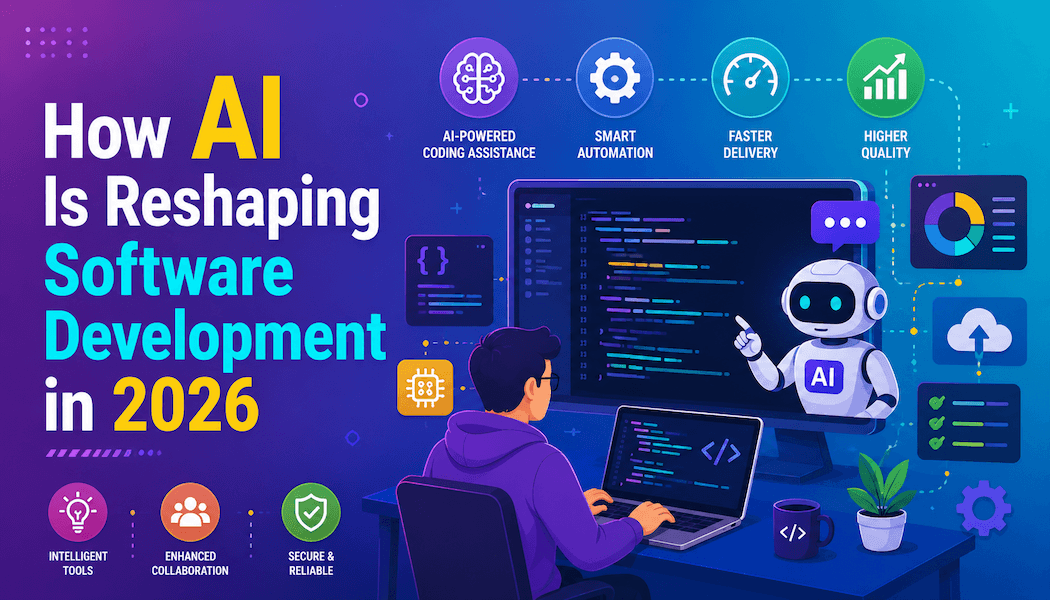
How AI Is Reshaping Software Development in 2026
A year ago, most engineering teams treated AI coding tools as a nice-to-have. Something a few developers used to autocomplete a function or clean up messy syntax. That's not where things stand anymore. AI reshaping software development in 2026 isn't a prediction; it's the daily reality inside most engineering orgs, where AI now drafts entire pull requests, writes its own tests, and flags bugs before a human ever opens the file.
What's changed isn't just the tooling. It's the shape of the job itself. Developers still write code, but a growing share of their time goes into reviewing what a model produced, correcting its assumptions, and deciding whether it actually solved the right problem. For a CTO or founder, that shift touches everything from how you write a job description to how fast you can ship a feature.
I've watched engineering teams go through this transition in very different ways, and the difference between the ones who benefit and the ones who don't usually comes down to something unglamorous: how well-organized their process was before AI showed up.
Where Things Actually Stand Right Now
Most mid-size and enterprise teams have at least one AI coding assistant baked into their daily workflow at this point. The bigger shift is toward agentic tools, the kind that can take a ticket, go explore the codebase on their own, make changes across several files, run the test suite, and come back with something close to a finished pull request instead of a single suggested line.
That's a real change in leverage. But it also means the old bottleneck, developer headcount, isn't the constraint it used to be. The new constraint is whether your codebase is clean enough and your requirements clear enough for an AI system to actually understand what "done" looks like.
What's Actually Driving This Shift
Agentic tools have replaced simple autocomplete
The early wave of AI coding assistants suggested the next line or the next block. What teams are using now behaves more like a junior engineer who never sleeps: it reads the ticket, pokes around the repo, writes the change, runs the tests, and iterates when something breaks.
The catch is that these tools do exactly what you ask, not what you meant. A vague ticket that a human teammate would have clarified in Slack becomes a wrong pull request when an AI agent runs with it literally. Teams that write precise, well-scoped tickets get dramatically more out of these tools than teams that rely on tribal knowledge and hallway conversations.
AI code review sits in the pipeline now, not on the side
It's become normal for an AI reviewer to scan a pull request before a human ever looks at it, catching security issues, obvious logic errors, and style violations. That hasn't eliminated human review. It's changed what humans are actually reviewing for. Instead of catching typos and missed semicolons, senior engineers are spending their review time on architectural fit and business logic, the things a model still can't judge well.
Testing has quietly become less of a chore
AI tools now generate test cases straight from requirements and existing code behavior, including the edge cases a rushed engineer would have skipped on a Friday afternoon. Some tools keep the test suite updated automatically as the code changes, instead of letting it slowly go stale.
That's a genuine win, but it comes with a catch worth flagging to any leader excited about the coverage numbers: a test suite that reflects what the code does isn't the same as a test suite that reflects what the business actually needs. Someone still has to check that.
Codebases are being built with AI in mind
Teams starting new products are increasingly thinking about AI agents as participants in the system, not just a tool bolted on afterward. That means structuring code so an agent can navigate it without getting lost, writing documentation in a form both humans and models can parse, and designing APIs that AI systems can call directly.
Messy, undocumented code has always been a drag on velocity. Now it's a drag on two workforces instead of one.
Governance stopped being an engineering-only conversation
Once AI starts writing production code, questions about liability, intellectual property, and vulnerability risk stop being a backend concern and start showing up in board meetings. More organizations are putting real policy in place: what AI is allowed to touch, how its output gets reviewed, how dependencies get vetted before they're pulled in.
Any company still treating this informally is carrying risk it doesn't need to carry, from license compliance headaches to security holes nobody signed off on.
The developer role is changing shape, not disappearing
Job listings for engineers increasingly mention system design, the ability to evaluate AI output, and comfort working alongside agentic tools, right next to the usual coding requirements. Junior engineers are picking up review and oversight responsibility earlier in their careers than they used to.
If your hiring rubric and onboarding plan still reflect what a "good developer" looked like in 2020, it's worth revisiting.
Traditional Development vs. AI-Augmented Development
| Aspect | Traditional Development | AI-Augmented Development (2026) |
| Writing code | Manual, line by line | AI drafts it, a human directs and refines |
| Code review | Human-only | AI screens first, humans focus on judgment calls |
| Testing | Manually written, often incomplete | AI-generated and kept up to date automatically |
| Documentation | Frequently out of date | Maintained with AI assistance, in sync with the code |
| Writing tickets | Loosely scoped, clarified in conversation | Precise enough for both a human and an AI agent to execute |
| Main bottleneck | Developer headcount | Review capacity and clarity of requirements |
| Junior developer's day | Mostly writing code | Increasingly evaluating and directing AI output |
A Framework for Adopting This Without Making a Mess
- Look honestly at your current workflow first. Find where your team spends the most time on repetitive, well-understood tasks. That's where AI earns its keep fastest.
- Start narrow. Test generation and code review are safer entry points than handing over an entire feature to an autonomous agent on day one.
- Write the policy before you scale usage. Decide what AI can touch, how its output gets reviewed, and who owns the outcome when something goes wrong.
- Fix your ticket-writing habits. AI tools amplify whatever clarity, or confusion, already exists in how your team communicates requirements.
- Measure what matters. Defect rates, cycle time, and review load tell you far more than how many developers logged into a tool this month.
- Actually train people. Prompt writing and output evaluation are skills, not instincts. Treat them that way.
What Leaders Are Actually Seeing
Teams that adopted these tools deliberately are seeing faster prototyping and noticeably less time sunk into boilerplate and routine test writing. That part is real. But it isn't automatic, and it isn't evenly distributed.
The teams with clean codebases, decent documentation, and disciplined review habits are the ones pulling ahead. Teams sitting on legacy code, unclear requirements, or no governance at all are finding that AI introduces roughly as many problems as it solves, quietly, and often in ways that don't surface until a production incident.
The honest takeaway here: AI doesn't fix a disorganized development process. It just makes the existing process move faster, good habits and bad ones alike.
Key Takeaways
- AI has moved from suggesting code to completing tasks, which changes how work gets assigned and reviewed.
- How clearly your team writes tickets and how clean your codebase is now directly determines what you get out of AI tools.
- AI code review and test generation are standard parts of the pipeline now, not experiments.
- A written policy on AI-generated code is a business necessity, not a nice-to-have.
- The developer role is shifting toward oversight and system thinking, not shrinking.
Frequently Asked Questions
Is AI replacing software developers in 2026?
No. It's changing what developers spend their time on, shifting the focus from writing routine code to reviewing, directing, and architecting systems. Demand is growing for engineers who can evaluate AI output well, not shrinking for engineers overall.
What is agentic AI in software development?
It refers to tools that can independently plan and carry out multi-step coding tasks, exploring a codebase, editing across files, running tests, and fixing failures, rather than just suggesting the next line of code.
How much of production code is AI-generated in 2026?
It varies a lot by team and codebase maturity. Organizations with strong documentation and clear processes tend to have a large share of routine work, boilerplate, tests, simple features, generated with AI and reviewed by a human.
Does AI-generated code introduce security risks?
It can, particularly around dependency choices and edge cases the model wasn't trained to catch. That's exactly why governance policy and human review still matter, no matter how good the tool is.
What skills should developers focus on now? Prompt and context engineering, system design, and the ability to critically evaluate AI output are becoming just as important as writing code by hand.
Should smaller teams and startups bother adopting AI development tools?
Usually yes, and often faster than larger companies, since small teams can set good conventions from the start instead of untangling years of legacy code first.
What's the biggest risk of moving too fast here?
Rolling these tools out across a messy codebase or an unclear process just amplifies the mess. You get inconsistent architecture and hidden defects instead of the productivity gains you were expecting.
How should engineering leaders judge whether this is working?
Watch defect rates, cycle time, and review load, not adoption numbers. A tool everyone uses isn't a win if it's quietly creating more rework than it saves.
Conclusion
AI reshaping software development in 2026 isn't a single dramatic event. It's a steady shift in where human judgment matters most. The teams getting real value share the same traits: clean codebases, clear requirements, and a deliberate policy around how AI gets used, not just permission to use it. The tools are ready. What separates teams now is discipline, not access.
If you're weighing how to scale AI adoption across your development process without creating a mess later, start with an honest audit of your current workflow before you add more tools on top of it.