How Is AI Companion App Development Blending Generative AI with Digital Identity Design?
The development of conversational systems has now reached an era where interaction alone is no longer enough to retain the interest of users. The current generation of users demands continuity, personality, and identity in digital companions. This new demand is revolutionizing the development of AI Companion Apps, where generative AI is being increasingly integrated with the design of digital identity. Instead of developing systems that interact, developers are now creating AI entities that have personalities, memory continuity, and presence. The integration of these two areas, namely generative intelligence and identity architecture, is transforming the way AI companions are perceived.
Understanding Digital Identity in AI Companions
Digital Identity Beyond Avatars
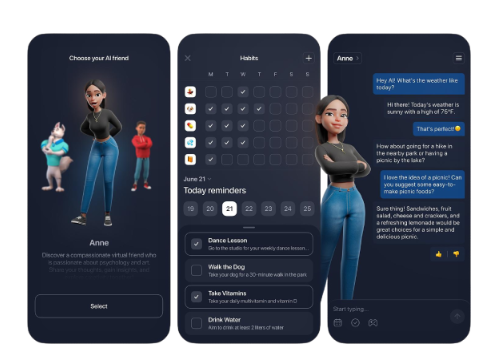
Digital identity in AI companions goes well beyond the realm of visual representation or names. It involves personality, speech patterns, emotional undertones, and behavior. In AI Companion App Development, identity design serves as a structural element that regulates the way generative AI communicates. This way, even when the responses are being dynamically generated, the AI still has a consistent sense of “self”.
Identity as a Persistent Construct
Generative AI models are probabilistic by nature, implying that they can generate different outputs for similar inputs. Digital identity design limits the variability of generative AI models by specifying fixed attributes, such as humor level, empathy expression, or communication formality. These limitations do not restrict intelligence but offer a recognizable framework that enables users to build a long-term relationship with the AI companion.
Generative AI as the Voice of Identity
Language Models as Personality Engines
Large language models are the expressive foundation of contemporary AI companions. By means of prompt engineering and contextual conditioning, AI companion developers condition the generative output on predefined identity parameters. In the development of AI Companion Apps, the prompt is no longer a static command but a living identity script.
Contextual Consistency Through Memory Layers
Digital identity is reinforced through memory systems layered on top of generative models. These systems store conversational context, preferences, and recurring themes, allowing the AI to reference shared experiences. This approach ensures that identity feels continuous rather than fragmented, even when conversations span long periods.
Visual and Multimodal Identity Expression
Visual Representation as Identity Reinforcement
Though text is the core, visual identity components like avatars or animations are essential to perception. Generative AI can be used to dynamically affect these components, changing facial expressions or visual signals depending on the conversation context. In Candy AI-inspired platforms, this coordination between text and visual elements enhances the experience of having a unified digital identity.
Voice and Tone Alignment
Text-to-speech models further extend identity design by translating linguistic personality into vocal characteristics. Pitch, pacing, and emotional inflection are tuned to match the AI’s defined persona. This multimodal alignment ensures that identity is not confined to text but expressed consistently across interaction channels.
Adaptive Identity Without Fragmentation
Controlled Evolution Over Time
One of the key challenges in the integration of generative AI and identity design is the ability to evolve while maintaining consistency. In the development of the AI Companion App, identity evolution is typically achieved through the adjustment of parameters instead of sudden transitions. This allows the AI to evolve together with the user while maintaining its essential characteristics.
User Influence on Identity Shaping
Generative AI systems can subtly adapt identity expression based on user preferences. Over time, the AI may mirror communication styles or adjust topic depth. However, digital identity frameworks ensure these adaptations occur within predefined boundaries, preventing the AI from becoming unrecognizable.
Architectural Foundations Supporting Identity-Driven AI
Separation of Intelligence and Identity Layers
Contemporary companion designs separate generative intelligence and identity governance. The language model is responsible for response generation, and the identity layer is used for filtering, modifying, and refining the output. This enables an ai development company to experiment with identity design without modifying the core models.
MVP-Centric Identity Validation
For companion apps in the early stages, AI MVP app development can be used to test identity resonance before scaling. This is because, by observing user responses to a particular persona, developers can improve identity parameters. Generative AI helps in making rapid changes through prompt tuning instead of architectural changes.
Emotional Continuity and Perceived Presence
Emotional Signaling Through Language Patterns
Generative AI conveys emotion not by explicit labels but through language choices—sentence length, word selection, and response timing. Digital identity design guides these patterns to ensure emotional signals remain aligned with the AI’s persona. This subtlety enhances realism without overemphasizing sentiment.
Presence as an Emergent Property
When generative AI and identity design are closely integrated, presence becomes an organic byproduct. Users feel the presence of the AI system as opposed to its mere reactivity. In AI Companion App Development, presence is a consequence of identity expression through adaptive intelligence.
Ethical Identity Design and User Perception
Transparency Without Disruption
Although the goal of identity design is to provide interesting experiences, it should not mislead the user about the nature of the AI. The designers walk a line between expressing the identity and communicating the fact that the companion is a machine. This is done through language framing and interaction boundaries rather than explicit disclaimers.
Cultural and Contextual Sensitivity
Digital identity frameworks also incorporate cultural context, ensuring generative AI outputs align with user expectations across regions. Identity parameters guide how humor, empathy, or formality are expressed, reducing misalignment in global deployments.
The Future Direction of Identity-Centric Companions
From Static Personas to Living Identities
With the increasing capabilities of generative models, the design of identity will evolve from fixed constructs to dynamic systems. These systems will handle identity states, emotional trajectories, and conversation histories as interrelated parts. AI Companion App Development is already heading in this direction, where identity is constantly being negotiated rather than fixed.
Identity as a Platform Differentiator
With an ever more saturated market, the question of identity consistency will set companion platforms apart much more than intelligence alone. Consumers may be willing to overlook the occasional mistake but will quickly lose interest in companions that seem inconsistent or insubstantial. This is where generative AI, with careful attention to identity design, helps meet this need.
Conclusion
The integration of generative AI with digital identity design represents a paradigm shift in the development of AI companions. By limiting the generative intelligence of AI companions through well-structured identity frameworks, AI Companion App Development enables the creation of systems that are perceived as persistent, expressive, and recognizable. The ai companion platform like candy ai demonstrates how language, memory, images, and voice can be integrated into a single digital identity. With the increasing integration of these elements, AI companions will evolve from interactive to identity-driven systems, which will redefine the future of human-AI interactions.