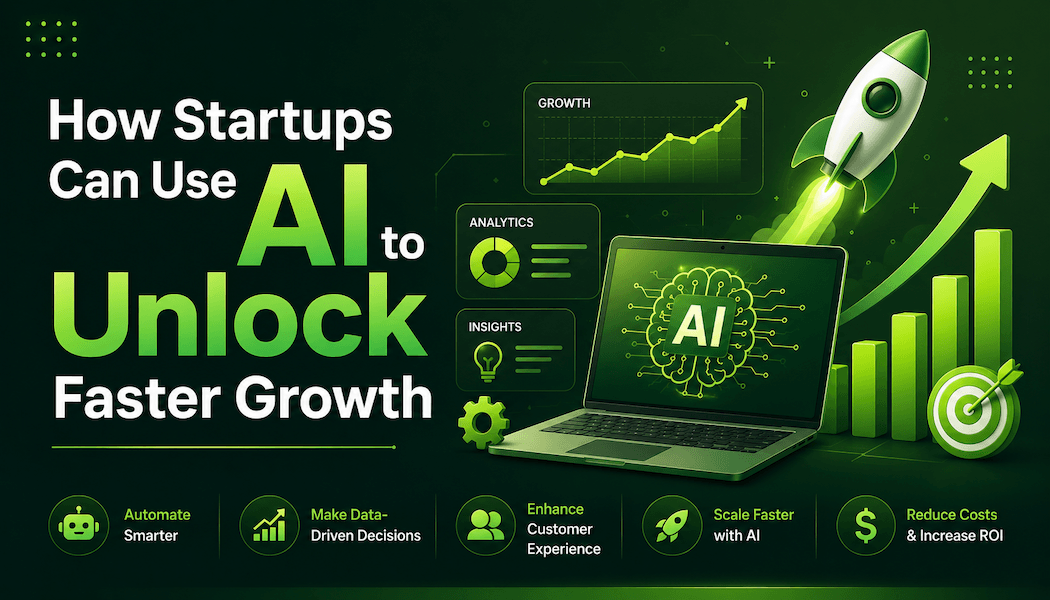
How Startups Can Use AI to Unlock Faster Growth
Launching a startup is always partly about making smart choices with pretty limited resources. Founders kind of need to validate ideas, build the product, pull in users, and then improve operations while competing with firms that often have larger teams, plus, bigger budgets too. For a lot of early stage companies, teaming up with experienced partners that offer software startup development services can really help turn creative concepts into scalable digital products, but keep the whole development process focused and kinda efficient.
And yes, artificial intelligence is shifting this whole balance. With AI tools, startups can automate those repetitive chores, sift through huge amounts of data, speed up product development, and also craft more customized customer experiences. It isn’t really about swapping out human know how. Instead, AI basically helps small teams move quicker, and then concentrate on the decisions that matter the most.
For startups, the biggest win from AI isn’t just “getting more done.” It is about shrinking the time between an idea and real measurable outcomes.
AI Helps Startups Test Ideas Before Investing Too Much

One of the biggest challenge s for any startup is uncertainty. Founders often have to decide if an idea is even worth pursuing , before they sink in a lot of time and money into actual development.
AI can help by trimming that uncertainty a bit, like supporting market research work, competitor analysis, and customer discovery. Instead of going through huge stacks of information by hand, startup teams can use AI-powered tools that help them spot patterns, wrap up feedback into clear summaries, and also uncover possible market chances.
For instance, an early stage company can study customer reviews, social media conversations , and industry reports to figure out what users actually like, which annoyances they run into, and what kinds of fixes or solutions they keep searching for.
AI can also make it easier for founders to craft and test product ideas more quickly. It can generate user personas, review customer behavior, or even help with prototype creation, so assumptions are easier to validate before the team commits to full development.
Automating Operations Without Growing the Team Too Quickly
A lot of startups get stuck with limited resources, like it’s just not enough to go around. Usually a small group has to juggle customer communication, marketing, admin tasks, plus product improvements all at once and at a pretty steady pace.
AI can step in and automate the boring parts so there’s less manual effort. For instance, support chatbots can respond to frequent questions right away, AI-powered marketing tools can help craft content and then analyze campaigns, and automation platforms can smooth out internal workflows, so people don’t waste time jumping between tabs.
Now, this is not about removing the human presence or whatever from business processes. It’s more like AI lets the team spend less time on repetitive chores, and then actually return that time to strategy, imagination, and those customer relationships.
For example, a startup founder can use AI to sort through customer inquiries, spot recurring problems, and also rank product changes based on real user needs. In the end it builds a quicker feedback loop between customers and the development team, which is honestly where a lot of momentum comes from.
Faster Product Development with AI-Assisted Tools
Building a digital product basically needs speed, because the market does not wait. Many startups end up going head to head with established companies, so the ability to ship, try things out, then refine them fast can become a real leverage.
AI assisted development tools help across a lot of parts of the product journey. Developers can use AI for code suggestions, surface likely bugs, draft documentation, and also make testing more reliable and consistent. In practice it can feel like having a co-pilot that never gets tired, yet it still needs guidance.
For startup teams, this can translate into quicker experiments and smaller development loops. Rather than burning weeks on first concepts, they can build prototypes, gather real feedback, then tweak the product based on what users actually do and say.
That said, AI is not magic on its own. It works best when it’s paired with solid engineering expertise. Even a strong AI workflow still depends on careful architecture, security safeguards, user experience design, and technical choices that leave room for scaling later on.
Creating Better Customer Experiences Through AI
Today, people want personalization. Customers need services which are able to identify their needs and give them personalized recommendations instead of the generic ones.
Using artificial intelligence enables new companies to provide more personalized user experience by analyzing user behavior and customizing solutions based on specific needs.
Examples of these services are:
- recommendation systems which suggest appropriate goods or materials;
- AI assistants which assist users to navigate through applications;
- personalized marketing services which take into account the behavior of customers;
- prediction systems which identify customers that may need assistance.
Personalization can become a growth factor for start-ups. Personalized products ensure greater user engagement.
Using Data and AI Insights to Make Smarter Decisions
Data is one of the most precious assets for startups; however, data collection is just the initial stage. The real task is to make the right conclusions from the available data.
AI enables the startup owners to investigate customers' behavior, recognize trends, and predict what might happen. Consequently, decisions can be made not on assumptions but on facts.
Some examples of key questions, which could be answered using AI analytics, include the following:
- What features do users appreciate the most?
- Why do customers discontinue using the product?
- What marketing channels deliver the best results?
- How could conversions be improved?
In such a way, startups would know where to invest efforts.
AI Does Not Replace Product Expertise
Although AI brings powerful opportunities, it doesn’t stand there and do everything on its own. A startup that really goes somewhere still needs product strategy that is clear, plus solid technical know-how and also a real grasp of what their customers actually need.
AI can speed up the whole process, but it cannot replace human judgment . Founders still have to pick the right problems, select the best solutions, and make sure the product delivers something of true value, not just cool features.
The startups that tend to win are the ones who blend AI abilities with human creativity, and lived experience . When companies treat AI like an enhancement instrument , they can move quicker while still protecting product quality, plus keep long term scalability on track.
Final Thoughts
AI is getting really valued as one of the most important tools for startup growth, it’s helping founders move quicker. it can help validate ideas at a faster pace, automate day to day operations , improve the product quality, and even craft more thoughtful experiences for customers.
But the key thing is this, don’t adopt AI just because it’s a trend and everyone is talking about it. instead, startups should figure out which parts of the business have real pain points, then see where AI can step in and solve them in a clear way. The improvements should also be measurable, not only “feels better” type results.
Used with a bit of strategy, AI gives startups the chance to run more efficiently, keep up with larger companies, and translate new concepts into working products much sooner.