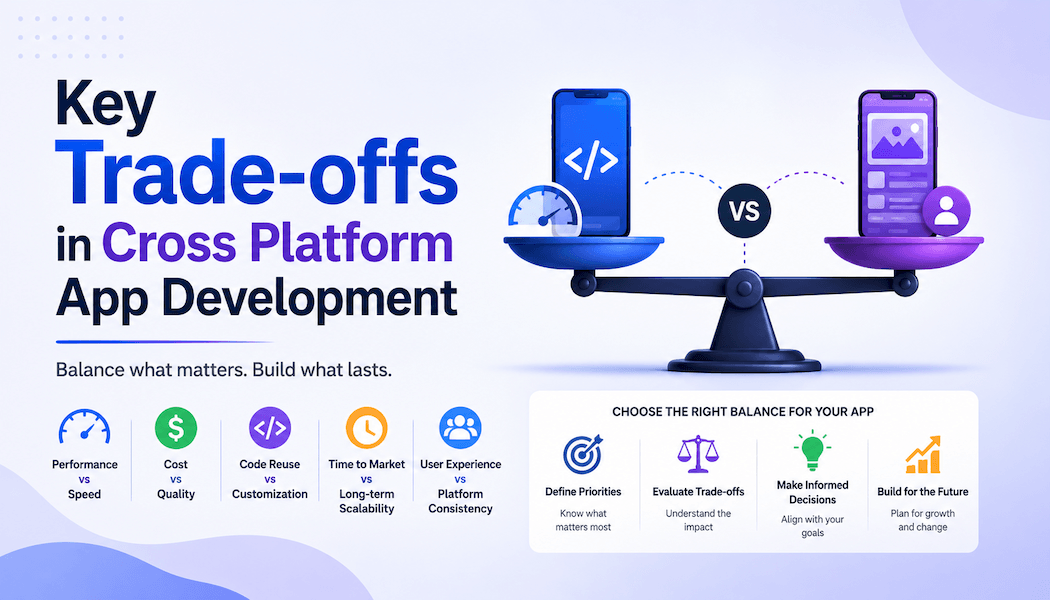
Key Trade-offs in Cross Platform App Development
Cross-platform development enables faster product delivery and decreases maintenance needs while allowing teams to evaluate their concepts on iOS and Android through a single codebase. Every shortcut that exists brings with it an associated cost. A founder, product owner, or CTO who chooses a cross platform mobile application development service needs to understand where cross-platform saves resources and where native development still gives more control.
The key decision rarely comes down to "cross-platform or native." A better question sounds more practical: which trade-offs can your product accept without hurting user experience, release speed, budget, or long-term growth?
You must evaluate these primary trade-offs because they determine your suitability for cross-platform development.
Faster delivery vs deeper platform fit
The fastest method of developing software requires developers to use cross-platform development. Engineers can build software for two main mobile platforms by using Flutter and React Native which enable them to develop a single codebase. The product team can develop identical main functions for both iOS and Android platforms which they will launch at almost the same time.
This advantage becomes essential for minimum viable products and marketplace applications and booking systems and internal business applications and customer access platforms and initial product releases which require rapid market validation.
The use of shared code restricts your application from fully adopting the native design elements of both operating systems. Users on iOS and Android systems expect different interaction methods and methods of navigating and authorization requests and design components. The cross-platform application must implement the identical elements which the team needs to develop on their existing platforms.
The basic rule states that developers should implement shared logic in situations where users cannot detect any distinctions and developers must customize the system experience to match the user behavior patterns of different platforms.
Lower cost vs future rework
Cross-platform applications will require less development time at the initial stage. There is no need to have two different native development teams, and a lot of common code for business logic, UI elements, and tests can be reused.
This advantage comes in handy when you:
- Need to prove your concept on a shoestring budget
- Need to appeal to users of both operating systems at once
- Have to quickly roll out updates across multiple platforms
- Want to maintain just one design and backlog for your apps
There is a drawback to this approach in case the product evolves in a way that is not supported by the framework used initially. An app created as a straightforward marketplace might evolve into a complex application that supports live video, extensive Bluetooth connectivity, augmented reality, or background services.
These are features that a cross-platform app doesn’t prevent you from implementing. However, they mean that your team will need to evaluate them in advance. Otherwise, refactoring the first version will negate any cost savings achieved at an earlier stage.
Which is why it pays off to think about architecture before development begins.
One codebase vs platform-specific performance
Modern cross-platform frameworks are highly optimized in terms of performance. Numerous business applications, social networks, e-commerce solutions, fitness apps, media platforms, etc. can be built with a single codebase.
However, performance is a factor that varies based on the type of application. Content applications with forms, feeders, payment gateways, and messaging differ from mobile games, video editors, and navigation tools.
Cross-platform becomes hard-pressed when the app requires:
- Heavy animations
- Non-stop work in the background
- Camera processing
- Complex data sync in offline mode
- Big amounts of data on low-cost devices
- Close integration with the hardware
The point is quite obvious – cross-platform provides faster development but no access to optimizations at the platform level. Native code provides access to the optimization but no fast development.
It turns out to be reasonable to build an app almost completely using a cross-platform framework and to use native modules only in certain areas of the app that require high performance.
Consistent UI vs native user expectations
The cross-platform system enables teams to maintain their visual brand identity. The product achieves visual consistency between iOS and Android platforms which benefits brands that maintain strict design guidelines.
Design-heavy applications and award platforms and creative tools and consumer products require that particular level of design consistency. The shared UI kit enables designers to work more efficiently while maintaining brand identity throughout their designs.
The danger exists that organizations will implement excessive standardization. Users evaluate an application based on its brand design. Users evaluate how authentic the application performs on their particular device. Android users expect a specific back function to operate in a particular way. iOS users expect particular sheet designs and user gestures and transition effects.
Cross-platform design requires designers to create different screens for each platform instead of using identical designs. The system maintains brand identity through its essential design patterns which control user interactions.
A checkout flow can maintain its visual identity across both platforms while implementing distinct payment methods and keyboard functions and navigation elements. Users will accomplish their tasks more efficiently because they need to deal with fewer obstacles that interfere with their work.
Shared team vs specialized expertise
The first advantage in cross-platform development is easier team composition. A single mobile team can do everything related to the product, and there will be better communications and less fragmentation of the backlog.
This is one of the main pluses for many businesses. The product managers won’t have to repeat the requirements twice; QA specialists will have to test only one main flow for two platforms, while the designers will have to work with one design system.
What is lost, though, is depth of knowledge. Cross-platform developers will have to know how iOS and Android work, how to use their stores, what limitations there are on each platform, how to deal with SDKs, and more.
A poor-quality team may think of cross-platform as "write once and forget about the platforms," while a high-quality team would see it as just the basis for their work, while still paying attention to platform differences.
When evaluating the vendor or looking internally for a cross-platform solution, make sure the team has skills related both to the cross-platform framework and the platforms themselves.
Faster updates vs dependency risk
Updating a shared codebase is easier. Whether you need to change pricing logic, onboard users, modify the dashboard, or fix a bug, the development process can be streamlined to implement the changes across both platforms simultaneously.
Having such an approach is valuable to product managers because they get more control over the release once the product launches. Moreover, cross-platform applications can help in cases when you receive feedback from the market and have to adjust your product accordingly every sprint.
The challenge that comes with the use of frameworks lies within dependency issues. Packages, plugins, open-source solutions, and framework updates may cause problems for developers in case the library or plugin is no longer supported, or an update makes some features break.
It does not mean, however, that you should abandon cross-platform frameworks. It implies that you should create an effective policy towards dependencies in order to keep the application up and running:
- Work only with mature packages and libraries
- Do not use additional plugins where possible
- Carefully review any upcoming updates for the framework
- Maintain a native version of critical features
- Take into account additional time for maintenance
Broad platform reach vs complex testing
Cross-platform development allows you to reach users who use phones tablets desktops and web browsers and it requires less development effort when you choose the right framework and base your project on specific product requirements. The solution applies to applications which require both web and mobile access and to software as a service products and internal systems and marketplace platforms.
Testing becomes more difficult because testing requires developers to create tests for multiple environments. The system operates through multiple devices because it uses a single codebase. Your application functions across various devices which include different screen sizes operating system versions and chipset and network conditions.
One Android phone display will show a layout correctly but another phone display will show the layout incorrectly. The latest iPhone shows smooth animations but older devices display slower motion. A payment flow may work in one region but fail in another due to provider settings.
To mitigate risks, Quality Assurance must be conducted across real devices; nonsimulated devices. The team should test platform-specific flows, offline behavior, permissions, push notifications, deep links, and app store builds before each major release.
When cross-platform is the right choice
The cross-platform approach suits well when your goal is to reach as many users as possible through your product as soon as possible with uniform functionality on multiple platforms.
The cross-platform development strategy would be suitable for:
- Minimum viable products and startup software
- E-commerce or marketplace software
- Hotel or food delivery applications
- Social and community software
- Financial technology and health technology applications with typical mobile functionality
- Software used exclusively within an organization
- Software that requires regular feature upgrades
In some cases, the use of the native application development process could be more appropriate for your product due to advanced hardware capabilities or advanced graphics.
Ultimately, it all depends on the nature of your project.
Final thoughts
Cross-platform app development serves as a strategic option which companies should choose instead of using it as a budget-friendly alternative to native development. The system enables you to launch products at an increased speed while it eliminates unnecessary work and maintains control over product development.
The system requires intelligent system construction and precise design choices and effective quality assurance and trained personnel who possess knowledge about platform operations.
Before you select a framework, identify your current application requirements and your future application needs for the next two year period. The analysis will reveal which trade-offs you can accept and which trade-offs will result in excessive costs for you to pay in the future. A successful cross-platform product does not come from one codebase alone.
Successful product development requires a clear understanding of the product together with technical expertise and a development team who knows which situations demand code sharing and which ones require native development.