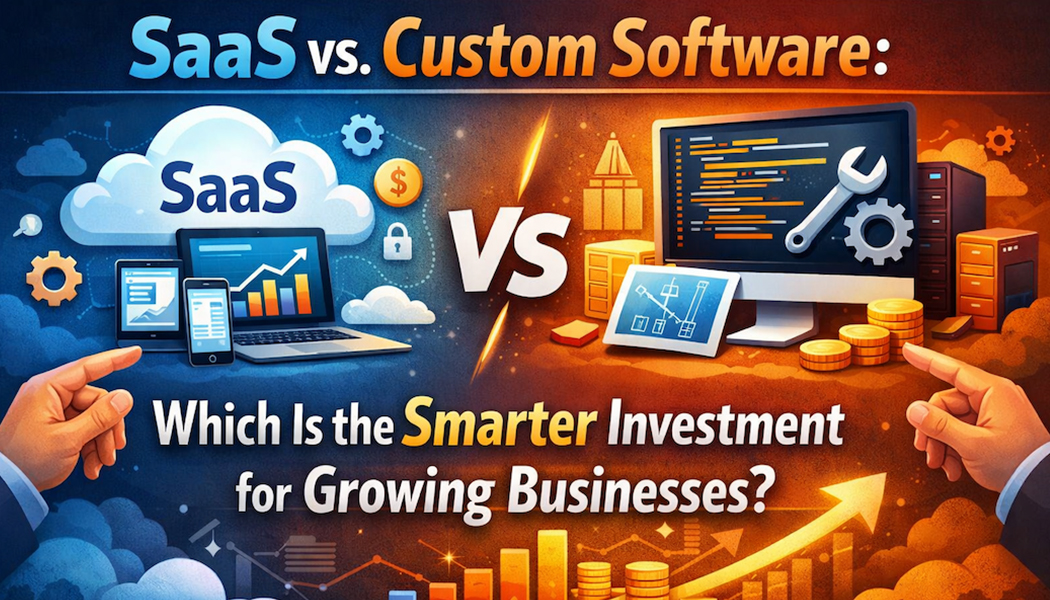
SaaS vs. Custom Software: Which Is the Smarter Investment for Growing Businesses?
In today’s digital landscape, the modern software solutions that your organization chooses can make or break your business. Evidently, this is why these decisions play a key role in deciding how quickly an enterprise can innovate, scale, and respond to changes in the market. Nonetheless, it also affects customer experiences at large.
From a development perspective, the software market has evolved immensely. With rapid advancements in cloud, APIs, AI-driven tools, and modular architectures, there are many emerging options to choose from. Among these choices, software-as-a-service (SaaS) platforms and custom software development are most dominant because of their distinct features, speed, flexibility, cost, and control.
Herein, a SaaS solution is a more standard one, and it enables a business to deploy apps more readily, with minimal investment. On the contrary, custom software solutions allow building tailored workflows that meet an organization’s unique goals. This is why SaaS is an emerging option for companies that need faster implementation and a more predictable cost curve, while the latter is better for a software development company seeking more complex digital objectives.
That being said, this choice has many tangents, among which are aspects like the company’s digital transformation goals, budget constraints, and project complexity. Focusing on these variables, this guide shares a comprehensive comparison of SaaS and custom models for leaders. This knowledge will help them make the right strategic choice, thereby achieving a sustainable level of growth and innovation.
What is a SaaS Solution?
Basically, a SaaS solution is an emerging software delivery model where apps are hosted on secure platforms that are supported by cloud technology. And their access is via a web browser or a mobile app. This is why companies opting for this solution do not need to invest in purchasing separate software licenses and installing programs on their local servers.
- Simply, they can use SaaS as an online service.
- What’s more, teams do not have to handle the hassle of managing the hosting, updates, security frameworks, maintenance, and other aspects.
- This is why it allows professionals to deploy apps faster, thereby reducing the complexity and stress in their tasks.
That being said, its key components include the following:
a. Cloud-Based Hosting
As we know, SaaS runs on remote cloud servers. This means that a team does not need to set up servers, advanced storage systems, and secure data centers while using this platform. Fundamentally, this is how using this tool reduces the IT costs considerably for a software development company.
b. Internet-Based Access
Since the apps can be accessed through the internet in SaaS service models, teams get to manage their workload and responsibilities remotely. As a result, leaders can achieve better results in terms of teamwork, accountability, and collaboration among professionals globally.
c. Subscription-Driven Model
Coming to the SaaS pricing model, it requires monthly or annual subscription fee payments. For IT teams, this means that their budgets can be planned in advance as per the selected timeline. It also helps them avoid a single costly investment and follow-up maintenance costs. In this way, the cost sheet also becomes more budgeted and optimized.
d. Central Updates and Maintenance
Well, the SaaS vendor shoulders the responsibility to manage the software updates and security patches automatically. This simply means that the teams need not worry about app security or manually installing any updates on their own.
Owing to these factors, SaaS is a trusted software solution for companies. Fundamentally, let us now understand the key benefits of SaaS for the IT teams.
1. Multi-Tenant Architecture
This means that a single software can easily fulfill the needs of multiple business functions and customers. And each function and company’s data is completely isolated, secure, and well-managed on SaaS.
2. Automatically Scalable
These advanced platforms are typically built on public and hybrid cloud environments. Fundamentally, it helps leaders to automatically increase server capacity as they grow, as cloud technology supports scalability.
3. API-First Ecosystem
Modern SaaS platforms use application programming interfaces (APIs) that allow them to connect one function with other business systems. Herein, the data flows can be more seamless and secure, fostering cross-functional coordination.
4. Lower Upfront Cost
As we know, SaaS platforms are managed by vendors. Here, companies do not need to purchase software licenses and manage them. This is why, for leaders, this means no extra cost or stress of managing the updates of this platform and its services.
5. Higher Security
Undoubtedly, cloud-based platforms offer immense security, which is why IT teams can spend less time worrying about their resources and managing their routine checks. Additionally, automated security measures supported by the cloud help teams in detecting and mitigating vulnerabilities faster.
This is why many popular customer relationship management platforms, project management tools, and accounting systems are based on SaaS models. So, there is no doubt that this software solution can be your go-to platform as it offers speed, scalability, and operational simplicity, thereby helping you tackle many operational challenges in the modern day.
What is a Custom Software Solution?
Moving on to the next solution that is more specialized than the standard SaaS model, we have a custom software solution. As the name states, it is a special application that is designed by seasoned custom software development companies.
- Its purpose is to meet the unique and complex needs of an organization, which goes beyond off-the-shelf (standard) solutions.
- Mainly, a tailor-made software is designed around complex business processes, workflows, and goals.
- So, the process of custom software development is not just focused on adapting your business needs to an existing solution. Rather, it focuses on making the software architecture itself more adaptive, agile, and flexible.
- Moreover, it provides teams with more control over features, scalability, and integrations.
Technically, it includes the following aspects:
a. Requirements Analysis
Here, the business teams start by brainstorming the capabilities they need in the system. Mainly, it includes defining the goals, the features, and workflows for a project, and understanding how they deliver more than just the generic functionality.
b. Developing the Right Architecture and System Design
Focusing on a niche function, business developers design the system’s architecture, database structure, and integration layers. This is a meaningful step that ensures scalability, security, and maintenance of the custom software in the long run.
c. Development and Testing
In the development stage, engineers work on figuring out how APIs, cloud services, and other key elements can be implemented in the system. Furthermore, their testing is done to check that the system is up to the mark, as set by teams. Overall, this helps the platform perform reliably and flexibly supports more complex APIs in the software.
d. Deployment and Continuous Improvements
The next stage includes checking the system architecture and design prior to software launch and ensuring that the system is scalable, secure, and business-focused. Additionally, improvements can be made accordingly before and after its launch.
That being said, IT teams can benefit from this elaborate custom software development process in the following ways:
- Teams can avoid investing in generic features and functionalities that don’t make sense to them.
- Meeting more complex business goals is easier this way, and engineers can allow more automation and control that SaaS tools may not generally support.
- Furthermore, this allows more dynamic integrations to be part of the custom software.
- Finally, all these aspects support the scalability and growth prospects of the company, as they are more tailored to meet a business’s needs.
So, ideally, for businesses with more specific workflows and industry requirements, a custom solution developed by an expert software development company may be more suitable. It is because it enables companies to scale autonomously and achieve higher operational visibility in their processes.
Comparison of the Two Models
As we closely look at SaaS and custom software solutions, we can understand that they are better suited for two diverse business goals, which include their flexibility and scalability-focused results.
So, this section shares a simplified table comparing these two models for better and informed decision-making of the leaders in this context.
|
Differentiating Factors |
SaaS Model |
Custom Software |
|
Cost |
|
|
|
Deployment Time |
|
|
|
Customization |
|
|
|
Ownership and Control |
|
|
|
Scalability |
|
|
|
Maintenance |
|
|
|
Flexibility of Including Integrations |
|
|
So, in short, SaaS is better for companies that need more speed and simplicity, while custom software solutions offer more flexibility and long-term strategic alignment for enterprises.
1. Which Businesses Should Consider SaaS?
Based on this analysis, we can say that SaaS is better suited for startups and mid-sized companies. This is because of the following key reasons:
- Allows quick setup in a minimal cost structure.
- Reduces the need for skilled developers (which is an additional cost).
- Enables access to secure, enterprise-grade software tools.
Additionally, SaaS tools work best in cases where the industry requirements are not very complex.
2. When Does a Custom Software Solution Become a Smarter Investment?
Although SaaS is a more convenient answer for a company’s software needs, a custom model can be better suited in cases when:
- Companies need to work with complex integrations that are not supported by an off-the-shelf solution.
- More control is needed over the firm’s data architecture.
- Higher scalability is one of the key business goals.
Thus, this choice is dependent on aspects like an organization’s growth stage, operational complexity, and long-term technology strategy.
Final Thoughts
Wrapping up, we can say that there is no right answer to the question that whether SaaS is better or custom solutions are a smarter investment. The right decision here depends on the workflows, goals, objectives, flexibility needed, and various other factors.
Ideally, a company should take a third party’s opinion in making this choice, as its outcomes actually affect its ROI and results. Hence, consulting with a software development company that has delivered successful projects in your industry can be incredibly helpful.
So, leaders need to thoroughly think about the goals in question and plan in a way that assures higher chances of growth, innovation, and differentiation in the industry.