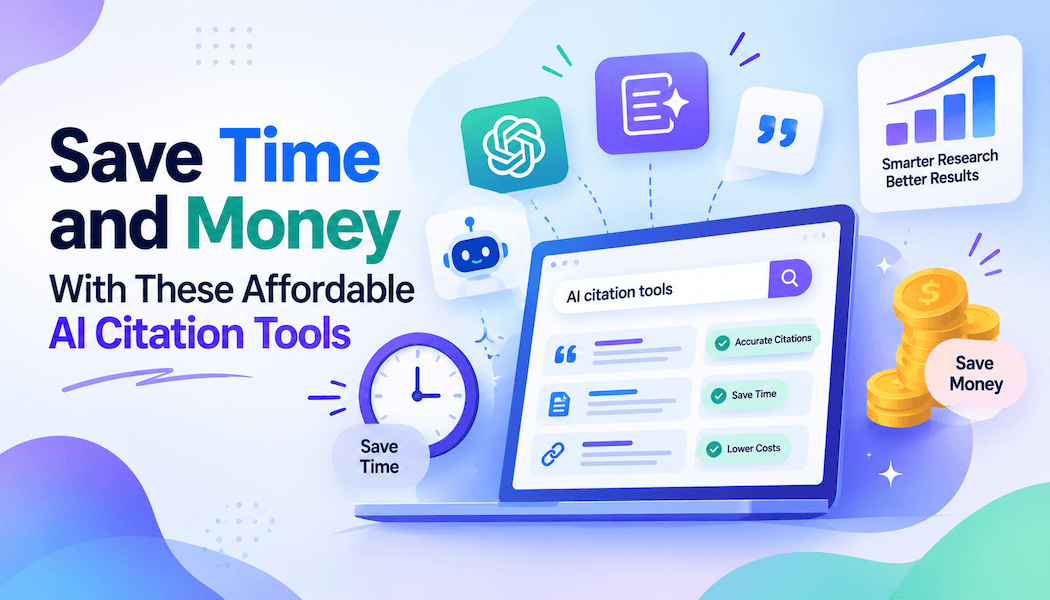
Save Time and Money With These Affordable AI Citation Tools
Research, writing, and content creation often require accurate citations, but building references manually can take hours. You may need to locate reliable sources, collect author and publication details, choose the correct citation style, and format every reference properly. Affordable AI Citation Tools simplify much of this work, helping students, researchers, marketers, writers, and businesses create organized citations without paying for expensive software.
However, these tools should support your research process, not replace human judgment. AI can format a citation quickly, but you should still verify whether the source is real, relevant, current, and correctly represented.
Why Citation Tools Matter
Citations do more than make a document look professional. They show readers where your information came from and help establish trust in your work. Proper references are especially important for:
- Academic essays, dissertations, and research papers.
- Blog posts containing statistics, studies, or expert claims.
- Business reports and market research.
- Legal, medical, and financial content.
- Presentations, white papers, and ebooks.
- SEO content designed to demonstrate expertise and credibility.
Without a reliable citation system, writers can lose track of sources, miss important publication details, or accidentally use inconsistent formatting. A citation tool can reduce repetitive work and help you focus more attention on research quality and writing.
Some modern tools can also verify whether a citation exists or whether a source supports a particular claim. For example, citation verification platforms may compare references against academic databases, while some research tools identify whether studies support or contradict a statement.
What Makes an AI Citation Tool Affordable?
An affordable tool is not necessarily the one with the lowest advertised price. Value depends on how much time it saves, how many sources it supports, and whether it reduces formatting or verification mistakes.
Before choosing a tool, consider:
- Whether a useful free plan is available.
- Monthly and annual subscription prices.
- Limits on daily or monthly citations.
- Supported citation styles.
- Browser extensions and document integrations.
- Access to academic databases.
- Citation verification features.
- Export options such as BibTeX, RIS, Word, or Google Docs.
- Privacy policies for uploaded documents.
- Whether the tool is suitable for individual or team use.
A free generator may be sufficient for a short assignment, while a paid research assistant may be more useful for a thesis, agency workflow, or long-form content operation.
Affordable AI Citation Tools to Consider
1. Zotero with AI Assistance
Zotero is a popular reference manager that helps users collect, organize, and cite sources. It can save information from webpages, journal articles, library catalogs, and research databases. Its browser connector makes it easy to capture source details while researching.
Zotero is especially useful because it stores your sources in a structured library rather than generating one citation at a time. You can create folders for different projects, attach PDFs, add notes, and insert references into documents.
Its main value comes from long-term organization. If you regularly write research-based content, building a Zotero library can save significant time. AI can be used alongside Zotero to summarize your saved material or help identify relevant sources, but the original references should remain the foundation of your work.
2. MyBib
MyBib is a simple option for students and occasional writers. It supports common styles such as APA, MLA, Chicago, and Harvard. Users can search for a webpage, book, or article and generate a formatted reference.
The tool is useful when you need a fast bibliography without learning every rule of a citation guide. It is also suitable for smaller assignments where advanced research management features are unnecessary.
The key limitation is that automatic source detection may sometimes collect incomplete or incorrect information. Always review the author, title, date, publisher, and URL before copying the final citation.
3. Semantic Scholar
Semantic Scholar is primarily an academic search and discovery platform, but it can also support citation workflows. It helps users find scholarly papers, explore related research, and identify influential studies. Some results include citation information and summaries that make initial research faster.
This tool is helpful when you do not yet know which sources to cite. Instead of beginning with a blank reference list, you can search by topic, compare related papers, and save promising studies for further review.
Semantic Scholar is most valuable during the discovery stage. You should still open the original paper and confirm that it actually supports the point you plan to make.
4. Scite
Scite is designed to help users understand how research has been cited. Its “Smart Citations” approach can indicate whether later publications support, mention, or challenge a cited claim. This makes it different from a basic citation generator.
For students and content teams, Scite can help prevent the misuse of research. A paper may appear authoritative, but later studies may question its findings or identify limitations. Checking the surrounding citation context gives you a more balanced view.
Scite may be more expensive than basic generators, but it can provide strong value for researchers who need to evaluate evidence rather than simply format references. Research-tool comparisons commonly highlight its citation-context and support-versus-dispute features.
5. Jenni AI
Jenni AI combines AI-assisted writing with research and citation support. It can help users draft content, work with research material, and insert references during the writing process. This may be useful when you want to move from research notes to a structured first draft.
Its advantage is workflow convenience. Instead of using one tool for writing and another for citations, you can manage more of the process in one environment. Current pricing information lists a free option alongside paid plans, although limits and features can change.
As with any AI writing platform, review every generated claim and citation. A polished sentence is not proof that its reference is accurate.
6. AI Citation Verifiers
Citation verifiers focus on checking whether references are authentic and correctly matched to available records. Some tools compare citations against databases such as Crossref, OpenAlex, or Semantic Scholar. They may flag suspicious titles, incorrect DOIs, missing authors, or references that cannot be located.
These tools are useful when working with AI-generated drafts. Large language models can sometimes invent realistic-looking papers, authors, journals, or publication details. A verifier provides an additional screening step before publication.
However, verification results are not always final. Legitimate older, regional, unpublished, or non-English sources may not appear in every database. Recent evaluations have warned that citation checkers can struggle with reference extraction, incomplete metadata, limited database coverage, and inconsistent results. Treat a warning as a reason to investigate, not automatic proof that a source is fake.
How to Use AI Citation Tools Properly
A reliable citation workflow has five stages.
1. Find the source
Do not rely only on an AI-generated citation. Search for the actual article, book, report, or webpage. Whenever possible, use the publisher’s page, a university repository, an official organization, or a recognized academic database.
2. Confirm the source details
Check the spelling of the author’s name, publication year, title, journal or website, volume, issue, page numbers, and DOI or URL. Small errors can make a reference difficult for readers to locate.
3. Check claim-to-source accuracy
Read enough of the original source to confirm that it supports your statement. A citation can be real but still be unsuitable if it has been used to support a claim the source never made.
4. Select the correct style
APA, MLA, Chicago, Harvard, IEEE, and AMA use different rules. Select the required style before generating your references, then review punctuation, capitalization, italics, and ordering.
5. Keep a source library
Save verified sources in a reference manager. This prevents you from repeatedly searching for the same papers and helps you reuse trustworthy sources in future projects.
Common Mistakes to Avoid
The biggest mistake is assuming that AI-generated citations are automatically correct. AI tools can create references that look authentic but do not exist. They can also mix details from different sources or provide an outdated version of a webpage.
Avoid these problems:
- Citing a search-result snippet instead of the source.
- Using a source without reading it.
- Trusting an incorrect DOI.
- Mixing multiple citation styles.
- Forgetting to cite statistics and paraphrased ideas.
- Uploading confidential research to an unclear platform.
- Treating a free tool as a substitute for fact-checking.
You should also consider data privacy. If you are working with unpublished research, client information, or proprietary business documents, review how the platform stores and uses uploaded content.
How to Save the Most Money
You do not need several paid subscriptions to build an effective citation workflow. Start with a free reference manager and a free academic search platform. Use a paid verifier or research assistant only when your project requires deeper checking.
A practical low-cost setup might include:
- A free reference manager for organizing sources.
- A free citation generator for basic formatting.
- An academic search engine for discovering papers.
- A paid verification tool for high-stakes documents.
- Manual review of every important source.
For occasional writing, free tools may be enough. For frequent research, the time saved by a paid tool can justify the cost especially if it prevents citation errors, duplicated work, or publication delays.
Final Thoughts
Affordable AI citation tools can make research faster, more organized, and less expensive. Their greatest benefit is reducing repetitive tasks such as formatting references, collecting metadata, and organizing source libraries.
The best tool depends on your goal: use a basic generator for quick formatting, a reference manager for long-term organization, an academic search platform for discovery, and a citation verifier for quality control. The most reliable approach combines AI convenience with human verification, ensuring that every citation is both correctly formatted and genuinely relevant.