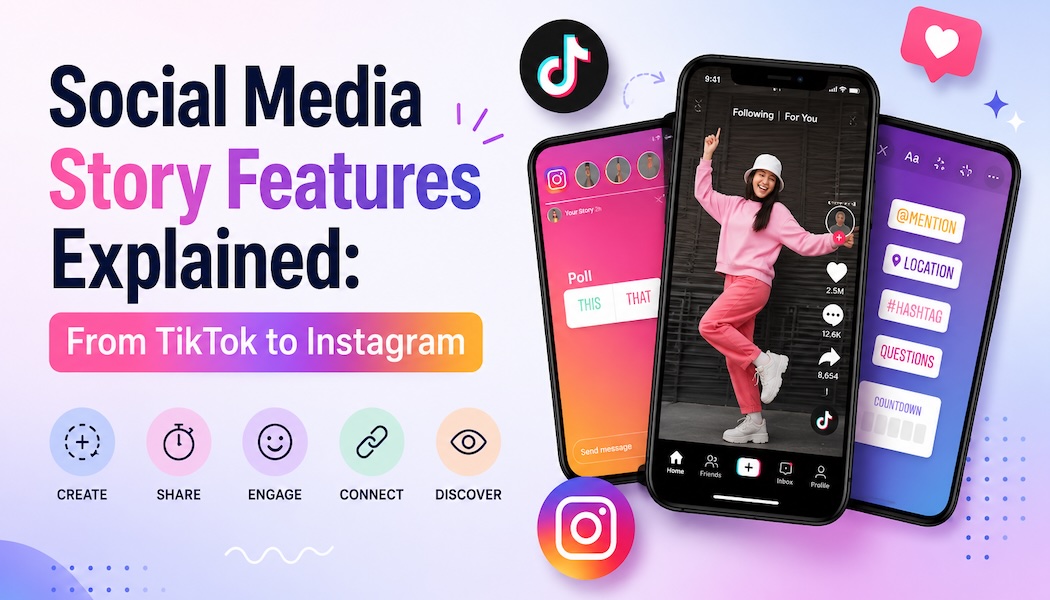
Social Media Story Features Explained: From TikTok to Instagram
Now, stories are shaping up to be one of the most powerful ‘formats' in the social media world, changing the way people capture moments, gather audiences and engage online. Once a minor quirk has become an essential component of virtually everything. But if you're anywhere from Instagram stories to TikTok's 'list', to listening to what Snapchat has in the works, you'll notice this format is rocked the landscape of how people use content, in favor of short, immersive, and temporary experiences over their feed posts.
Let's dive straight into the details of Stories on the various platforms, the differences between them, and their role and significance in digital communication.
The Types of Stories Format
Snapchat social media app is not very famous and popularized the Stories format, and it became popular thereafter as a way to create short-lived, vertical content that is deleted after 24 hours. It was a very different concept from more of the traditional, curated feeds that Instagram and Facebook used to have. It was an easy choice there: to Stories, Stories seemed more natural, spontaneous and authentic. To create just the right post was no longer a matter of concern as it would disappear the following day.
As younger people began flocking to Snapchat, Instagram did not sit idly by and quietly marveled at the success the app had created for children of its young audience.In 2016, Instagram began to realize that its younger users were acquainted with Snapchat and thus, it offered its own version of Snapchat Stories. This is one of the more remarkable feature replications that the tech industry has ever seen, because Instagram Stories gained immense popularity and even surpassed Snapchat's user base within a year of its launch.
Instagram Stories: The Standard-Setter
Many of the norms that we know today for Instagram stories emerged from Instagram Stories themselves. Users can upload photos or brief videos that vanish within 24 hours and users can add favorite Stories to Highlights so that they'll remain permanently on their profile.
Instagram has been adding on to the feature with:
- Interactive stickers: such as polls, quizzes, question boxes and sliders.
- The incorporation of music: in an audio format, where users could use pieces of music as a background.
- Personalization features: Text & Drawing Tools.
- Close Friends lists: lets people choose to share only select Stories with a specific and trusted set of recipients.
- Defines story replies and reactions: which are analogous to direct messages
The Chinese app also leverages Instagram Stories as a powerful marketing tool. Businesses use 'Swipe up' (usually link stickers) to increase the number of hits that their pages receive, and Stories ads are integrated between organic content making them great spots to advertise.
TikTok's Take on Stories
More recently, TikTok has launched its own story feature, in a parallel debut to short video feeds using its algorithm, in 2020. Tiktok story viewer social media app having a Stories option that functions quite differently from Instagram or Snapchat, as the popularity of the feature wasn't the focal point of TikTok; its For You Page already prioritized short snippets of engagement which disappear after 24 hours.
TikTok social media app stories are going to give creators a way to post the caption and content that only sticks around for 24 hours, which is makes it perfect that is used for posting lower effort content, personal updates or behind-the-scenes clips, without peoples are having to go to their social media profiles to find it. Enables to creators and writers to have a greater flexibility, for instance, to try out an idea or create more informal content information that is without the troubles linked to aesthetic or performance metrics in the main feed.
Ironically, TikTok's algorithm never locked a different behavior to it; it mimics Stories behavior in that videos can suddenly go viral but then go out of people's lives almost as fast.Interestingly, TikTok's main algorithm already adopts a similar behavior: videos can have a sudden viral surge and then vanish from the scene as quickly, giving it a similar feel of impermanence in main feed. For creator-led e-commerce brands capitalizing on these short-lived viral spikes, analyzing real-time consumer engagement through tools designed for trend discovery allows you to quickly align your content strategy with the products that are identified as peaking across social channels.
In the beginning, there was Snapchat.At the start, we have Snapchat
Stories continue to be at the heart of Snapchat's design. There is a need to focus on the Snap chat social media app that is having the feature of the Stories is authenticity and immediacy, with content often being unfussy and raw, such as snapshots, everyday moments, or brief video clips shared with friends. Beyond that, Snapchat launched some new elements such as:
- The geographical view of where friends' Stories were posted (Snap Map)
- Direct chat threads, aka Story replies
- Spotlight, a public feed of content, fashioned after TikTok's model.
Even as Instagram and TikTok story viewer hub have emerged as fierce rivals, Snapchat has been able to hold on to users especially because of its emphasis on more private and friend-based content sharing.
The Facebook apps, Stories and WhatsApp Stories are where it is found
Meta has rolled this Stories feature out to its other apps as well. Facebook Stories work pretty similarly to Instagram's, but have slightly fewer of them that engage. Facebook has a larger audience than Instagram, and they are typically older users that favor an old-school post style. In contrast, WhatsApp Status integrates Stories into the platform's messaging capabilities, with users having the ability to share snippets their contacts can see, but not to the wider group of strangers like on Instagram.
It is essential that stories have value and importance for the content creators and brands in question
Unlike a regular post, the transient nature of Stories will generate some sense of urgency and exclusivity. Viewers are aware that if they don't check a Story now, then it may not exist tomorrow. This has allowed Stories to be a useful tool in assisting with:
- Maximum communication of time sensitive promotions or announcements
- Creating a more personal connection with an audience.
- Trials on your ideas of content rather than a foray into full-time devotion.
- Using links for driving traffic, and interactive stickers.
- Marking up participation with poll questions/quizzes and direct responses
Being able to comprehend these differences is crucial for any creator with multiple platforms when formulating a solid content strategy. Content that's effective on TikTok may require reformatting for Instagram and the reverse is also true.
Final Thoughts
The proof is that stories have become more than a passing fad, they now are a staple communication method on virtually all social media platforms. Although the idea originated first with Snapchat, it was developed into a polished form by Instagram, and retranscribed to the algorithm-driven system by TikTok. The differences on each platform are a testament to their overall aesthetics, Snapchat opens up a new intimacy, Instagram a polished approach with commerce and TikTok an experimental and relaxed attitude.
With the ongoing advancements in social media, it's safe to predict that Stories will continue to grow and introduce fresh functions, like social interaction features, AI personalization, and increased commerce integration. At the moment, knowing the platforms' strategies for utilizing this format can aid creators and brands to connect with their audiences better.At present, knowing how each platform approaches this format can assist creators and brands in engaging their viewers/readers effectively.