The Future of Business Technology: SaaS vs Custom Software Explained
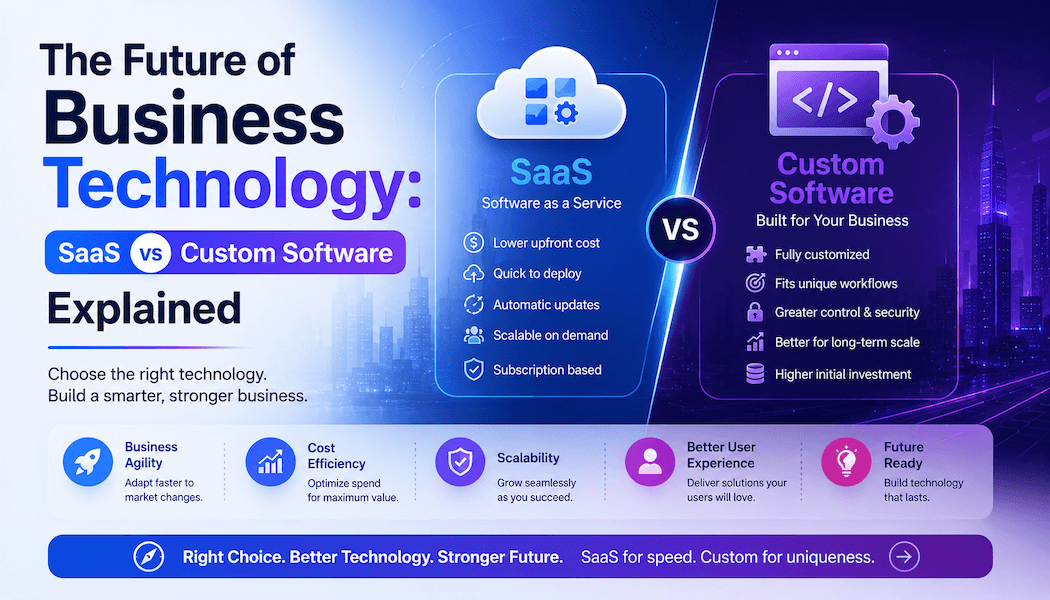
When companies discuss technology for their businesses, it comes down to one important question: Should I choose a "packaged" software service (one that has been created before) or invest in having a custom software development company that meets our specific needs? Both styles of software have great benefits to help improve processes, allow for the company to grow with the business and provide teams with the best tools to get their jobs done.
The challenge in deciding between the two methods isn't necessarily about which one is less expensive or faster; it is about matching core business goals (i.e. how the investment will help achieve the overall vision) with organizational culture, budget constraints, the company's long-term flexibility needs and changes occurring within the industry as businesses grow.
A new trend in software services has emerged - Software-as-a-Service (SaaS). Closed systems such as accounting, CRM, project management and human resources that have traditionally been handled by an organization have now been widely accepted to be used via web-based subscription services or phone apps, thus redefining what is expected from these services.
Core benefits include the ability to deploy quickly, know what the costs will be for future months/years due to having predictable/certain monthly fees, receive automatic updates to the applications, a marketplace of other web-based systems to integrate with and no longer have to spend time managing infrastructure, allowing the organization to focus on using their software versus developing their software, gives opportunities for all companies (small and medium size) to benefit from the same technology as larger organizations.
SaaS products are not perfect solutions for every company. Most SaaS products come with “general fit” functionality that encompasses a wide range of users but may not be 100% usable for any particular user’s business process. This is particularly the case when a business has custom business processes that do not fit into a general workflow.
If a business changes its business process to conform to the way that the SaaS vendor requires it to operate, it may lose efficiency and branding by doing so. Additionally, if a business wants to change from one SaaS vendor to another using a proprietary format, this can prove to be a difficult and costly endeavor.
Custom software, however, is designed around an organization’s unique business needs. Custom software can replicate and speed up unique business processes, will allow for seamless integration into existing business technologies, and has the capability of enforcing an organization’s specific security and compliance standards.
For a company that has specialized business processes and needs to maintain a competitive advantage with those processes, it is likely that a custom software solution will be justifiable over time.A quality custom software development company will assist you in transforming your business strategy into a technical design so that the finished product provides you with a measurable benefit.
Custom software development offers a greater degree of flexibility, but there are several tradeoffs involved. First, upfront costs for custom software can be substantially higher than those of software as a service (SaaS). Second, the time it takes to complete custom software development projects generally exceeds that of SaaS-based solutions typically requiring several months or even years to realize the end result.
Third, unless an organization has product leaders who can establish priorities, provide budget support for ongoing maintenance, and create a culture of ‘continuous improvement’ within their company, custom software development projects often run amok and turn into costly modifications to the original design without yielding anticipated results.
For many companies, implementing hybrid strategies is an effective alternative to 100% custom-built or 100% SaaS-based solutions. The majority of organizations utilize SaaS solutions for generic and low-complexity business functions such as providing email services, processing payrolls, and managing marketing campaigns, while leveraging custom-built software to gain a competitive edge through enhanced customer onboarding experiences, optimizing logistics processes, or providing advanced analytical capabilities to their customers.
Using both types of solutions allows companies to take advantage of both low-cost and high-reliability services for routine operations, and also deliver unique value to customers by providing them with bespoke solutions.
Speed of value is another key dimension. SaaS platforms allow for quick access to benefits as they can have an account set up, configured, and functional in no time. This speed provides a competitive advantage in fast-moving business environments and at the beginning stages of a company's growth when speed often matters more than perfection. On the other hand, the long-term return on investment for a custom-developed solution may be significantly higher due to lower manual process costs and an elimination of license fees, as well as the ability to modify a system for future use.
Security and compliance issues also influence the decision. Companies that purchase SaaS solution offerings from enterprise-grade vendors can have peace of mind that the vendor has invested heavily in creating a safe and secure environment (e.g., through multiple levels of security and extensive certifications), but the multi-tenant nature of the SaaS infrastructure may not meet the more rigorous requirements of regulatory or privacy-related compliance.
On the contrary, custom-built solutions can be developed to meet specific compliance requirements and to control the location of the data, giving the business more control over the management of secured data and maintaining that environment. However, this degree of control requires substantial resources to ensure that the company's custom-built system is secure and properly maintained.
Scalability should be evaluated in practical terms. Leading Software as a Service (SaaS) providers automatically scale to regions around the world, so their teams do not have to encode capacity into the systems. Custom-developed software can also scale, but only when it was originally developed with this capability and budgets exist to scale the supporting infrastructure as demand increases. Making plans to be able to expand in the future right from the start will prevent costly re-doing of the work from the start; however, it will also add to your initial development costs.
When looking at the relationship with the software vendor, the SaaS model is a transaction-based and service-oriented one; you purchase a package and rely upon the vendor to upgrade and support it. In contrast, custom development is a partnership in which the vendor becomes an extension of your business during development as well as ongoing support.
It is critical to engage with software vendors who can help you develop a solution to meet your needs and have the ability to evolve the product as your needs change. Therefore, ensure that you agree to what intellectual property will be owned both as part of the original contract as well as the service agreement and the expectations for both how frequently updates will be provided and the support to which you are entitled.
Using a decision framework is the best first step in developing a new SaaS application or custom development project by mapping your business processes. This will help you identify the areas of your business that have a direct impact on revenue and/or customer experience. You will also need to determine if the process area is a core component of your competitive advantage, in which case you should lean toward custom development.
In contrast, when there exists comparability among like products within an industry with no noticeable difference in value between them then The Software as a Service model should meet all of your needs. As you look at all of the solutions available to you calculate the total of all ownership costs associated with them by comparing all of your ongoing reoccurring monthly costs and consider any necessary customization expenses, support expenses after the implementation, and implementation expenses and have someone go through both solution providers to ensure they will minimize those as much as possible during the assigned timeframe (typically between 3 and 5 years).
Lastly, mindset is critical. SaaS allows you to iterate when you adopt new features, modify quickly based on experience, and change tools if they are not a fit. Custom development requires you to use a product development mentality by being highly selective in your priorities, investing in quality, and planning to enhance the product over time. Both mentalities can co-exist in the same organization; however, the key is to identify the best approach for each need and create governance to manage them both together.
Basically, SaaS and Custom Software are no longer a mutually exclusive option for the future of business technology, they’re a combination that aligns tools to your business strategy. Businesses that can clearly articulate what drives their value through proper funding between off-the-shelf solutions and custom-built systems will have greater agility in how they go to market, be more innovative over time and will be better positioned for resiliency as market conditions change.