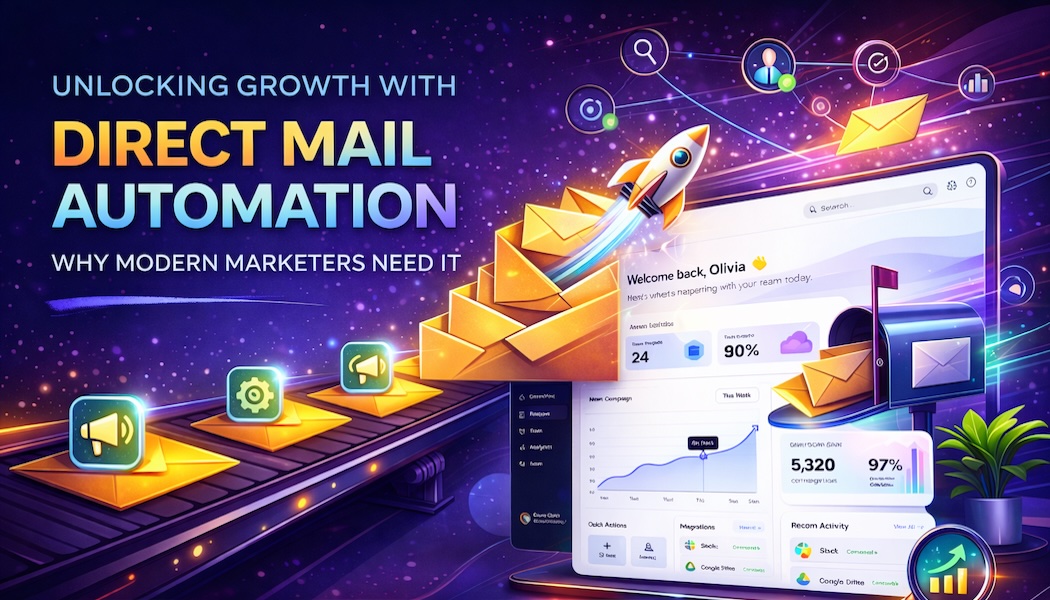
Unlocking Growth with Direct Mail Automation: Why Modern Marketers Need It
In today’s fast-paced digital world, it’s easy to assume that physical mail has lost its relevance. Yet, direct mail continues to deliver — quite literally. With rising competition in digital channels, marketers are rediscovering the power of tangible, personalized mail. But to use direct mail effectively in 2025, you need more than a printer and stamps. What truly moves the needle is direct mail automation software, backed by a robust direct mail API.
In this post, we’ll explore how modern automation tools — especially solutions like PostGrid — are transforming traditional mail into a scalable, cost-efficient, and high-impact marketing channel.
What Is Direct Mail Automation Software?
Direct mail automation software enables businesses to automate the entire lifecycle of physical mail campaigns, from design and personalization to printing, addressing, and shipping. Rather than managing manual processes (sorting spreadsheets, printing, stuffing envelopes), automation platforms let you:
- Create and manage mail templates (letters, postcards, invoices, checks)
- Set up trigger-based campaigns (e.g., welcome letters, thank-you notes, invoice reminders)
- Integrate with your CRM or marketing stack to sync customer data automatically
- Verify and clean customer addresses to reduce returned or undeliverable mail
- Track and analyze campaign performance through detailed dashboards
In short, direct mail automation brings the precision, speed, and measurability of modern digital marketing into the physical mail world.
The Role of a Direct Mail API in Automation
At the heart of direct mail automation software lies the direct mail API. A direct mail API lets your systems — CRM, e-commerce, customer database — communicate programmatically with a mail-automation provider. With PostGrid’s API, for example, you can:
- Send data from your CRM or application: Import names, addresses, and other contact data in real time to trigger mail.
- Use variable-data printing: Create highly personalized mailers tailored to each recipient — different names, images, messages — all via the API.
- Convert HTML to print-ready formats: PostGrid’s API can render your HTML templates into PDF for printing, making it easy to maintain your design flexibility.
- Auto-verify addresses: Before print, the API can validate addresses against postal databases to reduce misdeliveries or returned mail.
- Trigger campaigns programmatically: Whether you want to send a thank-you postcard after purchase, a statement when a payment fails, or a renewal reminder, you can set automated workflows.
- Monitor and analyze: Get delivery statuses, campaign analytics, and performance metrics via API or dashboard.
Through this seamless integration, companies can automate direct mail at scale, just like they automate emails or SMS.
Key Benefits of Using Direct Mail Automation
1. Save Time & Reduce Manual Work
Traditional direct mail campaigns can be labor-intensive: designing, printing, stuffing, addressing — it's a lot. Automation eliminates these repetitive tasks, letting you focus on strategy and creativity.
2. Improve Accuracy & Deliverability
Address verification via API means your mail goes to the right place. No more wasted budget on undeliverable or incorrectly addressed items.
3. Scale Campaigns Easily
Whether you're sending 10 or 10,000 mailers, scalable direct mail automation adapts to your volume. You can run both bulk and on-demand campaigns without logistical nightmares.
4. Personalize Every Piece
Using variable-data printing, your mailpieces can feel tailor-made for each recipient — increasing engagement and trust.
5. Triggered Campaigns for Better ROI
By integrating with your CRM, you can send mail based on customer actions or lifecycle events — for instance, cart abandonment, birthdays, renewals — maximizing relevance and ROI.
6. Cross-Channel Synergy
Automated direct mail doesn’t have to operate in isolation. You can integrate it with email, SMS, and digital campaigns to build a cohesive omnichannel marketing strategy.
7. Measurable Performance
Get insights into each piece of mail delivered, track campaign success, and use data to refine future automations and targeting.
Why PostGrid Stands Out
When it comes to direct mail automation software, PostGrid is one of the leading platforms. Here’s why businesses trust it:
- All-in-One Platform: From design to delivery, PostGrid supports letters, postcards, checks, invoices — everything you might need.
- Strong CRM Integrations: It integrates seamlessly with major CRMs and tools — HubSpot, Salesforce, ActiveCampaign, and more.
- Built-in Templates: You don’t need a designer — leverage PostGrid’s template library, or upload your own design.
- Address Verification: Leveraging postal authority databases, PostGrid ensures higher deliverability and reduces waste.
- Scalable & Flexible: Whether you’re sending one-off mailers or managing huge triggered campaigns, PostGrid handles it.
- Fast Turnaround: With a 2-business-day SLA for production, your mail goes out quickly.
- Security & Compliance: PostGrid is compliant for sensitive mail (HIPAA / PIPEDA), so transactional and confidential mail can be automated safely.
Use Cases: When to Use Direct Mail Automation
Direct mail automation isn’t just for big marketing campaigns. Here are practical use cases:
- Transactional Mail: Automate invoices, checks, statements, and receipts. With direct mail automation, you can ensure these important mailers are sent timely, securely, and with personalization.
- Triggered Marketing Campaigns: For drip campaigns, reminders, cart abandonment, or customer onboarding — automate direct mail to enhance your customer journey.
- Customer Retention: Use mail for birthdays, anniversaries, loyalty rewards — make customers feel valued.
- Regulated Industries: Highly regulated sectors (finance, healthcare) can benefit from direct mail API’s security and compliance for sensitive communications.
- Mass Marketing: Scale bulk mail campaigns cost-effectively by eliminating stock management, manual addressing, and logistics.
Best Practices for Implementing Direct Mail Automation
- Clean Your Data
Integrate your CRM with address validation to ensure that your mailing lists are accurate and up to date. This reduces cost and ensures better deliverability. - Design with Purpose
Use PostGrid’s templates or create your own. Define clear calls to action — whether it’s visiting a URL, scanning a QR code, or calling a number. - Use Triggered Campaigns Intelligently
Think beyond “send it all at once.” Set up triggers for key customer events (e.g., purchase, renewal, inactivity) to make mail relevant and timely. - Test and Iterate
Run A/B tests: different designs, different messages, different triggers. Use analytics to see what works best and refine your workflows. - Track & Analyze
Use PostGrid’s dashboard or pull data via API to monitor delivery status, campaign engagement, and ROI. Use this data to continuously optimize. - Ensure Compliance
If you’re sending sensitive or regulated mail, make sure your mail automation provider (like PostGrid) supports required compliance (e.g., HIPAA, PIPEDA).
Conclusion
In a world where inboxes are overloaded and digital ads are increasingly expensive, direct mail automation software offers a refreshing and effective alternative. By marrying the tangibility of physical mail with the scalability and precision of digital tools, you can create highly personalized, automated, and measurable campaigns.
And when paired with a powerful direct mail API, like the one from PostGrid, you get true end-to-end automation — from CRM integration to triggered campaigns, from address verification to analytics.
If you want to future-proof your marketing efforts, reduce manual workload, and generate better ROI through physical mail — automation is no longer optional. It’s essential.