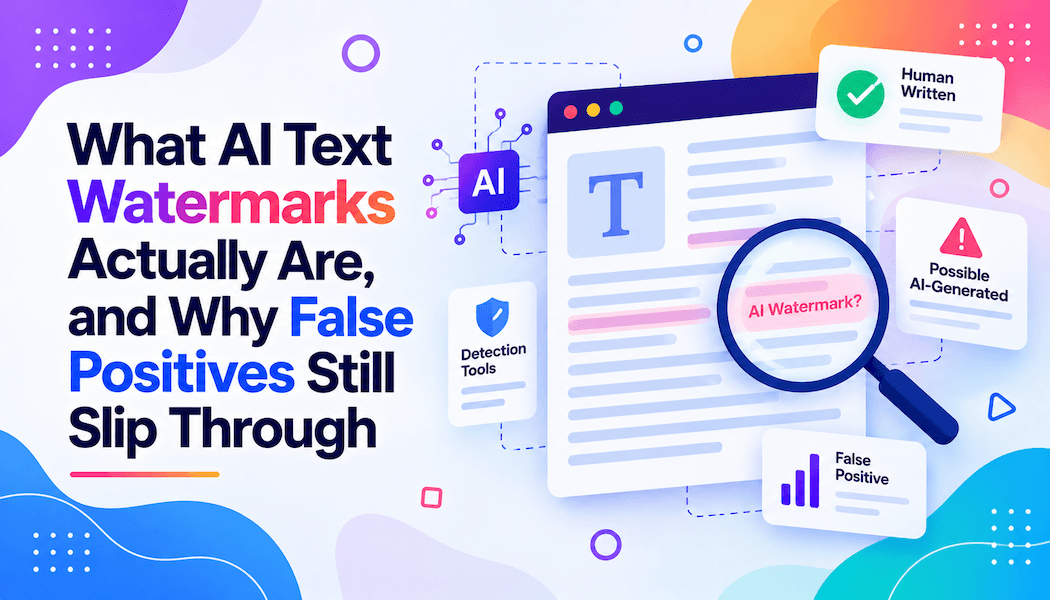
What AI Text Watermarks Actually Are, and Why False Positives Still Slip Through
A sentence can carry a signature nobody wrote and nobody can see. That is the basic idea behind AI text watermarking, a technique built to answer a question that has become harder to settle by the month: did a person write this, or did a model.
The answer matters for editors reviewing a client's draft, for journalists vetting a submission, and increasingly for ordinary writers who did the work themselves but still get flagged by a system checking for a pattern they never chose to leave behind.
The Signal Nobody Can See
Unlike a watermark on a photograph, a text watermark carries no visible mark at all. It is a statistical fingerprint folded into the choices a model makes while generating a sentence, invisible to a reader and, in most implementations, invisible to the writer using the tool. The idea is not new to text generation broadly; audio and image systems have used comparable techniques for years. What changed is that language models became good enough, and common enough, that regulators, publishers, and platforms all started asking for some way to trace where a piece of writing actually came from.
How a Watermark Gets Written Into a Sentence
Google's SynthID is the most documented example. Rather than adding anything after the fact, it works during generation itself, tilting the probability the model assigns to certain next-word choices in a way that stays invisible to a human reader but recoverable by a matching detector. The output of a check is not a flat yes or no. A detector running SynthID against a passage returns something closer to watermarked, not watermarked, or uncertain, because the signal is probabilistic rather than a fixed marker sitting in the file.
Why Detection Isn't Certain, Even When It's Right
That uncertainty is the point, not a flaw. A signal spread thinly across many small word choices is exactly what keeps the mark invisible in the first place. It also means the strength of the signal depends heavily on how much text a detector has to work with. A three-sentence excerpt carries far less signal than three full paragraphs, and a passage that has been heavily reworded carries less still. Independent research on SynthID has found that the watermark generally holds up under light editing and paraphrasing, but detection accuracy drops sharply once a passage goes through heavier rewriting, translation, or repeated round-trip edits.
Academic testing of SynthID against deliberate paraphrasing attacks has found the same pattern from a different angle: detection accuracy that sits close to perfect against unedited text can fall substantially once the passage is run through a paraphrasing tool or translated and translated back. The watermark is not being erased in these cases so much as diluted below the point where a detector can distinguish it from ordinary statistical noise.
What Happens When a Human Actually Rewrites the Text
This is where the false positive problem starts. A writer who takes an AI draft and substantially reworks it, restructures the argument, cuts half the sentences, adds original reporting, has done real editorial work. Watermark detection does not measure that effort. It measures a residual statistical pattern, and that pattern can survive lighter edits even when the resulting text reads as genuinely the writer's own. The people most exposed to this kind of misread are rarely the ones trying to hide anything:
-
Non-native English speakers, whose sentence structure already reads as more uniform to automated checkers, independent of any AI involvement.
-
Writers who lean on grammar and style tools, which can flatten the natural variation that checkers use as a signal of human writing.
-
Editors doing a quick check rather than a full rewrite, since detectable patterns track how much changed more than how carefully a piece was reviewed.
A 2023 study by Liang and colleagues, published in the journal Patterns, found that automated writing checkers misclassified non-native English writing as AI-generated at rates as high as 61 percent, even when every sentence had been written by a person. That number predates most current watermarking schemes specifically, but it captures the underlying problem: automated signals of AI-likeness and actual authorship are not the same thing, and the gap between them lands hardest on writers who were never trying to present something as other than what it was.
Cleaning up the residue that watermarking can leave behind, particularly in text that has already been substantively edited, is one of the more practical uses for a purpose-built AI text watermark remover built for that one step, rather than a general grammar check that was never designed to look for it.
Where the Major Labs Stand Right Now
The three largest model providers have taken different paths. Google has published SynthID in detail and made it central to its content provenance approach across text, image, and audio outputs. OpenAI has confirmed it built a comparable text watermarking method internally but has not released it broadly, citing concerns about robustness and the risk of uneven impact on writers working in a second language. Anthropic has not released a text watermarking system for Claude. None of these positions is fixed permanently, and any of them could shift with the next model release or the next regulatory deadline, so a status check made today is worth revisiting before treating it as settled a year from now.
The push for some technical way to signal machine-generated content has been building on the regulatory side too, not only inside the labs themselves. That broader momentum is one reason watermarking research has moved quickly over the past two years, even though the underlying methods are still far from settled.
Watermarking Is Not the Same Thing as Content Metadata
It helps to separate token-level watermarking from a second, unrelated approach: signed content metadata, of which C2PA Content Credentials is the best-known example. Metadata-based provenance attaches a cryptographically signed record to a file itself, noting how and when it was created, rather than folding any signal into the words. The two approaches solve different problems. A signed credential can be trusted the way a notarized document can, but it only travels with the file; copy the plain text out of it and the credential is gone. A statistical watermark travels with the words themselves regardless of file format, but carries no cryptographic guarantee and can weaken with enough editing. Coverage of AI content provenance sometimes treats these as interchangeable when they are better understood as two separate layers, each with its own failure mode.
Cleaning Up After the Edit
Separate from watermarking itself, a wave of unrelated invisible Unicode characters, zero-width spaces and non-standard spacing marks among them, has shown up in output from several chat tools over the past year. Researchers who studied the pattern concluded these are most likely artifacts of how the underlying models were trained on richly formatted text, not a deliberate tracking mechanism, but they cause real, mundane problems anyway: broken search-and-replace, garbled code comments, and formatting that looks fine on screen and behaves strangely once pasted into a CMS or a Word document.
For a writer or editor dealing with both issues at once, statistical residue in a heavily AI-assisted passage and stray invisible characters in anything copied from a chat window, the practical fix looks the same either way: run the passage through a cleanup step built for exactly that job rather than manually hunting for a character that cannot be seen. For teams already juggling more than one writing tool in a single pipeline, that cleanup step sits inside Phrasly AI alongside the detector and the rest of the writing suite, rather than requiring a separate subscription for just this one part of the process.
None of this changes what actually matters about a piece of writing: whether the argument holds up, whether the facts are right, and whether the person whose name is on it did the work of making it good. Watermarking and its side effects sit underneath that question as a technical layer, not a substitute for answering it. Understanding how the layer works, and where it tends to misfire, is what keeps an editor from mistaking a statistical artifact for a verdict on someone's honesty.