What If Your AI Agent Could Do the Work Instead of Just Telling You What to Do?
For years, AI has been an excellent advisor. It can summarize reports, draft emails, explain complex topics, and suggest next steps. But a new kind of AI is changing the question from “What should I do?” to “Would you like me to do it for you?”
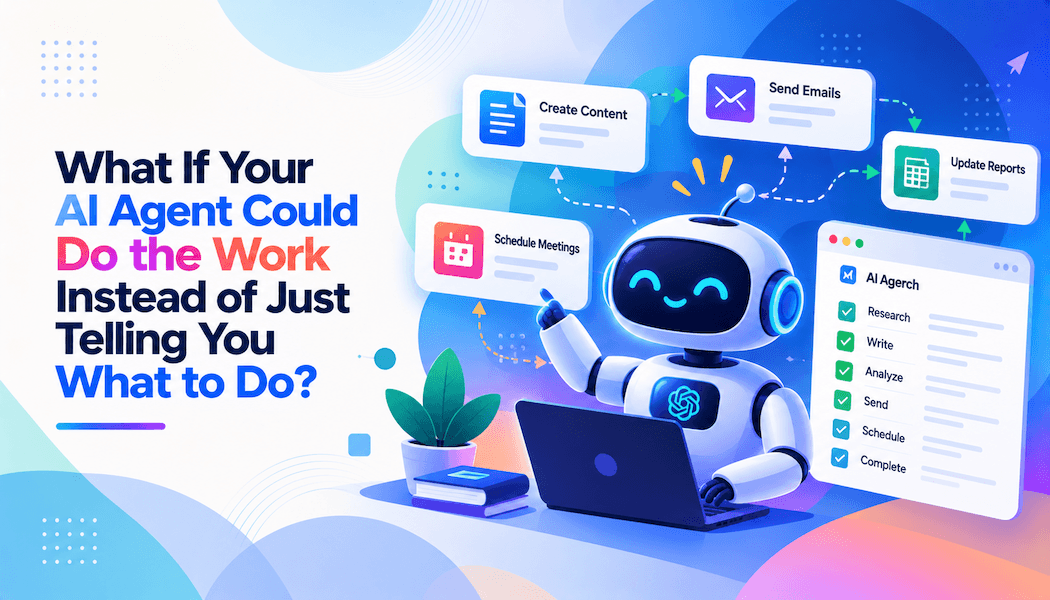
That shift is the promise of AI agent and agentic AI: software that can understand a goal, break it into steps, use tools, take action, check the result, and adapt when something changes. Instead of merely offering recommendations, an AI agent can carry a task forward within the boundaries you set.
From Advice to Action
Most people already use AI as a conversational assistant. You ask for a marketing plan, and it gives you a list of ideas. You ask for an email draft, and it writes one. You ask for a competitor analysis, and it returns a summary.
That is useful, but the work is still yours. You must copy the output into another tool, research the missing details, make decisions, update spreadsheets, send messages, and monitor progress.
An AI agent works differently. Rather than stopping at a recommendation, it can connect to the systems needed to complete the workflow. For example, instead of telling you how to improve a slow sales pipeline, an agent could review CRM records, identify stalled opportunities, draft follow-up messages, schedule reminders, and prepare a weekly performance report for your review.
The difference is not that the agent is “smarter” in every situation. The difference is that it has agency: the ability to pursue an outcome through multiple actions rather than respond once and wait.
What Is an AI Agent?
An AI agent is a software system that can perceive information, reason about a goal, plan a sequence of actions, use external tools, and adjust based on feedback. It may read documents, query databases, call APIs, browse approved websites, run code, update files, or communicate with other software systems.
A simple way to understand it is this:
| Type of AI | What it does | Example |
| Generative AI | Creates content from a prompt | Writes a product description |
| AI assistant | Answers questions and gives recommendations | Suggests ways to reduce customer churn |
| AI agent | Plans and executes steps toward a goal | Identifies at-risk customers, drafts outreach, schedules follow-ups, and reports results |
| Agentic AI system | Coordinates multiple agents for complex work | One agent analyzes data, another drafts content, another checks compliance, and an orchestrator manages the workflow |
Generative AI is often the “thinking” layer that creates text, images, code, or analysis. Agentic AI adds planning, memory, tool access, and execution so that the output can become real work.
How an AI Agent Works
Most capable agents follow a repeating loop: perceive, reason, act, and reflect. They gather context, decide what to do next, perform an action, evaluate the result, and revise their approach if needed.
1. Understand the goal
The agent begins with an objective, such as: “Prepare a monthly performance report for our sales team and flag accounts that need attention.”
A good goal includes the desired outcome, relevant constraints, and a definition of success. For instance, the agent may be told to use only approved data sources, avoid contacting customers directly, and escalate unusual findings to a human.
2. Gather context
Next, the agent collects the information it needs. It might pull CRM data, review recent support tickets, check inventory levels, read project documents, or analyze website analytics. The quality of this context matters enormously: incomplete, outdated, or poorly structured data can lead to poor decisions.
3. Plan the work
The agent breaks the larger objective into smaller tasks. For a sales report, it might identify data sources, calculate conversion rates, compare performance by region, detect unusual changes, draft insights, and format the final report.
This is where agents differ from traditional automation. A conventional workflow follows a fixed script. An agent can adjust its plan when it discovers something unexpected, such as missing data, a failed integration, or an unusual pattern in the results.
4. Take action
The agent then uses tools to do the work. It may query a database, generate a chart, write a draft, update a project board, create a ticket, or send a notification. The exact actions depend on the permissions and integrations the organization has granted.
5. Check and improve
After acting, the agent evaluates whether the result moved it closer to the goal. If a report contains an error, a test fails, or an API returns incomplete information, it can retry, revise its approach, or ask a person for help. This feedback loop is what makes agentic systems more flexible than rigid automation.
A Practical Example
Imagine a small e-commerce business facing a sudden delay from its main supplier.
A traditional AI assistant might explain the situation: “Your supplier is delayed. Consider contacting alternative vendors.”
An AI agent could do much more:
- Detect the delayed shipment through an inventory or logistics integration.
- Check which products will be affected and estimate the stock-out risk.
- Search approved supplier catalogs for alternatives.
- Compare price, delivery time, minimum order quantity, and reviews.
- Prepare a short comparison for the business owner.
- Draft a purchase order for the preferred option.
- Pause for approval before placing the order or sending payment.
The human remains in charge of the important decision, but the agent removes hours of searching, comparing, copying data, and coordinating. This is the real value of agentic AI: it handles the operational middle of a workflow so people can focus on judgment, strategy, and relationships.
Why This Matters for Businesses
The biggest benefit of AI agents is not simply speed. It is the ability to redesign work around outcomes rather than manual handoffs.
Less coordination burden
Much of modern knowledge work is not difficult because any single task is hard. It becomes tiring because people must move between tools, gather context, update records, follow up, and keep everyone informed. Agents can absorb much of that coordination overhead.
More time for high-value work
When agents handle repetitive execution, employees can spend more time on decisions that require experience, creativity, empathy, and accountability. Research cited by Anthropic found that organizations expect agents to shift employee time toward strategic work, relationship building, and skill development rather than routine execution.
Consistency at scale
A well-designed agent can apply the same checklist, data rules, and quality standards every time. This can be especially valuable for repetitive processes such as report generation, invoice processing, customer-service triage, onboarding, quality checks, and software testing.
Faster response times
Agents can monitor systems continuously and respond when conditions change. In supply chains, for example, an agent could notice a shipping delay, evaluate alternatives, and recommend or initiate a corrective action before the issue becomes a customer-facing problem.
Where AI Agents Can Help
AI agents are not limited to one industry. They are most useful in workflows that involve multiple steps, clear success criteria, and a need to connect information across systems.
- Customer support: Resolve routine requests, look up order details, draft responses, escalate complex cases, and update CRM records.
- Sales and marketing: Research prospects, personalize outreach, update pipelines, analyze campaign performance, and prepare reports.
- Reconcile transactions, flag anomalies, prepare summaries, and support compliance reviews with human approval.
- Human resources: Screen applications against defined criteria, schedule interviews, answer policy questions, and organize onboarding tasks.
- Software development: Investigate bugs, write code, run tests, review failures, and prepare pull requests for developer review.
- Operations and logistics: Monitor inventory, forecast demand, identify delays, and recommend supply-chain adjustments.
The Human Role Still Matters
The most important word in agentic AI is not “autonomous.” It is bounded.
An agent should not have unlimited permission to email customers, move money, delete records, deploy software, or make high-impact decisions. Responsible deployments use clear permission boundaries, approval checkpoints, audit logs, validation rules, and human review for consequential actions.
For example, an agent may be allowed to analyze a customer complaint and draft a resolution. But before it issues a refund, cancels an order, or sends a legal response, it should pause for human approval. This approach is often called human-in-the-loop or human-on-the-loop, depending on how much control the person retains.
The goal is not to remove people from work. It is to move people away from repetitive execution and toward the decisions only people should make: setting priorities, resolving ambiguity, managing exceptions, exercising ethical judgment, and taking responsibility for outcomes.
Risks to Manage
AI agents create new risks because they do not just generate text; they can take actions in real systems. A wrong recommendation is inconvenient. A wrong action can be expensive.
Key risks include:
- Incorrect information: An agent may produce a confident but inaccurate answer and then act on it.
- Tool misuse: It may call the right tool with the wrong inputs or choose an unsuitable action.
- Security and privacy: Broad access to business systems can expose sensitive data if permissions are poorly managed.
- Scope creep: An agent may take actions beyond the original task if its boundaries are unclear.
- Accountability gaps: Teams must know who is responsible when an automated workflow causes an error.
The solution is not to avoid agents. It is to design them carefully. Start with low-risk workflows, use least-privilege access, log every important action, test outcomes against clear criteria, and require approval before irreversible actions.
How to Start Using AI Agents
You do not need to automate your entire business on day one. The best approach is to begin with one workflow that is repetitive, measurable, and relatively safe.
- Choose a narrow use case. Start with something such as drafting weekly reports, triaging support tickets, or researching sales leads.
- Define the outcome. State what “done” looks like, including quality standards and exclusions.
- Connect only necessary tools. Give the agent the minimum access it needs to complete the task.
- Add guardrails. Set rules for what the agent may do independently and what requires approval.
- Run a pilot. Review outputs closely, measure accuracy, time saved, error rates, and user feedback.
- Expand gradually. Once the workflow is reliable, extend it to related tasks or additional teams.
The Future of Work Is Delegated
The next phase of AI will not be defined by better chat windows alone. It will be defined by systems that can take a goal and move it toward completion while people provide direction, oversight, and final judgment.
That changes the role of the professional. Instead of spending the day collecting data, updating systems, chasing follow-ups, and assembling reports, people can spend more time deciding what matters, interpreting results, building relationships, and solving problems that require human insight.
AI agents will not replace good judgment. They will amplify it. The organizations that succeed will not simply ask AI for answers; they will learn how to delegate work safely, measure results honestly, and keep humans accountable for the outcomes.