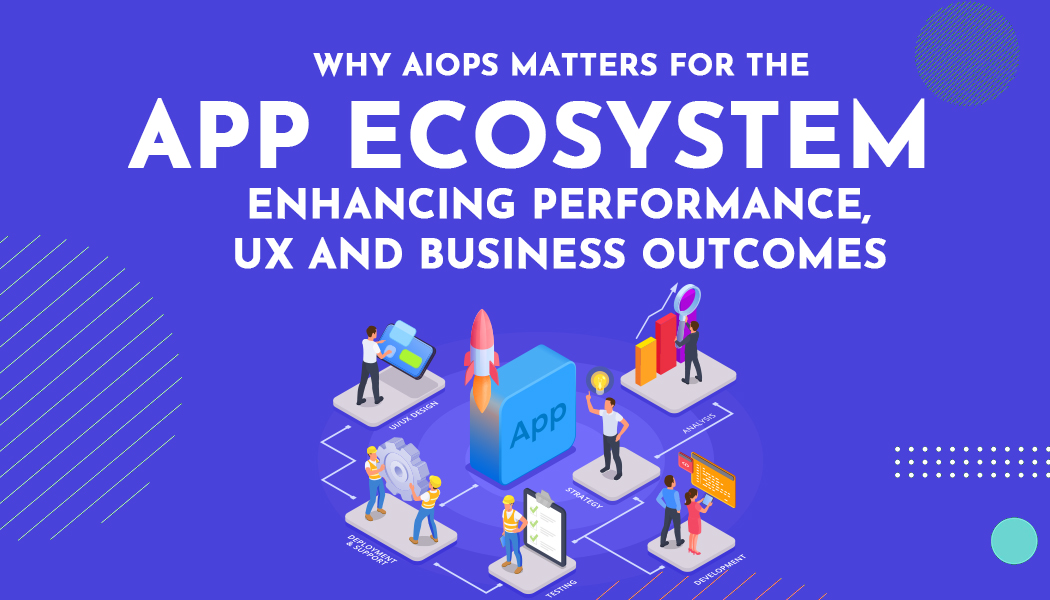
Why AIOps Matters for the App Ecosystem: Enhancing Performance, UX and Business Outcomes
One of the biggest challenges that the IT industry faces today is maintaining the optimal performance and user experience (UX) of applications whose complexities have been increasing drastically due to cloud infrastructures, microservices, and APIs. Artificial Intelligence for IT Operations (AIOps) is becoming the main instrument to overcome these difficulties by using AI and machine learning to automate the monitoring of system performance, identify issues, and deal with them in real-time without human intervention.
Besides its function of facilitating efficient operation of the app, according to Pristine Market Insights, the security aspect, which has been getting more and more attention, is having a major impact on the artificial intelligence for IT operations (AIOps) market, as companies are looking for solutions that not only give them operational efficiency but also protect them from the continuously evolving cyber threats. This article discusses how AIOps facilitates app performance, UX, and business success.
The Growing Complexity of Application Environments
One of the major factors contributing to the rapid explosion of app ecosystems over the last few years is the usage of cloud services, microservices, and hybrid IT environments. With this complicated system, it is extremely difficult to maintain consistent performance, to have issue resolution done in a quick manner, and to guarantee an excellent user experience across various platforms. It has been shown that traditional IT operations relying on manual monitoring and siloed tools have failed to meet these challenges, hence the introduction of AIOps in contemporary companies.
What is AIOps?
AIOps is a combination of AI, machine learning, and data analytics technologies that aims at performance monitoring, anomaly detection, and issue resolution automation in IT organisations. To do so, AIOps scours through a massive amount of data and then identifies patterns and reacts in real time to prevent potential problems. Some of the main sources of data are logs, metrics, and traces, but it also uses structured and unstructured data. Event correlation, predictive analytics, and automated remediation are examples of how AIOps can help a company extend its operational efficiencies as well as deliver better user experience and improve app performance.
Enhancing App Performance with AIOps
AIOps is really instrumental in upgrading app performance through its incessant surveillance of app behaviour, pinpointing bottlenecks, and rectifying any potential issues that may be caused by AIOps before the end-users are impacted. Using AI-driven predictive analytics, AIOps is able to locate it in advance when there will be system failures, performance degradation, or capacity issues so that the affected businesses can take a proactive, preemptive measure. This, therefore, not only cuts the time when the system is down but also assures app performance in a more efficient way. By way of illustration, AIOps may be used to balance automatically the load among different servers, improve resource allocation, and foresee errors happening on the basis of past data so as to enable errors to be solved quickly. Such functions concertedly work to ensure that applications remain highly available, lower the response times, and offer a more seamless user experience so that the applications will be able to perform at their best even at a time when there is peak usage or in a complicated environment.
Improving User Experience (UX) with AIOps
AIOps greatly changes the user experience (UX) as it allows the issues to be solved at a fast rate, which is the cause of end users' problems, such as slow response time or service disruptions. With the help of real-time anomaly detection, AIOps is able to locate irregularities in a flash and can also directly initiate the necessary actions, thus shortening the time of the failure and ensuring continuous service. This results in users getting a more stable and reliable experience, which leads to their satisfaction being raised. In addition, AIOps plays a major part in the process of making the app accessible and minimising the delay problem by utilising efficient resource allocation and load balancing. On top of that, it gives a user experience that is more personalized and customised because the backend systems and data flow are managed in a way that is not only efficient but also the most effective, hence the apps being in a good operational state, capable of adapting to the needs of users, and can be scaled with a load of request coming from users are guaranteed.
Impact on Business Outcomes
AIOps is an essential factor that directly influences business results as it goes ahead with the different mixes of the reduction of downtime, speeding up issue resolutions, and enhancing app performance. Along with that, money is saved as a result of the automation process, which is an indirect way of reducing operational costs and the overall efficiency level of the organisation. Besides that, AIOps is the primary enabler of fantastic user experience (UX) because it assures high availability, low latency, and stable performance, thus customer satisfaction reaches its peak. Consequently, customer loyalty gets even more solidified, and the new revenue streams' way is being paved, which makes AIOps a valuable resource for business continuation and expansion in the coming time.
Conclusion:
AIOps is a must for the very best to happen with the app, to make the user experience perfect, and finally to lead business success. In effect, through the automation of operations, the system's performance gets upgraded, and in addition, AIOps protects the system from security threats; hence, it is the main reason why the business can maintain its growth and stay ahead of the competition.