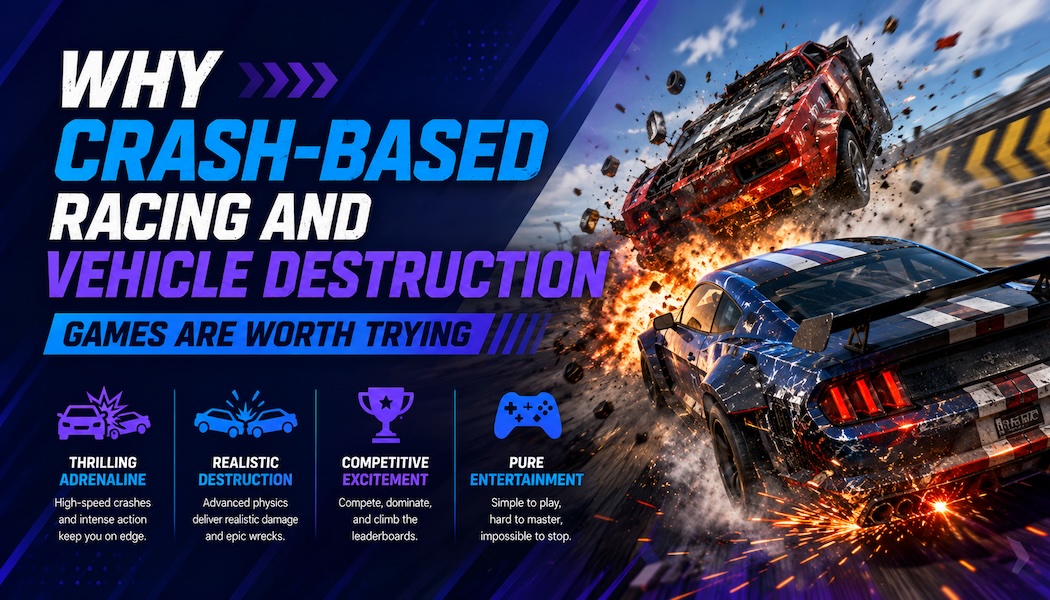
Why Crash-Based Racing and Vehicle Destruction Games Are Worth Trying
In recent years, crash-based racing and vehicle destruction games have become a recognizable niche in the gaming world. This video-game direction, in which the action focuses on simulated accidents, collisions and spectacular destruction, attracts players who are interested not only in speed but also in physics, chaos and visible consequences. As noted in materials related to CrashGamblers, interest in crash-based formats continues to grow because they combine simple visual appeal with strong emotional feedback. Why do players become interested in these games, and how do they differ from other racing, action and simulation genres? The answer reveals a broad range of historical, technical and emotional factors that may interest not only experienced players but also those who are just beginning to explore the unusual world of virtual disasters.
How crash-based racing and vehicle destruction games differ from other genres
Crash-based racing and vehicle destruction games are a special kind of video game in which accidents and destruction, most often in an automotive setting, are central. Unlike classic racing games, victory at the finish line does not always matter here. The main task may be to survive a derby, cause maximum damage, test vehicle behavior or enjoy chaos, spectacular collisions and the skillful use of physics. Arcade racing usually focuses on speed and agility, while crash-based games focus more on spectacle, impact and the consequences of risky decisions.
This is where their uniqueness lies for many players: they provide a chance to experience dangerous situations in a safe fictional environment where the consequences of accidents do not go beyond the screen. At the same time, it is better not to treat these games as a guaranteed form of emotional release. For some users, they work as short-term entertainment and a way to switch attention; for others, the appeal is more technical, competitive or creative.
Why crash-based games appeared and became popular
The roots of crash-based racing and vehicle destruction games are connected with the wider development of racing games, arcade driving and demolition-derby entertainment. Players encountered many key destruction-focused racing games through the same global PC and console wave that shaped other racing subgenres. Cult series and titles such as Destruction Derby, Carmageddon, Burnout and FlatOut helped establish the idea that crashing could be more than a mistake: it could become a goal, a scoring system, a tactical move or the main source of spectacle.
The appeal of spectacular accidents, stylized destruction physics and chaotic driving gradually formed a separate direction within racing and vehicle-based games. Some projects leaned toward arcade fun, where crashes were exaggerated and cinematic. Others moved closer to simulation, where mass, speed, impact angle and vehicle structure became important parts of the experience. Later, games such as Wreckfest and BeamNG.drive developed these ideas in different ways: one through competitive full-contact racing, the other through sandbox physics and crash experimentation.
This variety explains why the genre continues to attract attention. Players do not all come for the same reason. Some want a fast and funny arcade experience. Others enjoy technical crash testing. Some are interested in multiplayer demolition battles, while others prefer building custom scenarios, watching replays and experimenting with unusual vehicle setups.
Car culture and the appeal of safe extreme situations
Driving culture, motorsport, car videos and accident-analysis content all help explain why vehicle destruction games remain interesting. Cars are familiar objects, so watching them deform, lose control or survive extreme situations is easy to understand even without deep gaming experience. The player does not need a complicated fantasy world or a long tutorial to understand what happened after a crash: speed, impact and damage are immediately visible.
For many players, crash-based games offer a way to feel the thrill of racing without risking health or a real vehicle. They can test dangerous situations, make reckless decisions and watch consequences unfold in a controlled digital space. This does not mean that such games should be treated as realistic driving education or as a model for real road behavior. Their main purpose is entertainment, although simulation-focused projects can sometimes help demonstrate basic physical principles such as speed, mass, impact angle and vehicle instability.
Online races, community challenges and informal tournaments can also strengthen interest in such games. However, this should not be confused with a large professional esports scene. The genre works well for competitive communities and shared events, but its strongest appeal usually comes from spectacle, unpredictability and user-generated moments rather than from strict professional competition.
Which crash-based games players like
The market for crash-based racing and vehicle destruction games is diverse. Among the most recognizable projects are FlatOut: Ultimate Carnage, Wreckfest, Burnout Paradise and BeamNG.drive. These games stand out thanks to:
Realistic or stylized destruction physics
- A wide choice of cars, tracks and arenas
- The possibility of competition in multiplayer modes
- A strong focus on replayable crashes, risky driving and visible consequences
Arcade and action-racing titles such as Burnout Paradise or Split/Second offer lighter and more cinematic gameplay. They focus on quick reaction, speed, spectacle and dramatic set pieces without requiring deep knowledge of vehicle simulation. In such games, destruction is often designed to be readable, fast and entertaining rather than fully realistic.
Wreckfest appeals to players who want competition, derby arenas and rough multiplayer races. It represents the full-contact racing side of the genre, where body damage, car upgrades, track position and aggressive contact all matter. BeamNG.drive appeals to players who want physics experiments, crash testing, custom scenarios and sandbox freedom. Its advanced damage model accounts for vehicle behavior in much greater detail, making it especially interesting for those who look not only for spectacle but also for technical credibility.
Where fans of vehicle destruction games meet
Communities of crash-based racing and vehicle destruction game players include Steam discussions, Discord servers, Reddit communities, YouTube channels, Twitch streams, Facebook groups and dedicated gaming forums. Participants discuss favorite games, share tips on vehicle tuning, publish recordings of the most spectacular crashes and organize their own challenges or informal competitions.
Streamers and video creators play a special role because crash-based games are naturally suitable for short, memorable clips. A viewer does not need to know all the rules of the game to enjoy a dramatic pile-up, a ridiculous physics bug, a perfect takedown or a car barely crossing the finish line after heavy damage. This makes the genre especially strong in video content, where unexpected moments are often more valuable than perfect driving.
Community activity also helps extend the life of these games. Players create custom tracks, modify vehicles, design crash scenarios and test strange combinations that developers may never have planned. This is especially important for sandbox-oriented projects, where user creativity can become almost as important as the original content.
The role of developers and simulation-focused studios in the genre
Specialized developers play an important role in the development of crash-based racing and vehicle destruction games. Some studios focus on arcade spectacle, others on full-contact competition, and others on technical simulation. This variety makes the genre broader than simple “games about smashing cars.”
In full-contact racing games, developers usually work on car handling, damage feedback, multiplayer stability, progression systems and race structure. In sandbox-style projects, the focus shifts toward physics, modding tools, scenario creation and support for community experiments. These are different production models, even if both involve crashes and vehicle damage.
Automotive and technical themes also appear in related simulator genres, such as car repair, driving education or vehicle testing. However, these should not be confused with crash-based racing itself. A car mechanic simulator, for example, may share an interest in vehicles and technical detail, but it is not the same as a destruction-focused racing game. The strongest crash-based projects are those where vehicle damage directly supports the main gameplay loop instead of appearing as a decorative feature.
Technological and gameplay trends for the future
Judging by current genre development, crash-based racing and vehicle destruction games are likely to move toward more detailed damage systems, better performance and stronger community tools. Improved graphics and lighting can make crashes more impressive, but visual quality alone is not enough. What matters more is whether destruction affects handling, race outcome, player choice and replayability.
Future development is more likely to depend on better physics, component-based vehicle damage, smarter AI opponents, stronger mod support, replay tools and stable multiplayer than on VR becoming a standard feature. VR may be useful for selected cockpit experiences or controlled simulation projects, but fast crashes, sudden camera movement and repeated impacts can be uncomfortable for many players. For most projects, traditional screens will remain the more practical format.
Developers are also likely to continue experimenting with cross-platform features, asynchronous challenges, custom scenarios and community competitions. These tools can attract new players without forcing every game to become a strict racing simulator or professional esport. The genre works best when players can choose their own style: compete, experiment, build, destroy, record or simply enjoy short chaotic sessions.
Choosing your first crash-based game without making a mistake
Beginners are advised to start with games that offer a friendly interface, clear controls and enough structure to avoid confusion. These include FlatOut 2, Burnout Paradise Remastered and Wreckfest. When choosing a platform, it is worth considering not only technical parameters, such as minimum CPU and graphics-card requirements, but also the presence of multiplayer modes, replay tools, mod support and difficulty settings.
Before moving on to high-difficulty simulators, it is worth mastering basic control skills such as avoiding collisions, using nitro or boost, understanding track specifics and reading vehicle behavior after damage. More simulation-focused projects can be fascinating, but they may feel overwhelming if the player expects only simple arcade racing.
Here are a few tips for a successful start:
Practice controls in training levels and do not rush into online matches
- Use replay mode to analyze your own mistakes
- Do not forget to experiment with car settings and choose a comfortable difficulty level
- Start with arcade or full-contact racing before moving into complex physics sandboxes
- Check whether the game has active community content, because mods and custom tracks can greatly extend replayability
Is the genre worth trying?
Crash-based racing and vehicle destruction games are worth trying for players who enjoy racing, cars, physics, risky maneuvers, sandbox experiments or short sessions built around visible results. The genre is especially suitable for those who like games where failure can be funny, useful or spectacular rather than simply frustrating.
At the same time, the genre is not for everyone. Players looking for deep storytelling, calm pacing or strict realism may find some crash-based games repetitive or chaotic. Hardware requirements can also be a problem in projects with advanced physics and detailed vehicle deformation. Younger players may enjoy the spectacle, but it is important to treat these games as fictional entertainment rather than as a model for real driving behavior.
Such games can become shared entertainment for older children, teenagers and adults, especially when players understand the difference between arcade chaos and real road safety. They can also become a starting point for discussing why speed, mass and careless driving matter, but they should not replace proper traffic education or responsible driving habits.
Thus, crash-based racing and vehicle destruction games are not only entertainment built around smashing cars. At their best, they combine speed, physics, creativity, competition and experimentation. They appeal to different types of players because they offer more than one fantasy: winning a rough race, surviving a derby, testing a vehicle, creating a strange scenario or simply watching virtual machines break in ways that are surprising, funny and technically impressive.