Description
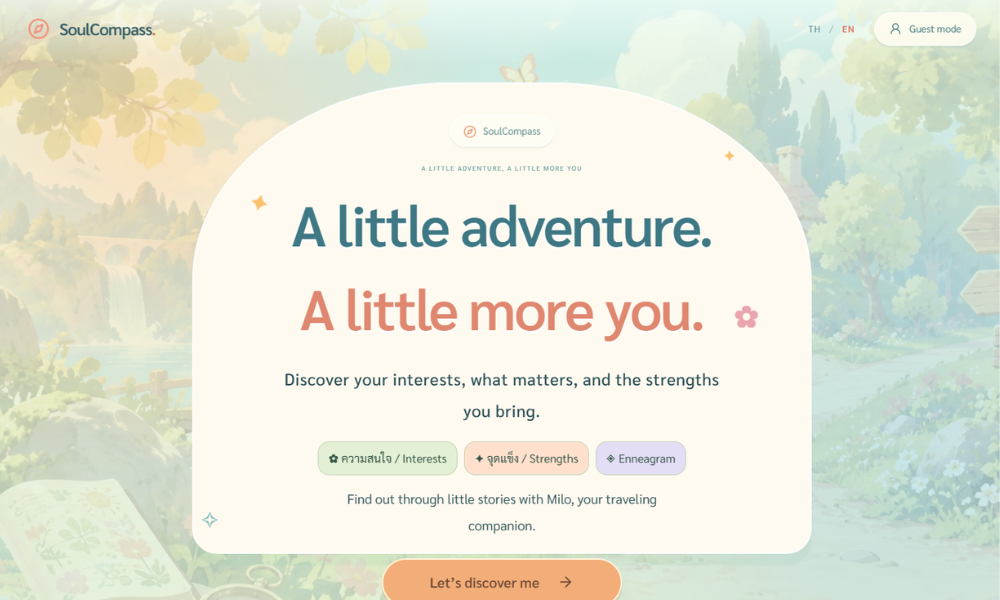
What if discovering yourself felt like an adventure, rather than taking a test?
SOULCOMPASS was inspired by a simple thought: learning about yourself should not feel like sitting in front of a questionnaire and choosing answers from a list.
Especially during adolescence, questions such as “Who am I?”, “What am I good at?”, and “Where do I belong?” can be difficult to answer directly. I wanted to design something that made these questions feel less intimidating and more like a journey—one where users could explore themselves through choices, situations, and stories.
That idea shaped SOULCOMPASS into a gamified self-exploration experience.
Instead of presenting psychological concepts as a conventional assessment, the website places users inside a journey. They encounter different situations, make choices, and gradually reveal patterns in what they value, how they respond to challenges, where their strengths may lie, and what kinds of environments or activities may suit them.
The visual design follows the same philosophy. I wanted the interface to feel like entering a small RPG world rather than opening an assessment form. Each stage represents another part of the journey, while illustrations, environments, interactive choices, transitions, and animations create a sense of progression and discovery.
The storytelling was also designed intentionally. Rather than asking users directly to describe their personality, scenarios give them something to react to. This makes each choice feel like part of the story while still encouraging users to reflect on themselves.
Behind the journey, SOULCOMPASS draws inspiration from psychological frameworks related to identity development, character strengths, coping, and vocational interests, including Erikson’s concept of identity development, VIA Character Strengths, coping mechanisms, and Holland’s RIASEC model.
At the end, these different parts come together in a Character Card. Instead of reducing the user to a single score or label, the card presents several dimensions of their journey—such as strengths, personal tendencies, coping suggestions, and possible areas of interest. It is designed as a starting point for reflection rather than a definition of who someone is.
For me, one of the most important design questions throughout this project was:
How can psychology become something people want to explore, rather than something they feel they are being tested on?
That question influenced everything—from transforming questions into scenarios, to designing the journey as an adventure, to turning the final results into a character the user has gradually discovered.
SOULCOMPASS is therefore not intended to tell someone exactly who they are. It is designed to give them a compass: a playful starting point for asking better questions about themselves and deciding where they may want to explore next.
Related Websites
-
Aaditri Technology
by Aaditri Technology
2954 -
The Hermes Community
by thehermescommunity
522 -
FitMantra
by HerMantra
1102