TextSpeed
by Textspeed technology Private limited
Description
WhatsApp Business API: Turning Customer Conversations Into Business Growth
Customers increasingly expect businesses to respond quickly, provide useful information, and make communication simple. Traditional channels such as email and phone calls still have their place, but messaging has become an important part of the customer journey.
This is where the WhatsApp Business API can become a powerful business communication layer.
Instead of managing every customer conversation manually, businesses can connect WhatsApp with their CRM, website, chatbot, support platform, lead forms, payment systems, and internal workflows. The result is a more structured approach to customer communication that can support sales, marketing, notifications, and customer service.
What Is WhatsApp Business API?
The WhatsApp Business API is designed for businesses that need to communicate with customers at scale through software and integrations.
Unlike the regular WhatsApp Business application, the API does not function as a standalone chat application. Businesses typically access its capabilities through a platform or solution provider and connect it with their existing communication and business systems.
With a properly configured WhatsApp Business API solution, businesses can build workflows for:
-
Customer enquiries
-
Order and delivery updates
-
Appointment reminders
-
OTP and authentication messages
-
Customer support
-
Lead follow-ups
-
Promotional campaigns
-
Automated conversations
-
Product and service information
This makes WhatsApp more than a messaging channel. It can become part of a broader customer engagement infrastructure.
Why Businesses Are Moving Toward WhatsApp API Integration
A customer may discover a product through an advertisement, submit an enquiry through a website, ask a question on WhatsApp, and later receive an order update through the same communication channel.
Without integration, these interactions can become fragmented.
WhatsApp API integration helps connect conversations with business systems so that customer information and communication workflows can move together.
For example, a real estate company could capture a lead from a campaign, send property information through WhatsApp, schedule a site visit, and route the conversation to a sales representative.
An e-commerce company could use WhatsApp for order confirmations, delivery notifications, product enquiries, and customer support.
A healthcare organization could use automated conversations for appointment reminders and routine communication.
The important point is that the API can be connected to a business process rather than being treated as an isolated messaging tool.
Key Capabilities of a WhatsApp Business API Platform
1. Automated Customer Communication
Businesses can create automated workflows for frequently used communication scenarios. This can reduce repetitive manual work while helping customers receive information faster.
Automation can be particularly useful for FAQs, notifications, lead qualification, order updates, and initial customer responses.
2. WhatsApp Chatbots
A WhatsApp chatbot can handle routine questions and guide customers through predefined conversation flows.
For example:
Customer: “I want to know the price.”
Bot: “Which product are you interested in?”
Customer: “Product A.”
Bot: “Here are the available options.”
For more complex questions, the conversation can be transferred to a human agent.
The goal should not be to automate every interaction. Good automation handles repetitive tasks while keeping human support available when customers need it.
3. CRM Integration
Connecting WhatsApp with a CRM can help sales and support teams maintain better visibility into customer conversations.
When a lead interacts with a business through WhatsApp, the conversation can become part of the broader customer journey instead of remaining isolated in a messaging application.
This can support lead assignment, follow-ups, customer history, and sales workflows.
4. Team Inbox
Growing businesses often have multiple sales and support employees handling customer conversations.
A shared WhatsApp team inbox can allow multiple agents to work from the same business number while maintaining structured conversation ownership.
This is particularly useful when customer enquiries increase and individual phone-based communication becomes difficult to manage.
5. Rich and Interactive Messaging
Business messaging can go beyond plain text.
Depending on the approved messaging capabilities and use case, businesses can use media, buttons, templates, catalogs, and other interactive elements to make conversations more useful.
For example, an online store can showcase products through a WhatsApp catalog and guide customers toward purchasing or requesting additional information.
6. Lead Generation Through WhatsApp
WhatsApp can also become part of a lead-generation strategy.
With click-to-WhatsApp campaigns, a customer can move from an advertisement directly into a WhatsApp conversation. This can reduce the number of steps between discovering a business and starting an enquiry.
The conversation can then be connected to automated qualification workflows or a sales team.
WhatsApp Business API vs WhatsApp Business App
The two solutions serve different business requirements.
The WhatsApp Business App is generally suited to smaller businesses that need a straightforward way to communicate manually with customers.
The WhatsApp Business API is intended for businesses that require greater scalability, automation, integrations, multiple-agent workflows, and structured communication.
A growing company may therefore consider moving toward an API-based setup when manual communication starts creating operational limitations.
How TextSpeed Supports WhatsApp Business Communication
TextSpeed provides a WhatsApp Business API platform designed to connect business communication with automation and existing systems.
Its platform supports integrations with CRM, ERP, HRM, websites, lead forms, payments, and webhooks. It also provides capabilities such as team inbox management, automated workflows, catalogs, chatbot functionality, and click-to-WhatsApp lead engagement.
For businesses looking for a WhatsApp Business API provider, TextSpeed focuses on helping organizations move from basic messaging toward structured, scalable customer communication.
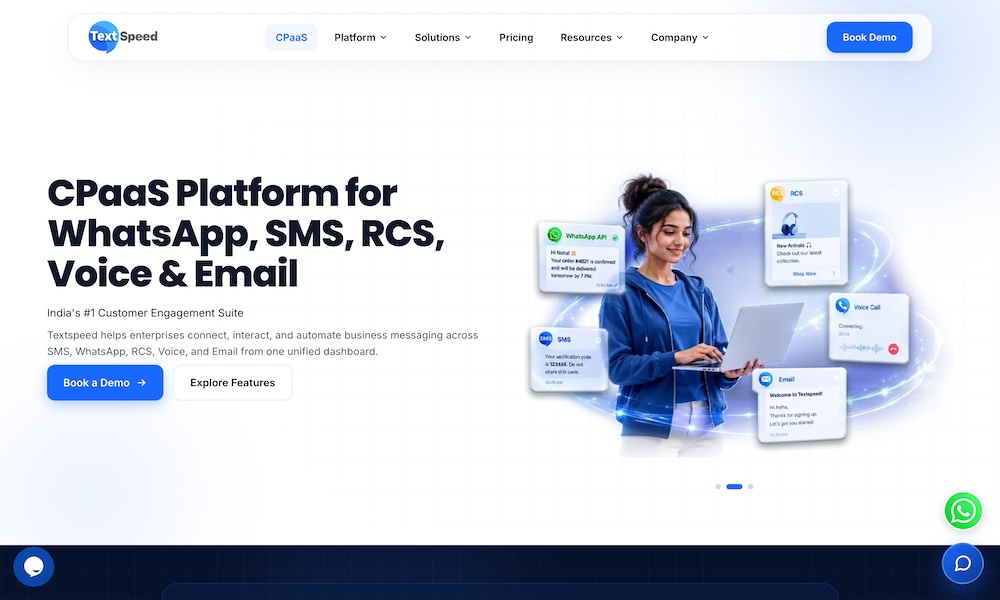
The platform also forms part of TextSpeed's broader CPaaS offering, which includes WhatsApp, SMS, RCS, voice, and email communication channels.
How to Get Started With WhatsApp Business API
A successful implementation requires more than simply connecting a phone number.
A typical setup involves:
Step 1: Define the business use case
Identify whether WhatsApp will be used for support, sales, notifications, marketing, lead generation, or a combination of these.
Step 2: Select an appropriate WhatsApp API provider
Evaluate integration capabilities, automation features, onboarding support, analytics, scalability, and technical assistance.
Step 3: Complete business and number setup
The required business information, phone number, and verification processes need to be completed according to the applicable WhatsApp requirements.
Step 4: Connect business systems
Integrate the API with CRM, ERP, websites, forms, chatbots, payment systems, or other applications required for the workflow.
Step 5: Configure message templates and automation
Create appropriate communication flows for notifications, customer support, lead follow-ups, and other use cases.
Step 6: Monitor conversations and performance
Track response activity, campaign performance, customer interactions, and workflow outcomes to identify opportunities for improvement.
WhatsApp Business API for Different Industries
The same communication infrastructure can support different customer journeys.
E-commerce
Businesses can use WhatsApp for order confirmations, delivery updates, product discovery, customer support, and promotional communication.
Healthcare
Hospitals, clinics, and healthcare providers can use messaging for appointment reminders, patient communication, and routine notifications.
Real Estate
Property businesses can capture enquiries, share property information, qualify leads, and coordinate follow-ups through WhatsApp.
Education
Educational institutions can communicate admissions information, reminders, updates, and student enquiries.
BFSI
Financial organizations can use structured messaging for notifications, customer service, authentication, and account-related communication where permitted.
Logistics
Logistics businesses can provide shipment updates, delivery notifications, and customer support through automated communication workflows.
Building a Better WhatsApp Customer Journey
The real value of the WhatsApp Business API is not simply sending more messages.
The objective should be to create better conversations.
A business can connect advertising, lead capture, automation, customer support, CRM data, and follow-up into a connected workflow. This can make communication more consistent while giving customers a convenient way to interact with the business.
For example:
Advertisement → WhatsApp conversation → Automated qualification → Sales agent → CRM update → Follow-up → Customer support
Instead of treating each interaction separately, businesses can build a connected communication journey.
Final Thoughts
The WhatsApp Business API has become an important option for businesses that want to combine messaging, automation, customer support, and business-system integration.
For companies managing increasing customer enquiries, manual WhatsApp communication can eventually become difficult to scale. An API-based approach provides the infrastructure needed to organize conversations, connect teams, automate repetitive tasks, and integrate messaging with existing business applications.
TextSpeed provides a platform for businesses looking to implement WhatsApp Business API capabilities alongside CRM integrations, chatbots, team collaboration, lead engagement, and broader CPaaS communication channels.
Businesses can explore the TextSpeed WhatsApp Business API platform to understand how WhatsApp-based communication can fit into their existing customer engagement strategy.
Related Websites
-
SEO Aim Point Web Solution
by SEO Aim Point Web Solution Private Limited
2647 -
Web Brewery
by Web Brewery
995 -
Elax Furniture
by Elax Furniture
374