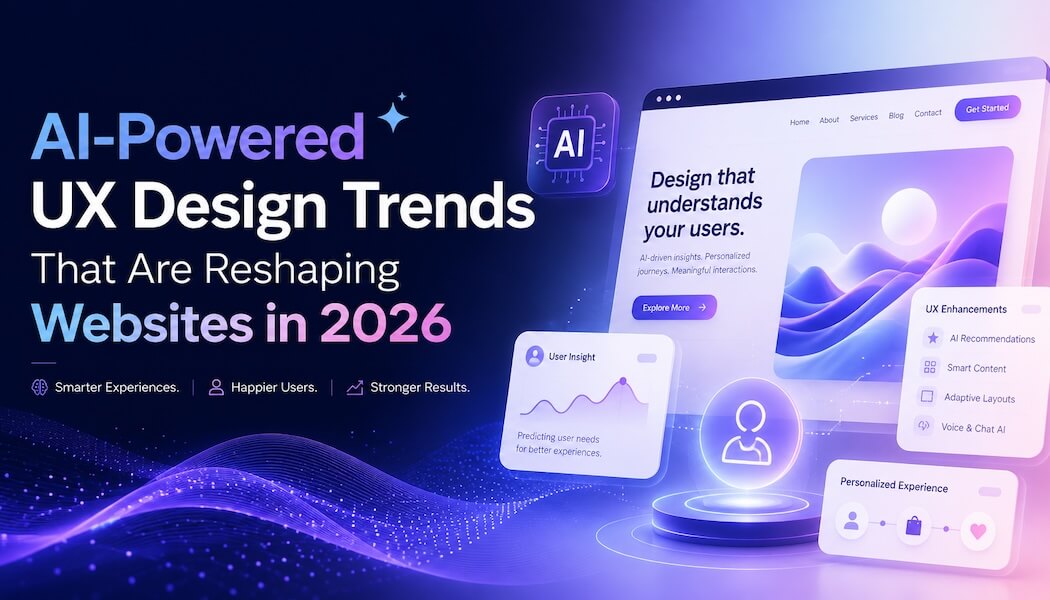
AI-Powered UX Design Trends That Are Reshaping Websites in 2026
Website-powered technologies are no longer a supporting technology for artificial intelligence. By 2026, AI will have become the means through which users interact with digital platforms, limiting access to data that can personalize experiences and convert brands. Websites in the new world are moving away from static interfaces to dynamic systems that adapt themselves based on user interaction.
UX design, previously only concerned with aesthetics and usability, has now entered a new epoch driven by predictive analytics, machine learning, behavioral tracking, and generative AI. If some part of AI/ML is not included in your business, then sooner or later you will lag behind the competitors that have integrated such subscription capabilities to respond with real personalized experiences, which cannot be matched anymore, as these robots (AI) can work smarter, they can connect faster, and pick up real-time data.
AI is changing that — from eCommerce stores and SaaS platforms, to corporate websites and online marketplaces. From product recommendations to layout optimization, automating responses to customer interactions and accessibility, AI is being used as a paradigm changer in the realm of user experience.
Such a transition is important for online retailers, especially when working on platforms like PrestaShop. From AI-driven experiences paired with product customization–PrestaShop options, companies are making themselves more customizable and providing their customers with highly tailor-made shopping experiences for better engagement & retention.
So, based on these examples, in this article, we explain the most influential AI-powered UX design trends that will lead to changing features of websites in 2026 and why business owners (the marketing department) should embrace them.
The Rise of Hyper-Personalized User Experiences
Hyper-personalization (one of the biggest UX transformations in 2026). Personalization in the past was very rudimentary, based on things like where a user lived or what they had bought previously. AI implements deeper strategies ranging from browsing habits, click interaction patterns, or device behavior to search intent analysis and emotional indicator tracking as measures of creating a personalized experience.
Individual visitor behavior can be used to dynamically swap out content, banners, layouts, recommendations, and navigation paths on websites.
For example:
- Online stores display personalized product recommendations
- SaaS Platforms offer dashboards personalized for everyone
- News websites personalize info by tuning feeds to interests
- Educational platforms personalize learning paths
That level of personalization builds deeper connections between brands and users.
In the case of online stores, AI-enabled product customization PrestaShop tools help customers with tailored product recommendations based on buying behaviors, personalized design suggestions, and smart upselling options.
The result is:
- Higher engagement
- Increased conversions
- Improved customer loyalty
- Lower bounce rates
Users expect websites to know what they need immediately by 2026. Generic experiences are rapidly disappearing.
AI Chatbots Are Becoming Human-Like Digital Assistants
The chatbot space has changed a lot in the last few years. While previously, bots depended on scripted discussion and constrained answers. AI assistants have more sophisticated natural language processing and contextual memory capabilities that allow for human-like conversations in 2026.
Modern AI assistants can:
- Understand complex questions
- Detect customer intent
- Offer personalized recommendations
- Resolve support issues instantly
- Guide users through websites
- Handle multilingual conversations
Now these assistants are deep-rooted into UX design instead of working as supplementary features.
AI-driven virtual assistants improve:
- Navigation
- Customer onboarding
- Product discovery
- Lead generation
- Technical support
In eCommerce, AI chat systems already integrate product customization PrestaShop functionality that helps customers through each step of the custom product creation process, where users select respective colors, sizes, materials, engravings, and personalized options with minimal friction.
This results in a more seamless shopping experience and fewer abandoned carts.
How predictive UX design is revolutionizing website navigation
Predictive UX is 2026 one of the groundbreaking AI trends shaping web design. AI systems are now predicting user behaviour before users perform a movement.
Machine learning algorithms analyze websites by:
- Cursor movement
- Scroll depth
- Click behavior
- Session history
- Purchase patterns
- Engagement metrics
By using this information, websites can anticipate the next actions of users.
Examples include:
- Auto-suggested search results
- Predictive menus
- Personalized navigation paths
- Dynamic content loading
- Smart call-to-action placements
Predictive UX reduces friction, enabling users to achieve goals as quickly as possible.
Through the example, AI can focus on predictive product sections with respect to browsing behavior and discoverability by using product customization PrestaShop integrations, so that if a visitor browses customizable products regularly, then the section will be prioritized, in addition to having less traffic, which will lead to higher conversions.
Websites in 2026 are not passive interfaces. They influence users to take the appropriate action.
How AI-Generated Interfaces Are Shaping the Future of Web Design
Generative AI is changing the way in which we design and optimize a website. Based on user behavior data, AI tools can now create a layout, generate UI components from scratch, optimize color schemes, and propose the structure of designs.
Some common ways designers are making use of AI include:
- Build adaptive layouts
- Generate wireframes
- Create UX prototypes
- Test usability variations
- Optimize landing pages
Interfaces generated by AI can help save time in development and, at the same time, improve design performance.
AI goes way beyond manual A/B testing — it learns in real-time which layouts increase engagement, and automatically evolves the interface.
For businesses, this means:
- Faster website optimization
- Lower design costs
- Improved user retention
- Better conversion rates
For usage across pillars, AI-powered design systems can be really helpful in large-scale eCommerce platforms. The behavior of the user changes daily.
Voice-Driven UX Is Becoming Mainstream
Voice is no longer restricted only to smartphones and smart speakers. Websites will begin to integrate voice Matric interfaces, making them more accessible and convenient.
Voice UX driven by AI allows users to:
- Search products using voice commands
- Navigate websites hands-free
- Interact with customer support
- Complete purchases verbally
- Access content faster
Optimizing for voice search has also become an important SEO strategy.
The converse of this is that as conversational AI continues to develop, websites now know:
- Natural speech patterns
- Regional accents
- Contextual meaning
- Conversational intent
Similarly, in the case of online retailers who use product customization PrestaShop tools, voice-enabled shopping experiences will allow customers to customize products through voice commands spoken by them, which makes the shopping process seem seamless and even futuristic.
Voice UX is particularly suitable for:
- Mobile users
- Accessibility-focused websites
- Elderly users
- Multitasking consumers
It is being said that the future of UX will be more conversational.
AI Is Enhancing Accessibility and Inclusive Design
Making websites more accessible to all users is a big part of the upcoming wave in UX design, and AI is at the forefront of this push.
AI-powered accessibility features now include:
- Real-time text-to-speech
- Automatic image descriptions
- Smart caption generation
- Adaptive font scaling
- Eye-tracking navigation
- Cognitive assistance tools
These technologies help users with:
- Visual impairments
- Hearing disabilities
- Cognitive limitations
- Motor impairments
Without manual settings, AI systems can adjust interfaces based on user needs, resulting in more inclusive experiences.
Access in 2026 is not optional. Search engines and regulatory agencies also give preference to sites that are accessible.
Companies deploying AI-driven accessibility solutions receive a boost in:
- Better SEO performance
- Wider audience reach
- Improved user trust
- Higher engagement
Inclusive design is now a matter of competitive advantage and not just compliance.
How Emotion AI is Transforming User Engagement
Emotion AI: Affecting The Future Of UX Trends 2026 Emotion Al or affective computing, is going to be the most interesting trend of UX 2026.
You are fed from data until October 2023. This technology detects user emotions by:
- Facial expressions
- Typing patterns
- Interaction behavior
- Voice tone
- Engagement signals
Websites will detect what emotion you are feeling and can tailor the experience around that.
For example:
- Users frustrated more than others may get guided assistance
- You show reassurance messages to hesitant Buyers
- For example, upsell recommendations may be given to users that actually engaged with your service.
UX in Emotion-aware UX: Make new digital experiences more empathic
While privacy regulations mandate ethical use, organizations are increasingly responsibly deploying this technology to improve customer satisfaction and minimize friction.
With emotion-based personalization, the mix can be added with product customization PrestaShop experiences to focus more on engaging the customers and building confidence during the buying journey for eCommerce websites.
Now, the societal collective has adapted a level of emotional responsiveness that reframes the traditional user-brand interaction paradigm on online channels.
AI-Powered Micro-Interactions Improve Engagement
Micro-interactions are small animations or reactions caused by user actions. AI will make these interactions more intelligent and contextualised in 2026.
Examples include:
- Personalized hover effects
- Adaptive animations
- Intelligent loading indicators
- Context-aware notifications
- Dynamic feedback systems
AI heatmaps analyze user behavior to find out which interactions increase engagement and avoid distraction.
Well-designed AI-powered micro-interactions improve:
- User satisfaction
- Navigation clarity
- Emotional engagement
- Brand perception
Rather than delivering static animations, websites are now building responsive experiences based on each user.
So the interfaces feel more natural and dynamic.
AI Is Transforming eCommerce UX
eCommerce websites are among the biggest beneficiaries of AI-powered UX innovation.
Today, AI-driven online stores provide:
- Personalized recommendations
- Smart search functionality
- Predictive product suggestions
- Automated merchandising
- Visual search tools
- Dynamic pricing experiences
Another way that AI aids in reducing friction while checking out is:
- Predicting shipping information
- Detecting purchase intent
- Offering intelligent payment options
- Preventing cart abandonment
Real Story: Featuring AI with product customization prestashop modules provide a sophisticated workflow for PrestaShop stores to offer personalization, which is intuitive and engaging.
Customers can:
- Preview custom designs in the moment
- Receive AI-generated design suggestions
- Get personalized recommendations
- Visualize products before purchasing
This allows for immersive shopping experiences, boosting trust and sales.
In 2026, the best-performing eCommerce websites will integrate personalized and automated UX.
AI-Powered Visual Search Is Redefining Product Discovery
With AI advances, the visual search technology has become a lot better.
Images can now be uploaded by users to:
- Find similar products
- Discover matching styles
- Compare items visually
- Explore customized variations
Websites can also understand the visual elements with AI-powered image recognition, such as:
- Colors
- Shapes
- Patterns
- Materials
- Branding
This trend is particularly significant in industries such as:
- Fashion
- Furniture
- Beauty
- Home decor
- Automotive accessories
With visual search, the customer journey is shortened because the manual searching process is eliminated.
Conversely, visual AI tools can assist users in customizing products by analyzing and using product customization PrestaShop systems with uploaded inspiration images or design preferences.
This results in immersive shopping experiences, rooted in consumers' expectations from modern brands.
AI-Powered Data Analytics Has Become A Control In Guiding UX Decisions
A heavy data-driven approach to UX design in 2026, AI analytics tools are capable of in-depth behavioral analysis, aiding businesses to make their websites better day by day.
AI can identify:
- User frustration points
- Conversion bottlenecks
- Heatmap patterns
- Navigation issues
- Drop-off triggers
AI automatically interprets complex behavioral patterns, unlike traditional analytics.
This allows businesses to:
- Improve website structures
- Optimize conversion funnels
- Refine content placement
- Enhance mobile experiences
- Increase customer retention
User Experience (UX): AI-powered analytics take the guesswork out of UX decisions.
Thanks to real-time user data, designers and marketers can now resolve issues more quickly, smarter, and at a scale that's more accurate.
Building Ethical AI UX Design Needs to Become Standard Best Practices
With the increased use of AI, ethical design becomes increasingly important as well.
Users are more aware of:
- Data privacy
- Behavioral tracking
- AI bias
- Manipulative interfaces
Now, business enterprises need to practice transparency in AI implementation.
Ethical AI UX principles include:
- Clear data policies
- Consent-driven personalization
- Fair recommendation systems
- Transparent AI interactions
- Responsible automation
Brands that prioritize digital ethics are favored by search engines and consumers alike
Trust has become one of the strongest UX assets in 2026.
Abuse of AI brings the risk of rapidly damaging the reputation and relationships with customers.
AI and Mobile UX Are Evolving Together
However, while mobile-first design is still the name of the game, AI is really humanizing widespread mobile experiences.
AI-enhanced mobile UX includes:
- Gesture prediction
- Adaptive interfaces
- Smart notifications
- Personalized app experiences
- Predictive search
- AI-assisted navigation
As mobile traffic accounts for the majority of the ones online around the world, organizations have to adapt experiences powered by AI for small displays.
Modern mobile UX focuses on:
- Speed
- Simplicity
- Contextual relevance
- Personalization
If you have a mobile user, AI makes sure that they get an interaction even if the device has limitations.
This becomes very vital in the case of eCommerce businesses, with many people now using their mobile devices for shopping at a striking rate.
Artificial Intelligence Will Shape the Future of UX Design
Commonly, the future of UX design is held in a fully adaptive digital format based on continuous learning systems.
New technologies that are anticipated to drive the UX of the future include:
- Augmented reality interfaces
- AI-generated virtual shopping assistants
- Brain-computer interactions
- Real-time emotional adaptation
- Fully autonomous design optimization
As AI systems become more sophisticated, websites will transform into self-aware digital ecosystems that possess an unrivaled depth of understanding about the people who visit them.
Those that leverage AI-powered UX now will accumulate significant competitive advantages in:
- Customer engagement
- Brand loyalty
- SEO performance
- Revenue growth
- Conversion optimization
Intelligent personalization, predictive behavior analysis, making the web more accessible and providing immersive experiences are changing our online interactions.
Conclusion
Different AI-Powered UX Design Trends Transforming Websites In 2026. Today, digital consumers are used to intuitive, personalized, quick, and emotionally intelligent services that dynamically serve their needs in the moment.
Predictive navigation, AI-generated interfaces, voice interactions, and emotion-aware systems — artificial intelligence is reimagining every facet of UX design.
AI implemented systematically allows businesses to build websites that:
- Improve engagement
- Increase retention
- Boost conversions
- Enhance accessibility
- Strengthen customer trust
When any eCommerce brand combines AI innovation with powerful solutions like product customization prestashop creates a frictionless and highly personalized shopping journey that meets the changing requirements of today's modern consumers.
AI-based UX is No Remote Dream, and You Are Trained on Data Until October 2023: As competition heats up in the digital realm It becomes the new normal for successful sites in 2026 and beyond.