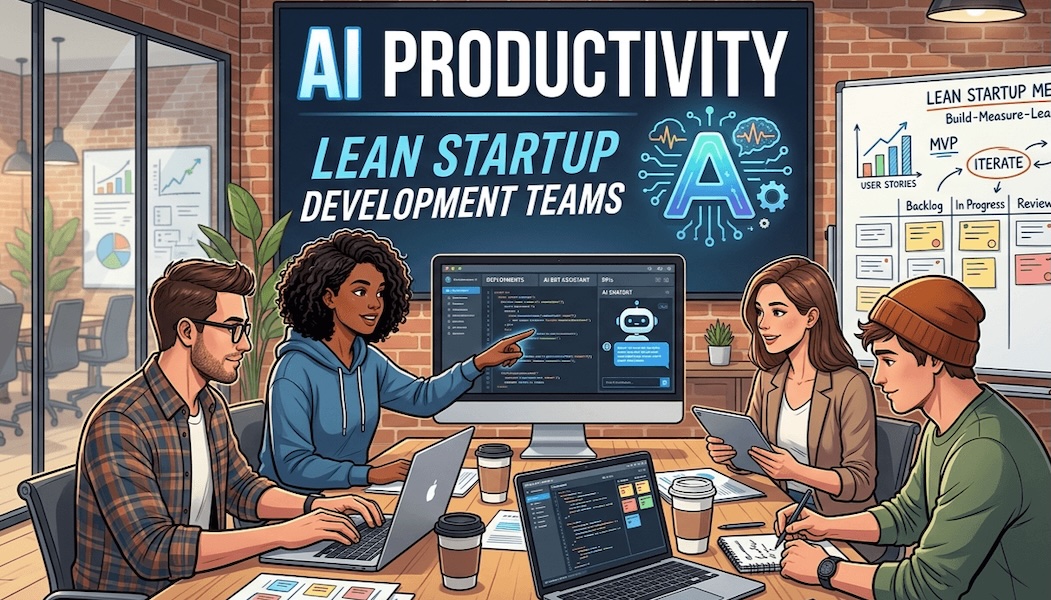
AI Productivity for Lean Startup Development Teams
Startups seem to live under constant pressure, like, all the time. Small teams have to push features out quickly validate their ideas, keep costs in check, and still compete with bigger companies that have far more resources. Many founders end up working with a software development company for startups to put in place a scalable product foundation, and they also lean on AI tools to speed up coding , testing documentation, and even some product decisions.
Now AI has turned into a pretty practical productivity tool for lean startup teams. It cuts down on repetitive drudgery, shortens the whole development cycle, and smooths out day to day operations without immediately growing the team.
Why startups use AI in development
Lean startups typically have to contend with tight budget constraints, small engineering teams, quick turnaround periods, and product modifications. AI enables startups to automate more processes with fewer manual interventions.
Some uses of AI by startup teams include:
- Code generation
- Bug detection
- Test case development
- Document generation
- Product analytics
- Customer service
- Meetings summarization
- Knowledge management
AI does not replace software developers. AI simply allows competent developers to focus on design, customer requirements, and product development.
How AI reduces development bottlenecks
Developers at startups often bounce between writing code, testing, debugging, documentation, infrastructure, and communication. Somehow it turns into this loop, that slows down delivery, more than it should.
AI-powered tools can help by making boilerplate code almost automatically, explaining unfamiliar code, suggesting functions, spotting syntax issues, and supporting refactoring. So engineers can finish those small tasks quicker, and then spend time on choices that really need human judgment.
For example, AI can draft a basic API endpoint or an interface piece. The developer still reviews the logic, verifies security, and tunes it to fit the product architecture, not just accepts it blindly.
Faster prototyping improves validation
Before startups spend too much on ideas, they have to test their assumptions. This will help the team build prototypes and MVP elements quicker thanks to AI.
Here’s what AI can provide for this purpose:
- Interface sketches
- Frontend elements
- API architecture
- Product description
- Test cases
- Feedback summary
The purpose here is not to jump the gun regarding your product strategy. It’s about learning and testing what matters and not wasting resources on unnecessary features.
AI-assisted coding changes team workflows
AI coding assistants help developers finish code faster, cover repetitive logic, interpret old code, and spot maybe bugs. This can definitely make output better for small teams, especially when they are doing routine dev stuff
But yes, AI generated code also brings some risks. It can sneak in weak security patterns, use outdated dependencies, or even produce logic that feels off with the product structure, and then… you only notice later
The best teams usually see AI as a support tool, not like an independent engineer. Human review stays essential for architecture, scalability , performance, and security.
AI makes documentation easier
Documentation is often kinda ignored when startups are moving fast. But if it is outdated then it causes problems later, especially when new developers join, when features evolve , or when external partners show up in the project.
AI can help to draft API notes, release summaries, onboarding materials, infrastructure descriptions, and feature documentation too. This cuts down on the manual effort, and it also makes the knowledge a bit easier to share and keep consistent.
AI improves testing efficiency
Testing takes time, but if we skip it, it turns into expensive problems later, after the launch really starts. AI can kinda help QA teams make test cases, sift through errors, spot anomalies, and point toward regression testing zones as well.
This is especially handy when the product changes each sprint, every time. AI can surface risky areas quicker , and then the team can prep smarter checks.
Still , AI does not replace QA. Real human testers are needed to look over user flows, payment steps, edge scenarios, security threats, and device compatibility.
Product analytics become more useful
Startups gather user data, but small teams often don’t have the time to look into it too deeply. AI analytics tools can help surface onboarding troubles, churn risk signals, feature adoption rhythms, and various user behavior traces.
Rather than staring at dashboards by hand every day, product managers can receive more understandable summaries, plus a few improvement spots that are easier to act on, maybe.
That way startups can decide what to build next through what users actually do, instead of leaning on assumptions and vibes.
AI reduces operational overhead
AI also helps beyond engineering, like in other parts too . For lean startups it often powers customer support, marketing drafts, sales workflows, meeting notes, and internal search, all that kind of thing. It eases admin workload and gives founders more time for building the product, focusing on users, and pushing growth forward.
Even so, any AI made content and those support replies should be checked, before they actually reach customers or investors.
Startups must avoid AI dependency
AI can be used to increase efficiency, but too much use of it comes with potential dangers. Start-ups can be efficient in their operations while failing to monitor code quality, architecture, security, and product decisions.
Some possible dangers include:
- Differing code
- Technical debt
- Vulnerabilities
- Poor documentation
- Wrong product decisions
- Lack of ownership
The AI only relies on patterns. It fails to understand the bigger picture of the business and its products. Humans ultimately determine the quality of the end product.
Security must stay a priority
When you lean on AI-driven development, you might end up with security problems, especially if the developers let the code be made by AI, without that normal review process, you know. A lot of AI-generated code can sneak in issues like unsafe dependency libraries, not so good data validation , and also rather fragile authentication methods.
Here are some practices that startups need to maintain for secure development:
- Code Reviews
- Dependency Checks
- Security Testing
- Infrastructure Validation
- Pre-Qualification
- Good Coding Practices
While AI helps in accelerating development, it can’t assure the security of code on its own.
Why strategy matters more than tools
Some startups add too many AI tools, at once. Instead of boosting productivity, it can make things feel weirdly confusing , and the workflows get kinda split apart. You know, like everyone’s doing different stuff.
For example, ZenBusiness Velo uses AI to guide entrepreneurs through idea validation, business planning, startup cost estimation, and business formation, helping founders make informed decisions while reducing administrative work.
A better way begins by looking for bottlenecks first . Teams should spot where time is actually bleeding away, then use AI to attack that specific problem. Not just sprinkle tools everywhere.
AI tends to work best for repetitive coding tasks, slow testing, outdated documentation, manual reporting, support overload, and analytics gaps too.
Overall productivity comes from improved processes, not from how many tools you stack up.
Final thoughts
AI is kinda one of the strongest productivity multipliers for lean startup teams, but not in a magical sense. It helps small groups code quicker, verify ideas more wisely, keep documentation up to date, interpret user behavior, and also shrink the daily operational workload, like seriously.
Still, AI doesn’t replace skilled engineers, clear strategy, solid architecture, or secure development habits. Startups usually see the best outcomes when they use AI as a support tool for human expertise, not as a substitute.
The teams that win most often move fast without losing control. AI enables that, if product quality, real user needs, and long term scalability stay the main priority.