ChatGPT Ads: 5 Powerful Ways to Win More Customers
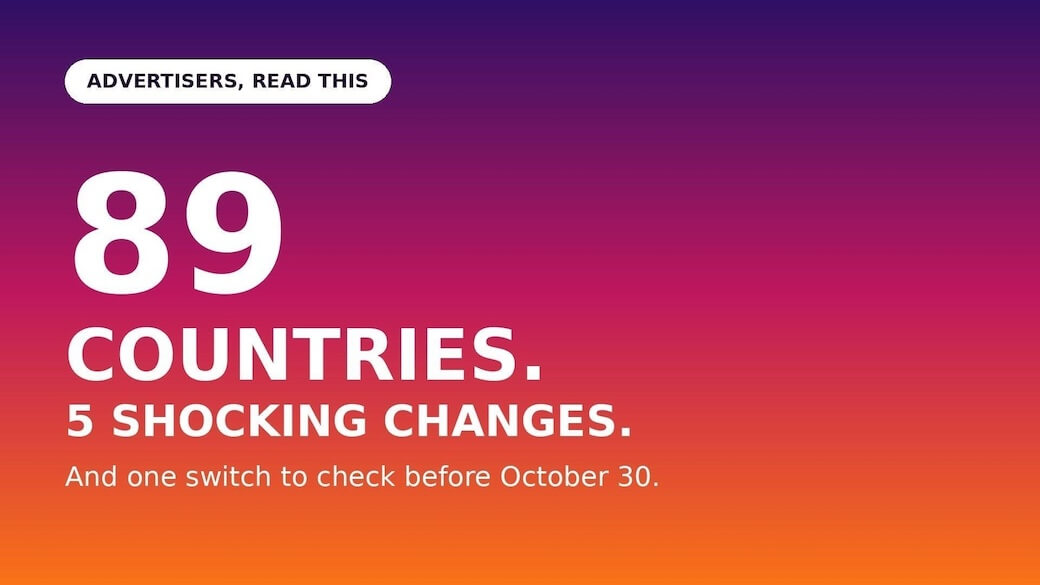
ChatGPT Ads now run in 89 countries, and AI rewrites switch on by default on October 30. OpenAI added 26 markets on October 21, 2026, and more than 100,000 advertisers have run campaigns since launch. Ads still show only on the Free and Go plans. Paid plans stay ad-free. This article explains the expansion, the rewrite switch, and the exact checks to run first.
The problem is control. ChatGPT Ads started as a simple placement: your ad, your words, your landing page. Now OpenAI can rewrite your headline, translate your text, resize your image, and send clicks to a different page on your site. One switch covers all four changes. Ads may then run without your review of each version. Most advertisers have not opened that switch yet.
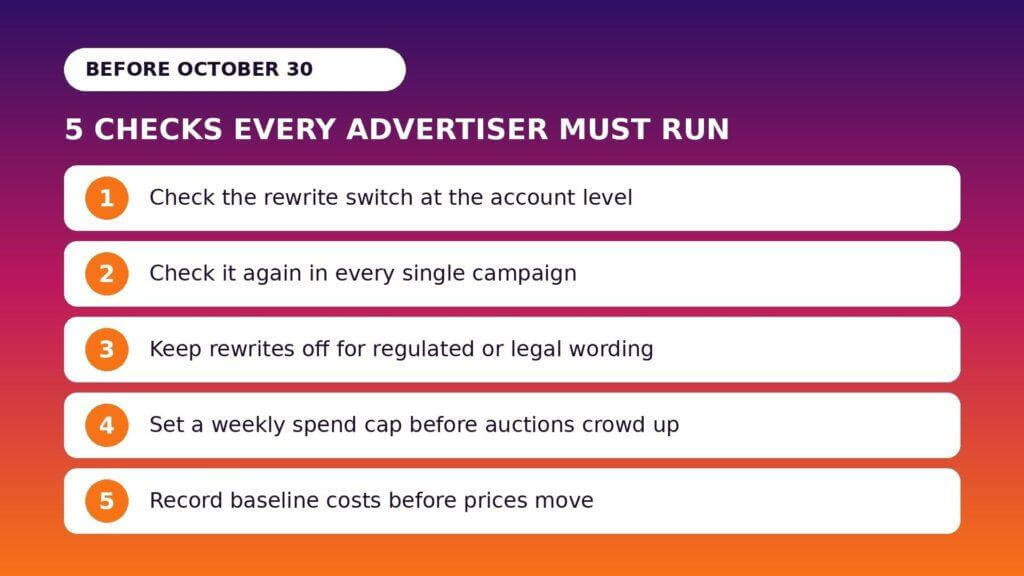
First, check the creative enhancements switch at the account level. Then, check it again in every campaign, because the campaign setting wins. Finally, decide before October 30 whether your brand can live with AI-edited copy. That order matters, because a campaign-level setting overrides the account default.
This article explains what ChatGPT Ads now cover, which countries joined, and what the rewrite switch really does. You will see the rollout timeline, the revenue numbers behind the push, and the control gap with Google Ads. Then you will get a short checklist for the week ahead.
Key Takeaways
- ChatGPT Ads expanded to 26 more countries on October 21, 2026, bringing the total to 89 countries.
- More than 100,000 advertisers have run campaigns since ads launched, a cumulative count, not a current active count.
- Ads appear only on the Free and Go plans. Plus, Pro, and Enterprise users see no ads.
- Creative enhancements switch on by default around October 29 to 30, and one switch covers headlines, translations, images, and landing pages.
- Check the switch at the account level and in every campaign before October 30, because the campaign setting wins.
What Are ChatGPT Ads?
ChatGPT Ads place sponsored messages inside ChatGPT conversations for users on free tiers. OpenAI began testing ads in the US earlier in 2026 for logged-in adults on the Free plan and the Go plan. Advertisers buy through Ads Manager or through technology partners. The product grew fast from there, and it now forms a major revenue line for OpenAI.
For example, OpenAI said in August that its ads business had reached a $1 billion annualized revenue run rate. That figure came less than 200 days after the company introduced the product. Reporting on the expansion puts OpenAI on pace for $2.5 billion in booked ad revenue for the full year. For comparison, the same reporting notes that Google took around four years to reach that pace. Treat the booked-revenue pace as reported, not as an audited result.
So scale explains the urgency. OpenAI puts ChatGPT weekly users at more than 1.2 billion. Ads reach only the free tiers. Still, the free tiers hold a huge audience. So even a small share of that audience gives advertisers reach that most platforms cannot match. That reach is the pitch. Control is the catch, and the next sections cover both sides.
ChatGPT Ads Reach 89 Countries
The October 21 expansion added 26 markets at once. Latin America took the biggest share, with 14 countries, including Argentina, Chile, Colombia, and Peru. Those joined earlier launches in Mexico and Brazil. Europe, the Middle East, Africa, and Asia took the rest, including Nigeria, South Africa, Serbia, Ukraine, Cambodia, Bangladesh, and Pakistan. OpenAI did not name the other 15 markets in the batch.
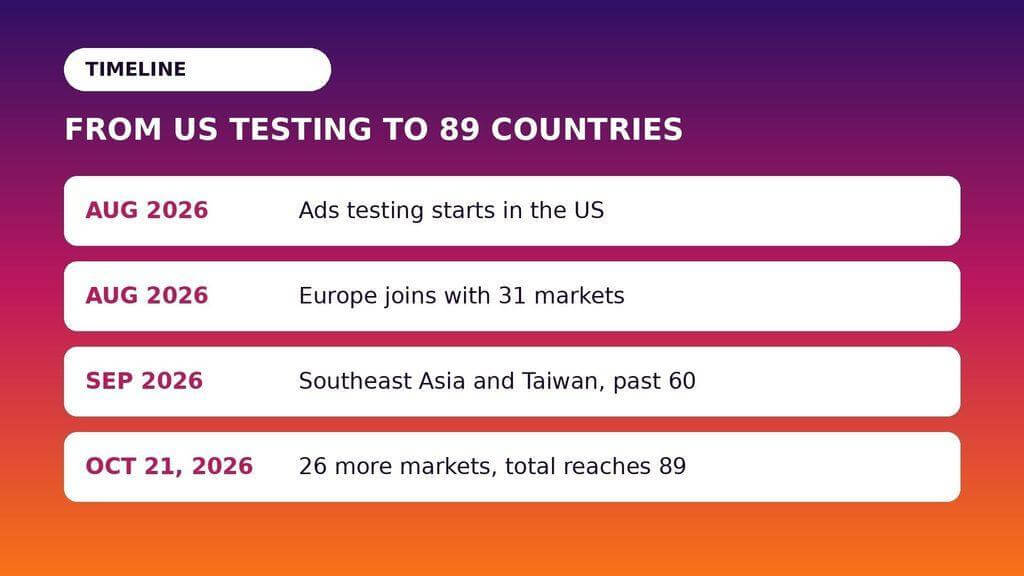
The rollout moved in stages. Ads began testing in the US in August 2026. Then, Europe joined later in August with 31 markets. Then, Southeast Asia and Taiwan followed in September, pushing the total past 60 countries. October brought the total to 89. Also, buying partners grew alongside the map. Adform sells them in Europe, and Equativ covers 12 markets, including Poland. Advertisers in new markets can buy through partners or get self-service access through Ads Manager.
Still, for US advertisers, the expansion changes competition more than reach. More countries mean more advertisers bidding for similar prompts and audiences. It also means more ad formats, objectives, and buying options on the way, since OpenAI said its next growth phase will add them. So early movers should lock in measurement now, before the auction gets crowded. First, set up conversion tracking, name campaigns clearly, and record baseline costs this month. That baseline will tell you whether the expansion raised your prices or just widened the map.
ChatGPT Ads and the Rewrite Switch
However, the bigger change hides behind the country count. OpenAI emailed advertisers on October 20 about creative enhancements, its name for automatic ad edits. Reuters covered the expansion on October 21, and Marketing Newsroom detailed the rewrite switch on October 22. Once the setting turns on, OpenAI can write new headlines and descriptions for your ads, translate ad text into other languages, resize images, and send clicks to a different page on your site when it judges that page more relevant.
The email gives October 30 as the start date, while OpenAI help pages say October 29. Plan for October 29, since the earlier date controls your risk. Edits can draw on the ad itself, the landing page, and the context of the conversation. The email says ads may then run without your review or approval of each version. One switch covers all four ad rewrites, so you cannot allow headline edits while blocking landing-page redirects. You take the bundle or you turn it off.
Opt-out controls exist at two levels
Still, opt-out controls exist at two levels. You can turn the setting off for the whole account or for one campaign, and the campaign setting wins over the account setting. Opt-outs made earlier stay in place. So check both levels, because an account-level opt-out will not save a campaign that has the setting on. Brands with legal wording that must not change, such as banks or drug makers, should turn it off until reports show which version of an ad actually ran.
Meanwhile, the reporting gap is the weakest part of the rollout. OpenAI has published no performance data from testing the rewrites. It has not said how it picks a replacement landing page, whether users see any sign that an ad was rewritten, or whether reports show which version ran. In September, the company described AI text customisation as a feature advertisers had to opt into, and it began testing business-sponsored agents with select US advertisers. The new default flips that choice around. So advertisers now carry the burden of opting out, on a feature with no public test results.
What This Means for Small Advertisers
First, small advertisers should treat the platform as a new channel with real reach and thin controls. Start small and measure hard. First, pick one product and one landing page, and run it for two weeks before you scale. Then, compare cost per click and conversion rate with your current channels. Finally, keep the AI rewrite switch off for that first test, so you measure your own copy, not the machine edited version.
Also, budget discipline matters more here than on mature platforms. Auction prices will move as 89 countries of advertisers join. Also, the rewrite switch can change your message without warning, which can break a compliance claim or a price promise. So set a weekly spend cap, review search terms and placements weekly, and keep a human in the loop for any ad that carries a price, a claim, or a legal line.
The channel also rewards good landing pages more than clever ads. ChatGPT users arrive mid-conversation, with a specific question in mind. For example, a page that answers that question fast will convert better than a generic homepage. So build one focused page per campaign, match the headline to the question, and cut every paragraph that does not help the visitor decide. That advice holds for any ad platform, and it matters most where the platform itself may redirect your clicks.
Marketers who compare tools before they buy should also read our guide to Ahrefs alternatives for SEO and marketing tools. The same discipline applies: compare on your own numbers, not on vendor claims. And the automation habits in our guide to AI automation workflows that pay off transfer directly to ad operations, from weekly reporting to spend alerts.
The Control Gap With Google Ads
For example, Google Ads gives advertisers granular control: edits, approvals, and version history are standard. The platform now moves the other way, with one switch that bundles four kinds of edits and no version reporting. That gap should shape how you split budget. Also, use Google Ads where message control and legal precision matter most. Use it where conversational reach matters more than exact wording, and keep the rewrite switch off until reporting improves.
The comparison also covers intent. Google searchers type a query and see ads beside results. ChatGPT users hold a conversation, and ads appear inside that flow. So the same product can perform very differently on the two platforms. Then, test both with the same landing page and the same offer, and judge on cost per conversion, not on clicks. Clicks flatter conversational placements, because curiosity clicks cost the same as buying clicks.
Finally, choice of AI tool matters here too, and our guide to comparing AI tools before you buy covers the same habit: test on your own task, on your own numbers, before you commit budget. Platforms change defaults often, as the October 30 switch proves. So treat every default as temporary, and re-check your settings each month.
ChatGPT Ads: Honest Limits
This story has real limits. First, the 100,000 advertiser figure counts every advertiser that has ever run a campaign since launch. It is not a count of advertisers active right now. Industry reporting had pegged active advertisers near 20,000 in late August, which makes the growth real but smaller than the headline suggests.
Second, 15 of the 26 new countries remain unnamed in public coverage. So advertisers cannot yet judge the full map or plan local campaigns for those markets. Also, the October 29 versus October 30 start-date gap shows sloppy rollout communication. Plan for the earlier date, and check the switch again on both days.
Still, no independent performance data exists for the rewrites. Everything about their effect comes from OpenAI itself, and OpenAI has shared no test results. Finally, search interest data for this keyword is unmeasured in this run, as the package block states plainly. That gap says nothing about the product itself. It only means this article makes no trending claim.
ChatGPT Ads: FAQs
Q: What are ChatGPT Ads?
ChatGPT Ads are sponsored messages that appear inside ChatGPT conversations for users on the Free and Go plans. Advertisers buy them through Ads Manager or through technology partners. Plus, Pro, and Enterprise users see no ads.
Q: How many countries do ChatGPT Ads run in?
ChatGPT Ads run in 89 countries after OpenAI added 26 markets on October 21, 2026. The new batch included 14 Latin American countries, plus markets in Europe, the Middle East, Africa, and Asia. OpenAI did not name 15 of the 26 new markets.
Q: What are creative enhancements?
Creative enhancements are automatic edits OpenAI can make to your ads. They cover new headlines and descriptions, translations into other languages, image resizing, and sending clicks to a different page on your site. One switch covers all four kinds of change.
Q: When do creative enhancements switch on?
Creative enhancements switch on by default around October 29 to 30, 2026. The advertiser email gives October 30, while OpenAI help pages say October 29. Plan for October 29, and check the switch on both days.
Q: How do I turn off creative enhancements?
Open Ads Manager and turn the creative enhancements switch off for the whole account, then check it again in every campaign. The campaign setting wins over the account setting, so both levels must agree. Opt-outs made earlier stay in place.
Q: Do ads show on paid plans?
No, ads do not show on paid plans. They appear only on the Free and Go plans. Plus, Pro, and Enterprise subscriptions stay ad-free.
Q: Should a small business advertise on the platform now?
A small business should test the platform with one product, one landing page, and the rewrite switch off, then judge on cost per conversion. Keep spend capped and review results weekly. Turn the rewrite switch on only after reports show which version of an ad actually ran.
The Bottom Line
ChatGPT Ads now reach 89 countries, and the rewrite switch changes the deal for every advertiser. Reach is real, revenue growth is fast, and the free-tier audience is huge. Still, one switch now controls your headline, your translation, your image, and your landing page, with no version reporting and no public test results. So test small, keep rewrites off until reporting improves, and re-check your settings before October 29. That discipline lets you use the reach without handing your message to the machine.
Know AI news, SEO, automation, or SaaS tools well enough to explain them this clearly? Write for Ai Blitzo: real editors, fast replies, and your work in front of people who actually use AI tools.