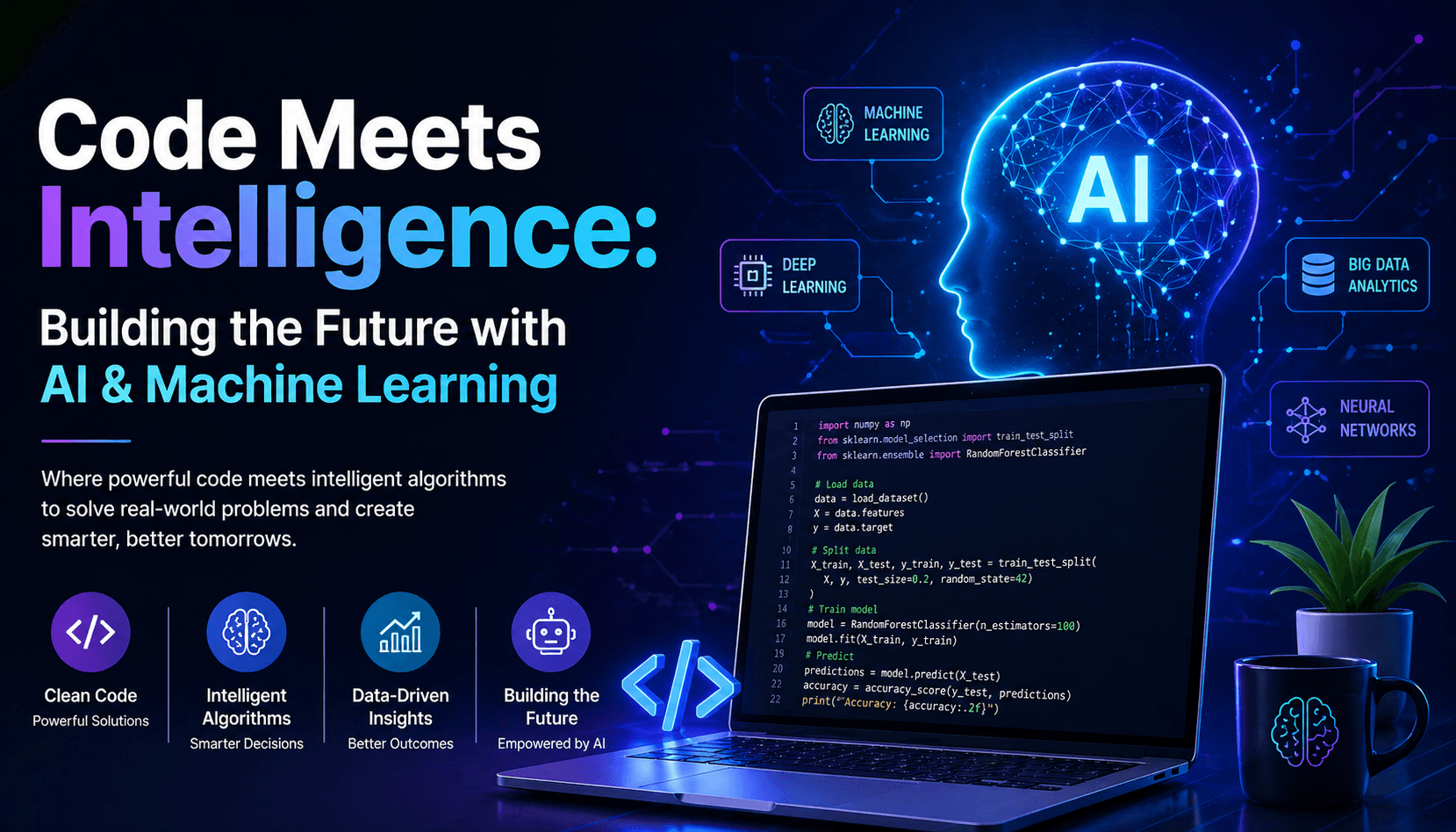
Code Meets Intelligence: Building the Future with AI & Machine Learning
Imagine a world where your coffee machine doesn't just brew your morning cup but predicts exactly when you'll need it, based on your sleep patterns from last night. Or a self-driving car that navigates rush-hour chaos not by rigid rules, but by learning from millions of miles of real-world driving data.
This isn't science fiction, it's the fusion of code and intelligence, powered by AI and Machine learning (ML). At its core, this marriage is transforming how we build software, solve problems, and shape tomorrow.
Let's start with the basics. Traditional programming follows a clear if-then path: coders write explicit instructions, and computers execute them faithfully. But what happens when the problem is too complex or the data too vast for humans to script every scenario? Enter machine learning, a subset of AI where algorithms "learn" patterns from data instead of being hand-coded.
Think of it like teaching a child to recognize animals. You don't list every possible cat; you show thousands of photos, and the child figures out the whiskers, fur, and tail on their own. ML does the same with neural networks layers of interconnected nodes mimicking the human brain that adjust weights through trial and error to minimize errors.
Building this future starts with data, the lifeblood of AI. Developers collect massive datasets, clean them (removing noise like duplicates or outliers), and feed them into models. Take image recognition: convolutional neural networks (CNNs) excel here, scanning pixels for edges, shapes, and textures.
A practical example? In healthcare, ML models trained on X-rays detect pneumonia with 95% accuracy, often spotting subtle signs radiologists miss. I once worked on a project where we used Python's TensorFlow library to build such a model. We started with 50,000 anonymized scans, split into training (80%), validation (10%), and test sets (10%). After epochs of training on a GPU cluster, the model achieved superhuman precision, slashing diagnosis times from days to minutes.
But code meets intelligence most powerfully in deployment. Tools like Docker containerize models for seamless scaling, while Kubernetes orchestrates them across cloud servers. APIs turn these brains into services like ChatGPT's backbone, where transformer models process language via attention mechanisms, weighing word importance dynamically.
This isn't just chatbots; it's revolutionizing industries. In finance, ML algorithms predict stock fraud by analyzing transaction graphs, flagging anomalies humans overlook. E-commerce giants like those mimicking Amazon use recommendation engines (collaborative filtering) to suggest products, boosting sales by 35% on average.
Of course, challenges lurk. AI bias is a big one: models learn prejudices from flawed data. If training data skews toward certain demographics, predictions follow suit. Remember the facial recognition fiasco where systems misidentified darker skin tones? Ethical coders combat this with diverse datasets and fairness audits, using techniques like adversarial debiasing.
Compute power is another hurdle; training a large language model like GPT-4 equivalents guzzles energy equivalent to a small town's yearly use. Enter efficient architectures like sparse transformers or federated learning, where devices train locally without shipping raw data to the cloud.
Looking ahead, the real magic happens at the edge of AI on devices like smartphones. TinyML frameworks squeeze models into megabytes, enabling voice assistants on wearables or predictive maintenance on factory robots.
Imagine drones inspecting oil rigs, using reinforcement learning (RL) to optimize flight paths amid wind gusts. RL, inspired by games like AlphaGo, rewards good actions and penalizes bad ones, evolving strategies over time. In gaming, it's already creating NPCs that adapt to players, making worlds feel alive.
This code-intelligence synergy extends to creativity. Generative AI, like diffusion models for art or music, starts with noise and iteratively refines it into masterpieces. Coders fine-tune these on custom datasets, generating architectural blueprints from sketches. In education, adaptive platforms personalize learning; if a student struggles with algebra, the system pivots to visuals, tracking progress via Bayesian optimization.
Yet, building the future demands more than tech chops. Collaboration is key. Data scientists team with domain experts farmers for crop-yield ML, urban planners for smart cities. Open-source communities accelerate this; Hugging Face's model hub lets anyone download pre-trained weights and tweak them. Governments are catching on too, with initiatives like India's AI for All pushing ML in agriculture to predict monsoons via satellite data.
The risks? Job displacement fears loom, but history shows tech creates more roles coders now specialize in prompt engineering or MLOps (ML operations). Privacy erosion is real; differential privacy adds noise to datasets, protecting individuals. Regulation lags, but frameworks like the EU AI Act classify systems by risk, mandating transparency.
Ultimately, code meeting intelligence isn't about replacing humans, it's augmentation. Surgeons wield AI-guided robots for precision incisions; writers use tools to brainstorm plots. As quantum computing emerges, hybrid classical-quantum ML could crack unsolvable problems, like protein folding for new drugs.
We're at dawn. Start small: grab Jupyter Notebook, load scikit-learn, and build a sentiment analyzer on movie reviews. Watch accuracy climb as you tune hyperparameters. That's the thrill of coding the intelligence that builds our shared future. The canvas is blank; your code paints it.