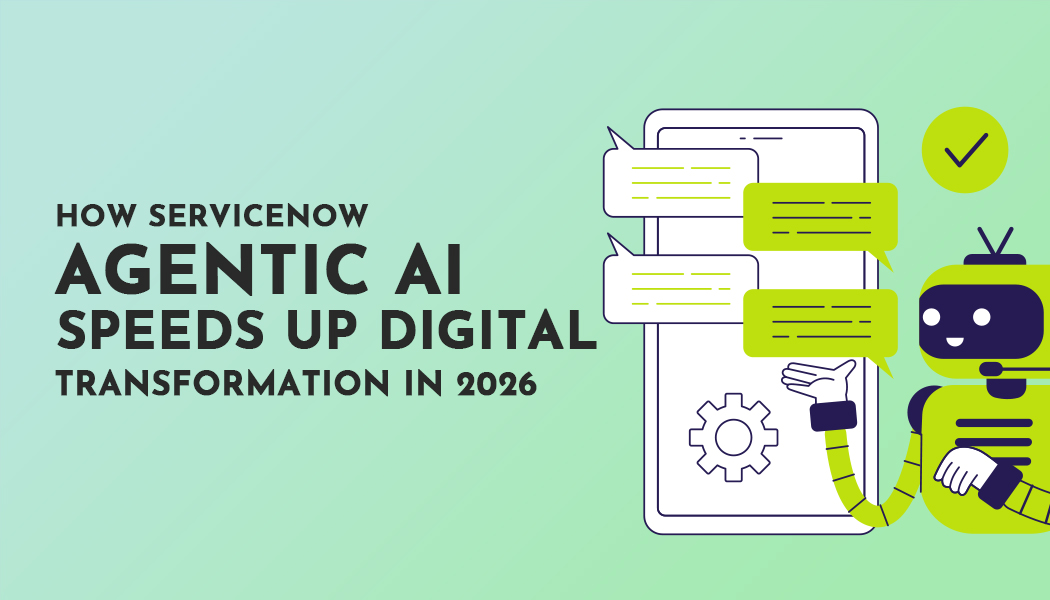
How ServiceNow Agentic AI Speeds Up Digital Transformation in 2026
As the rapid industry shifts and digital economic reforms happen, ServiceNow Agentic AI is recognized as an organ of digitizing enterprise workflows, linking IT, employee services, customer service, and security from a single platform. But Modern digital transformation surely does not ask us for systems that only complete the hardwired workflows; it needs to work on platforms that can think, act, and learn themselves.
Agentic AI The Agentic AI brings smart agents to bear, which can comprehend business context, coordinate across domains, and perform multi-step actions without constant human handholding. And finally, these agents are managed, controlled, and monitored inside of ServiceNow, so that the customer can trust, secure,r e and govern their use across the enterprise.
This blog post is woven on the concept of what ServiceNow’s Agentic AI really is and how it changes the digital space. And also, unpacking the challenges, building blocks, and use cases of ServiceNow Agentic AI.
What is ServiceNow Agentic AI?
ServiceNow Agentic AI is a native ecosystem of independent AI agents in ServiceNow that can plan, decide, and take action autonomously. It’s not here to help users or hint at what might come later. But it is accountable for results across the business processes.
The classic ServiceNow AI capabilities revolve around automation and helping. And Generative AI can assist users in writing or summarizing. But many of these approaches are still very dependent on humans to review, approve, and execute work. However, the Agentic AI is generally capable of allowing an AI agent to independently act based on predetermined rules and policies without relying on developers.
Some Characteristics of ServiceNow Agentic AI
The Agentic AI from ServiceNow encompasses a set of advanced, platform-specific capabilities that empower self-directed processes to achieve outcomes across the enterprise.
But ServiceNow Agentic AI is organized to do work right, operating in the context of governance and security on the ServiceNow Platform. Here are the main features:
1. Goal-Driven AI Agents
ServiceNow Agentic AI uses a set of specialized AI agents that can operate spontaneously once they have an objective in mind. They do not wait around for specific instructions, but go out and get the job done by evaluating the situation, determining what needs to be done, and completing tasks on their own. But this allows ServiceNow to move the conversation beyond advice and actually fix stuff in IT, HR, customer service, security, and more.
2. Multi-Agent Collaboration and Orchestrator
Processes within your business often span different departments. ServiceNow Agentic AI utilizes an AI Agent Orchestrator that orchestrates different specialized agents working together towards a common goal. Furthermore, each agent manipulates a portion of the process, sharing context and dependencies. This orchestration also enables complex, cross-functional processes to run as unified activities instead of separate jobs.
3. Guided Self-Action with Human Monitor Actions
Agentic AI: The Gift of Targeted Human Supervision. Agents can independently execute low-risk tasks while asking for human consent to take high-risk actions. But this balance ensures that companies can move quickly and effectively, while maintaining governance, compliance, and trust.
4. Collaboration with External Systems
Normally, ServiceNow Agentic AI integrates with automation applications and services via the Integration Hub. That allows agents to perform tasks outside of the ServiceNow ecosystem - it might encompass account provisioning, updating systems elsewhere, triggering external workflows, and enabling “true end-to-end automation” across an enterprise’s technology ecosystem.
Key Concepts of ServiceNow Agentic AI
ServiceNow Aegntic AI is built on the concept of Demo explains how this came about and what’s different versus typical automation or other AI tools. But grasping the fundamentals makes it easier to understand why, when connected with AI-enabling capabilities, ServiceNow makes digital transformation part of its DNA.
ServiceNow Agentic AI is rooted in AI agents. Maybe an AI agent is like a virtual employee, also, and can get some job done and decide how to do it themselves. What is more, unlike chatbots, which are only able to answer questions, these agents can carry out actions.
How ServiceNow Agentic AI Plays a Role in the Digital Transformation
Before the rise of AI, digital transformation was based largely on manual techniques, siloed systems, and reactive maneuvers. Organizations commonly face sluggish approval procedures, human error, disparate systems, and limited scalability.
Even with automation software in place, many workflows still required human oversight, and hence, slow, costly , and buggy transformation projects were the norm. These limitations inhibited the achievement of truly efficient, integrated , and scalable business flow in organizations.
1. ServiceNow Agentic AI
ServiceNow Agentic AI is a breakthrough in digital transformation: It infuses intelligence and autonomy directly into enterprise processes. What’s more, unlike traditional AI that only makes suggestions, Agentic AI can take action, make decisions, and complete tasks on its own.
But with predictive analytics and context-aware automation sitting on the Now Platform, sound predictions are directly built into workflows that help accelerate work at higher precision, so your employees can focus on innovation instead of menial tasks.
2. ServiceNow Virtual Agent AI for IT Operations
For IT departments, Agentic AI increases efficiency as it streamlines incident management, problem resolution, and service request fulfillment. But it autonomously triages tickets, finds the root cause, and takes action.
In addition, this reduces downtime, improves system reliability, and allows IT operations to work proactively to drive digital transformation versus reacting to issues.
3. AI in Human Resources
In HR, Employee Support AI optimizes processes such as onboarding, leave management, payroll queries, and employee helpdesk. But automating menial tasks and giving quick responses make employees happier and more engaged. Plus, organizations can scale the workforce's capabilities up without adding staff.
4. Client Assistance and Solutions
In customer service, Agentic AI can automatically ask and answer questions, solve common problems, and automate proactive help. This leads to faster ticket resolution, better customer satisfaction, and more efficient support. In addition, it also accelerates and contributes to a smooth digital-first customer journey.
What Does the Future Hold for ServiceNow Agentic AI in Digital Transformation?
ServiceNow Agentic AI tends to play an important role in digital transformation. The following are the reasons elaborating on the idea of what the future holds regarding ServiceNow Agentic AI:
1. From Automation to Autonomous Digital Functions
Moving away from We are moving away from rule-based automation to fully autonomous processes in the digital arena. Agentic AI systems will not need to receive bullet points from human operators who successfully cluster what the goals and contexts mean, but by themselves understand what outcome is desired when they act on the relevant fragment of capital available in a given context. Digital platforms will not just facilitate workflows—they’ll manage outcomes, making operations faster, smarter, and more resilient.
2. AI-Integrated Digital Platforms
Agentic AI will become an integral part of digital platforms rather than just being a peripheral feature. AI agents will be embedded in the enterprise at the level of workflows, data formats, and decision criteria. These agents will have continuous learning from enterprise data such as events, users’ activity, policy, and performance information, and allow platforms to adapt themselves to dynamic business realities on their own.
3. Advancing Corporate Technology Framework
The next technology stack for Agentic AI will combine enterprise data lake(s), large language models, live analytics, and workflow engines. This architecture will enable AI agents to reason across systems, work with other agents, and complete goals in the context of both internal and external platforms. Integration layers and APIs are also going to be crucial in enabling true end-to-end automation.
4. Integrated Governance, Security, and Trust
As Agentic AI gains autonomy, governance will be based on policy and automation. Guardrails, approval thresholds, and compliance rules will be set up by organizations that agents are to follow. Transparency and comprehension will help institutions to track decisions and maintain trust; protection provisions will protect sensitive data and systems.
5. Self-Repairing and Forecasting Digital Systems
We’re on the cusp of Agentic AI and self-repairing digital ecosystems. Systems will detect problems, predict failures, and take action before they impact users. Making the shift from a reactive to a proactive approach to operations will significantly reduce downtime, improve service quality, and enhance digital experiences.
Conclusion
ServiceNow Agentic AI powers travel's digital transformation by driving autonomous, intelligent workflows that enable predictive and proactive work from planning to doing in end-to-end enterprise operations. Additionally, goal-oriented AI agents can be embedded into the Now Platform to eliminate manual efforts and increase productivity while achieving faster, more predictable outcomes.
An era of Independently Savvy Digital Operations. As organizations move to 2026, ServiceNow Agentic AI is the key to unlocking for teams the capacity to focus on innovation and strategy.