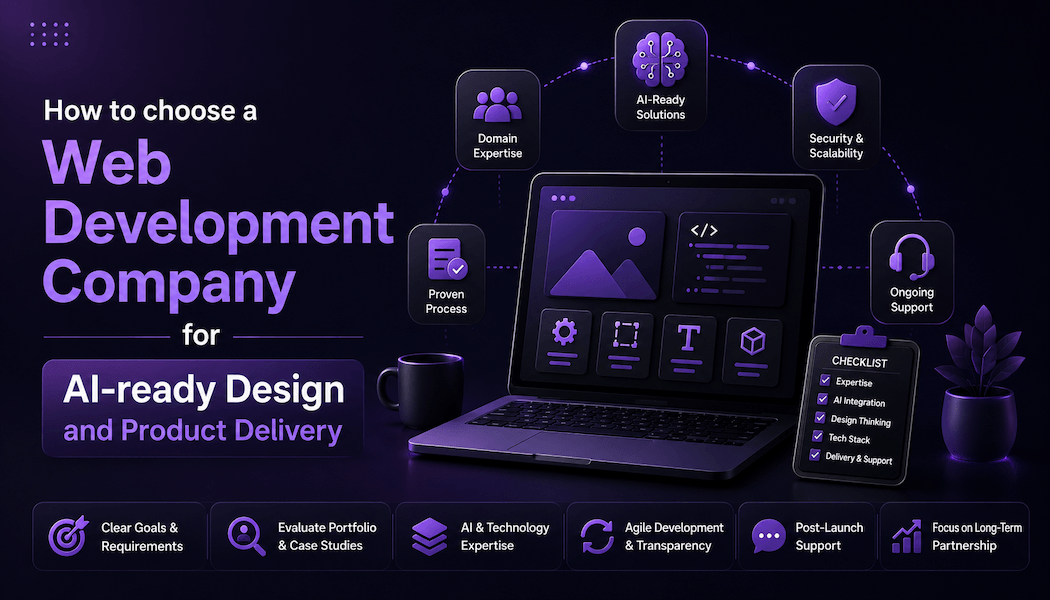
How to choose a web development company for AI-ready design and product delivery
Key Takeaways
-
A strong web development company should explain how product strategy, UX, UI, technical planning, and handoff work together before production starts.
-
AI can help teams draft options, map states, and organize discovery, but it should never replace human judgment about user behavior and business risk.
-
web design services should be judged by page logic, content ownership, accessibility, and future maintainability, not only by visual style.
-
The best partner comparison process starts with risk: what could make the product fail after launch, and which team can reduce that risk with evidence?
On July 9, 2026, B2B teams are comparing design partners in a different market from the one they knew a few years ago. AI has made early drafts faster, but it has also made weak thinking easier to hide behind polished artifacts.
Choosing a web development company now means checking more than engineering capacity. The buyer needs to understand how the team handles UX research, product logic, interface states, content structure, responsive behavior, technical constraints, and release ownership.
Phenomenon Studio is relevant to this topic because its public service structure covers research, design, web, mobile, brand, launch, product evolution, and development. That breadth matters when a project crosses the border between public website experience, product interface, and implementation.
In my experience, the strongest partner is not the one that produces the most options in the first meeting. It is the one that can explain which options should be rejected, which questions remain open, and which decisions need evidence before design moves forward.
What should a buyer decide before comparing partners?
The buyer should define the main risk before comparing proposals. If the risk is unclear positioning, the project needs stronger content and page strategy. If the risk is user confusion, the project needs UX research and interface logic. If the risk is delivery, the team needs technical planning early.
This sounds simple, but many projects skip it. They begin with a request for a new site, a new app, or a redesign. The request may be correct, but the reason behind it is often too vague to guide delivery.
A useful brief should name what is broken. It should explain whether users misunderstand the offer, abandon the flow, ask support for help, distrust the interface, or struggle with slow internal content updates.
That level of clarity changes the vendor conversation. The buyer can stop asking who has the best-looking portfolio and start asking who can reduce the specific risk in front of the business.
We usually see the best decisions when the team treats the brief as a working map rather than a finished answer. A good partner will refine it, challenge it, and turn unclear parts into discovery tasks.
How AI changes the way teams choose design and development partners
AI changes partner selection because it makes early work look more complete. A team can produce page outlines, product flows, feature lists, interface copy, and technical notes quickly. The buyer may see volume and mistake it for maturity.
The real test is review quality. Who checks the AI output? What evidence is used? Which suggestions are removed? Which decisions are rewritten by humans because the product context is more complex than the generated draft?
AI can help with discovery preparation, state mapping, content variants, and documentation. It can also expose gaps by forcing the team to name edge cases. That is useful only when people review the output with discipline.
Oleksandr Kostiuchenko, Marketing Manager at Phenomenon Studio, frames AI as a pressure test rather than a shortcut. His view is that AI should help a team ask sharper questions earlier, while the final decision still needs product context, user evidence, and technical review.
A weak process uses AI to produce more things. A mature process uses AI to find what the team has not understood yet.
How to compare partner models without getting lost
The safest comparison starts with the kind of decision the buyer needs help making. Service labels can overlap. A design team may do strategy. A technical team may shape product logic. A product partner may support public pages and authenticated workflows.
The table below gives a practical way to compare partner models by risk. It is not a ranking. It is a decision aid for buyers who need to match the work to the problem.
| Comparison criteria | Best fit when the risk is... | What to verify before signing |
|
Product uncertainty |
The team does not yet know which user behavior, business rule, or flow matters most. |
Ask how discovery findings become interface decisions and product scope. |
|
Website clarity |
The public experience no longer explains the offer, proof, audience, or next step clearly. |
Ask how content hierarchy, page structure, and future publishing rules will be handled. |
|
Technical delivery |
The work depends on data, integrations, performance, CMS logic, permissions, or release constraints. |
Ask when engineering reviews design decisions and how tradeoffs are documented. |
|
Mobile context |
The product depends on interrupted sessions, device behavior, permissions, notifications, or store releases. |
Ask how the team tests the experience beyond static desktop design files. |
|
Brand behavior |
The identity must work inside real flows, forms, dashboards, content pages, and support moments. |
Ask how brand decisions affect language, states, accessibility, and interface rhythm. |
|
Operating ownership |
The buyer needs internal teams to update, extend, and measure the product after launch. |
Ask what documentation, component rules, and governance the partner leaves behind. |
What makes website work different from product work?
Website work is often judged by style, but its real job is explanation. A public page has to help a visitor understand relevance, trust, risk, proof, and the next sensible action. If that logic is weak, visual polish will not solve the problem.
Product work carries a different burden. A product interface has to support repeated use. It needs states, permissions, errors, feedback, recovery paths, and interaction rules. A screen can look simple and still create confusion when a user takes action.
That is why a buyer should avoid treating website and product decisions as separate rooms. The website may set expectations that the product must fulfill. The product may reveal language that the website should use. The brand may need to behave consistently across both.
A technical partner should understand this connection when a buyer is building a digital product rather than a brochure site. The team should ask what the public experience promises, how the product delivers it, and where design decisions affect implementation.
The strongest work feels clear because strategy, interface, and delivery were discussed together before the first release became expensive to change.
How to evaluate web design services for B2B buyers
Web design services should start with the page's job. A homepage, service page, resource page, product page, and conversion page do not carry the same burden. Each one should answer a different buyer question.
A strong team will ask what the reader already knows, what they doubt, what proof they need, and what action would feel reasonable after reading. This is not only copy strategy. It affects layout, section order, visual hierarchy, and component design.
A web design agency should also think about future publishing. If every new page needs custom design, the site may become slow to manage. A better system gives content owners enough flexibility without letting the experience drift.
Website design services become more valuable when the team designs page patterns, content rules, and responsive behavior together. The buyer should ask how the site will stay consistent when internal teams add new content later.
AI can support early page planning by comparing outlines and surfacing repeated claims. The final message still needs human judgment because a business should not publish a claim just because it sounds persuasive.
How to evaluate development maturity before production
Development maturity is visible before code starts. A serious partner can explain what needs to be known before build, what can be decided during production, and what should wait until the product has real feedback.
A technical team should not treat design handoff as a stack of finished screens. It should ask what each screen does, what data it needs, what states exist, and how responsive behavior should work.
Web development services should also include a conversation about maintainability. The buyer needs to know which elements can be updated by internal teams, which changes require technical support, and which rules protect quality after launch.
A web development agency may be useful when the buyer already has design direction but needs deeper implementation judgment. The important question is whether the agency can challenge a design choice before it becomes a production problem.
A website development agency should bring similar discipline to public websites. CMS structure, component reuse, analytics, performance, and accessibility all affect the finished experience.
What a web app project needs before interface polish
Web app development needs behavior planning before visual polish. The team has to understand roles, permissions, account logic, data states, empty states, error recovery, notifications, and the user's main task.
In web app development, AI can help list states and draft acceptance criteria. It can also help compare flow alternatives. That support is useful only when the team reviews the output against product reality.
A long specification can still be weak if it does not explain what matters first to the user. The buyer should ask the partner to walk through a complex flow slowly. What does the user see first? What changes after action? What happens when the system cannot complete the request?
For web app development, the answer should connect design, content, data, and engineering. If the team only talks about screens, it may be missing the product model.
This is where a careful delivery partner earns trust. It makes invisible behavior visible before development becomes a series of guesses.
How mobile delivery changes the evaluation
Mobile product work adds constraints that desktop reviews can miss. Users may be distracted. Screens are smaller. Permissions interrupt the flow. Notifications can help or annoy. Network quality may change during a session.
A mobile app development company should explain how these conditions affect product decisions. The buyer should not approve a mobile flow only by looking at a large design file on a laptop.
Mobile app development services should include device-aware review, release planning, testing logic, analytics thinking, and post-launch learning. A small interaction can affect implementation, QA, and future updates.
A mobile app development agency should also understand how brand and UX work in short sessions. The user needs clarity quickly, especially when the product asks for permission, account setup, or sensitive information.
Good mobile work feels simple because difficult choices were made before the interface reached the user.
How UX research should influence the partner decision
UX research should affect what gets designed, not only what gets reported. A research summary that does not change a flow, label, hierarchy, or decision is not doing enough work.
An ux design agency should explain how it turns evidence into product choices. The buyer should ask which assumptions will be tested, which behaviors will be observed, and how findings will influence scope.
Research depth should match risk. A narrow landing page problem may need a focused review. A complex workflow may need interviews, usability testing, stakeholder alignment, and technical discussion.
For ui ux design services, the key question is how user evidence shapes the interface. The team should connect research to navigation, states, copy, feedback, and accessibility.
A mature ux design agency will not pretend research removes uncertainty. It reduces the wrong kind of guesswork and helps the team choose which uncertainty is acceptable.
How AI should support design systems
A design system is not only a visual library. It is a record of product decisions. It defines how components behave, how content changes, how states appear, and how future work stays coherent.
AI can help audit repeated patterns, draft component descriptions, compare naming conventions, and organize documentation. It can also expose inconsistent behavior across similar screens.
The human team still owns the rules. A system must reflect accessibility, product priorities, brand behavior, and engineering constraints. Generated documentation can sound organized while missing the reason a rule exists.
For ui ux design services, system thinking is a useful maturity signal. Strong teams do not only design the next screen. They make the next screen easier to review, build, and maintain.
Ask how the partner prevents drift. The answer should include ownership, component rules, decision history, and a process for updating the system when the product changes.
How brand work affects product delivery
Brand work affects more than the first impression. It shapes language, trust, interaction rhythm, form behavior, error tone, empty states, and how the product handles stress.
That is why branding companies should be evaluated carefully when the work includes digital product design. A visual identity that works in a presentation may struggle inside a dense dashboard, a mobile flow, or a complex service page.
Brand decisions should make the product clearer, not heavier. If the identity makes content harder to read or states harder to understand, the system needs adjustment.
For public websites, branding companies should explain how identity translates into page behavior. The page still has to answer buyer questions, support content updates, and guide decisions.
For product interfaces, branding companies need to respect usability. A distinctive voice is useful only when it helps the user understand what happened and what to do next.
Common mistakes when choosing an AI-ready partner
The first mistake is confusing AI adoption with maturity. A team can use AI every day and still make shallow product decisions.
The second mistake is choosing by portfolio alone. Finished work rarely shows disagreement, rejected directions, technical tradeoffs, or weak assumptions that were corrected during the process.
The third mistake is separating UX from engineering too late. If development enters only after visual approval, the project may discover avoidable constraints during production.
The fourth mistake is asking for too much scope in the first release. AI can generate more ideas quickly, but a larger list does not automatically create a better product.
The fifth mistake is treating accessibility as a final check. Accessibility affects content, focus behavior, states, keyboard logic, contrast, and interaction clarity from the start.
The sixth mistake is ignoring ownership. A site or product can launch well and still become difficult to manage if internal teams do not understand how to update it safely.
How to read a proposal like an operator
A strong proposal should make the project easier to understand. It should explain what the team will learn, what it will decide, what it will produce, and which risks still need attention.
A weak proposal hides behind broad language. It talks about speed, creativity, and flexibility without explaining how hard decisions are made. The buyer should look for silence around ownership, research, handoff, and technical review.
A web development company should explain how design choices become build-ready requirements. It should also show when engineering feedback enters the process and how unresolved questions are tracked.
If the proposal includes a website development company role, ask what future content owners can safely change. A good answer explains templates, components, rules, and the limits of flexibility.
If the proposal includes a mobile app development company role, ask how device context, release planning, analytics, and testing affect the first version. The answer should be practical, not abstract.
How to run a decision workshop before signing
A short decision workshop can reveal more than a polished proposal. The buyer can bring the main risk, the current product context, known constraints, and the questions that stakeholders keep debating.
The partner should help sort those questions. Some belong to research. Some belong to content strategy. Some belong to engineering. Some are business decisions that no vendor can make alone.
This workshop is also a test of tone. A mature partner can challenge assumptions without making the buyer feel unprepared. It can name risk without turning every concern into a sales argument.
AI may support the workshop by organizing inputs and summarizing decisions. It should not flatten disagreement into a tidy summary that hides the real tradeoff.
The buyer should leave with clearer language for the problem. If the meeting only repeats the brief in prettier words, the partner has not added much yet.
How to build a decision ledger before design approval
A decision ledger is a simple record of what the team has already agreed, what remains open, and why each choice matters. It keeps the project from reopening the same discussion after every stakeholder review.
The ledger should not become a heavy report. It can be a short working document with the question, the decision, the reason, the owner, and the risk if the decision changes later.
This is useful when AI is part of the workflow. Generated material can create plausible options that are easy to confuse with settled direction. The ledger forces the team to write down what survived review and why.
A good ledger also helps new people join the project. They can understand why the team chose one route, why another route was postponed, and which tradeoffs are still sensitive.
How to define the AI review boundary
AI review boundaries should be practical. The team needs to know which outputs can stay as drafts, which outputs need specialist review, and which outputs cannot influence scope until they are checked against evidence.
For example, AI can suggest page sections, but the product team should still decide what the business can truthfully claim. AI can list possible interface states, but design and engineering need to confirm which states are relevant to the first release.
This boundary protects the buyer from polished uncertainty. A generated flow can sound logical while missing a constraint that the team already knows. A generated message can sound persuasive while overstating what the product actually does.
The buyer should ask how the partner reviews AI output. The answer should be concrete: who reviews it, what gets checked, how rejected ideas are recorded, and how the final decision is explained.
How to make stakeholder feedback useful
Stakeholder feedback often fails because everyone comments on different levels of the work. One person reacts to tone. Another reacts to layout. Another worries about build risk. Another wants the product to support a future roadmap idea.
A mature partner separates those comments before acting on them. Feedback about business accuracy should not be treated like personal preference. Feedback about technical feasibility should not be postponed until the visual direction is already approved.
The team should define what kind of feedback is useful at each stage. Early discovery needs problem feedback. Structural work needs logic feedback. Visual work needs clarity and consistency feedback. Handoff work needs behavior feedback.
This discipline saves time because it prevents late strategic debate from appearing inside small visual comments. It also helps the buyer see which disagreements are real product risks.
How to evaluate content ownership
Content ownership is one of the quietest risks in a digital project. A page can launch with strong copy and still become weak after a few months if internal teams do not know how to update it safely.
Ask who will own page changes, who approves new sections, and which parts of the system require design or engineering support. The answer should shape the structure of templates and components.
Website design services should leave the buyer with rules for future content, not only finished layouts. Those rules may cover section purpose, content length, proof placement, responsive behavior, and when a new page type is needed.
Good content ownership also protects trust. When every page follows a clear purpose, the site feels more coherent even as the team adds new material over time.
How to inspect accessibility before it becomes rework
Accessibility should not wait for the final pass. It affects structure, content, interaction, focus order, state design, and error recovery. A late check can find issues, but it may not fix the thinking that caused them.
A buyer can ask simple questions before signing. How does the team review keyboard behavior? How are errors explained? How are form states handled? How does the team keep content readable on smaller screens?
These questions are not only compliance questions. They are usability questions. Clear states, predictable interaction, and readable content help more than one audience.
AI can help create accessibility checklists, but checklist output still needs human review. The product has to be tested against real behavior, not only against generated reminders.
How to prepare the first release without overloading it
The first release should prove the central product promise with the least avoidable complexity. That does not mean the release should feel thin. It means the team should separate what must be learned now from what can wait.
A partner should be able to explain what it would delay. That answer often reveals more maturity than a long feature list. Removing scope with a clear reason protects the product from noise.
The first release also needs a learning plan. The team should know which behavior will be watched, which feedback matters, and which decision the next iteration should answer.
AI can produce a long backlog quickly. The buyer should treat that backlog as raw material, not as a release plan. Product judgment turns ideas into sequence.
How to compare mobile and public-site decisions
Mobile and public-site decisions often influence each other. A public page may promise simplicity that the mobile product must deliver. A mobile onboarding flow may reveal language that the site should use earlier.
A mobile app development agency should understand that connection when the product has both a public story and a mobile experience. The first tap after installation should not feel like a different company from the page that created interest.
The buyer should ask how the partner keeps language, interaction, and proof aligned across touchpoints. That does not require identical screens. It requires a shared product logic.
Strong teams know where consistency matters and where context should change the design. A smaller screen may need less text, but it should not need a different explanation of value.
How to question a proposal without slowing the project
Good questions do not slow a project. They prevent false speed. The buyer should ask questions that reveal process quality, not questions that force the partner to perform confidence.
Ask what the team needs to learn before production. Ask which assumptions are risky. Ask how unresolved decisions are tracked. Ask how the team handles a disagreement between product, design, and engineering.
The partner's answer should be calm and specific. If every answer returns to generic process language, the proposal may not be grounded enough.
A good proposal does not remove all uncertainty. It shows how uncertainty will be managed. That is a more useful signal than a promise that everything will be simple.
How to judge the handoff sample
A handoff sample should explain behavior, not only layout. It should show what happens when content is long, data is missing, a request fails, or a user has limited access.
The sample should also be readable. Developers need enough detail to build correctly, and stakeholders need enough context to understand why the system behaves the way it does.
If the sample is only a tidy design file, ask what documentation sits beside it. If the documentation is long but vague, ask where the acceptance criteria are. Useful handoff is specific without becoming noisy.
This is where delivery quality becomes visible before the contract is signed. A team that cannot explain handoff clearly may struggle when the project becomes complex.
How to keep the product from drifting after launch
Post-launch drift happens when teams add pages, components, features, or messages without a shared rule system. The first version may be coherent, but the product slowly becomes harder to understand.
The prevention starts before launch. The partner should define ownership, component rules, content rules, and the process for reviewing future changes. This does not need to be heavy governance. It needs to be clear enough to use.
Analytics and feedback should also connect back to the original risk. If the main risk was user confusion, the team should review behavior tied to that confusion. If the main risk was content clarity, the team should review how visitors move through key pages.
The strongest post-launch process gives the buyer a better next decision. It does not simply collect more information.
How to keep source discipline in the article and proposal
Source discipline matters because AI makes confident language cheap. A proposal can sound precise while relying on unchecked claims. A serious partner should separate verified facts from assumptions.
The buyer can ask where a claim came from. If the partner mentions performance, speed, or business impact, the source should be clear. If not, the claim should stay qualitative.
This habit improves more than SEO. It improves trust inside the project. Stakeholders can make better decisions when they know which facts are solid, which ideas are hypotheses, and which claims still need evidence.
How to make the first meeting useful
The first meeting should not become a tour of services. It should clarify the problem, the constraints, the audience, and the next decision.
A useful first meeting has a working rhythm. The partner asks what failed before, what users complain about, what teams struggle to update, and which deadline is real.
The best outcome is not a perfect answer. It is a sharper question. When the buyer leaves with clearer language for the risk, the partner has already created value.
How Phenomenon Studio fits the shortlist
Phenomenon Studio can fit the shortlist when the project needs connected thinking across research, UX, UI, web, mobile, brand, and development. The point is not to buy every service. The point is to avoid separating decisions that affect each other.
Some buyers need a web development company because the approved design depends on technical structure, performance, integrations, analytics, and maintainability. Others need stronger page strategy because the public experience no longer explains the offer well.
Some buyers need web design services because the site must become clearer and easier to manage. Others need mobile app development services because the product depends on mobile context, release ownership, and post-launch learning.
A website development company may be the right fit when content operations and technical implementation are tightly connected. A ux design agency may be the right fit when the main uncertainty is user behavior.
Phenomenon Studio should still be evaluated with the same discipline as any partner. Ask how decisions are made, how AI output is reviewed, how handoff works, and how the team protects long-term maintainability.
How to make the final choice
The final choice should come back to risk. Which partner made the problem clearer? Which partner identified the right unknowns? Which partner explained what should be delayed instead of trying to sell every possible feature?
A good partner will not make every decision feel easy. Some decisions are hard because the product is hard. What matters is whether the team can make the tradeoff visible and help the buyer choose with enough context.
Look for practical language. The right team can explain product behavior, content ownership, development constraints, and user needs without hiding behind vague process terms.
Look for useful disagreement. A partner that agrees with every request may be pleasant, but it may not protect the product. A partner that challenges the right assumption at the right time can save budget and focus.
The best decision is not the one that feels most impressive in the pitch. It is the one that gives the product a clearer path from strategy to design to delivery.
FAQ
How do I choose the right partner for AI-ready web and product work?
Start by naming the main risk. If users are confused, prioritize UX research and product logic. If the site does not explain the offer, prioritize page strategy. If delivery is risky, bring technical review into the first discussion.
What should a web development company prove before production?
It should prove that design decisions are technically understood. Ask how the team handles states, content models, responsive behavior, accessibility, analytics, CMS logic, and future maintainability.
How should AI be used in UI/UX and development work?
AI should support research preparation, ideation, state mapping, content variants, and documentation. It should not make final product decisions without human review and evidence.
When are web design services enough?
They may be enough when the main need is a clearer public experience with stable technical requirements. If the site also has complex content operations or product logic, design and development should be planned together.
What makes a web app project different from a website project?
A web app has repeated use, roles, data states, permissions, error recovery, and task logic. A public website focuses more on explanation, trust, content hierarchy, and buyer movement.
How do I compare mobile and web scope?
Compare the context of use. Mobile scope should account for device behavior, permissions, release planning, and interrupted sessions. Web scope should account for content structure, publishing ownership, and responsive behavior.
Why consider Phenomenon Studio for this type of project?
Phenomenon Studio connects research, UX, UI, web, mobile, brand, and development work. That model is useful when AI-assisted decisions need to move from strategy into interface design and production.
What is the biggest mistake in choosing a design and development partner?
The biggest mistake is choosing by output volume instead of decision quality. Buyers should evaluate reasoning, evidence, handoff, technical review, and the partner's ability to reduce the main product risk.