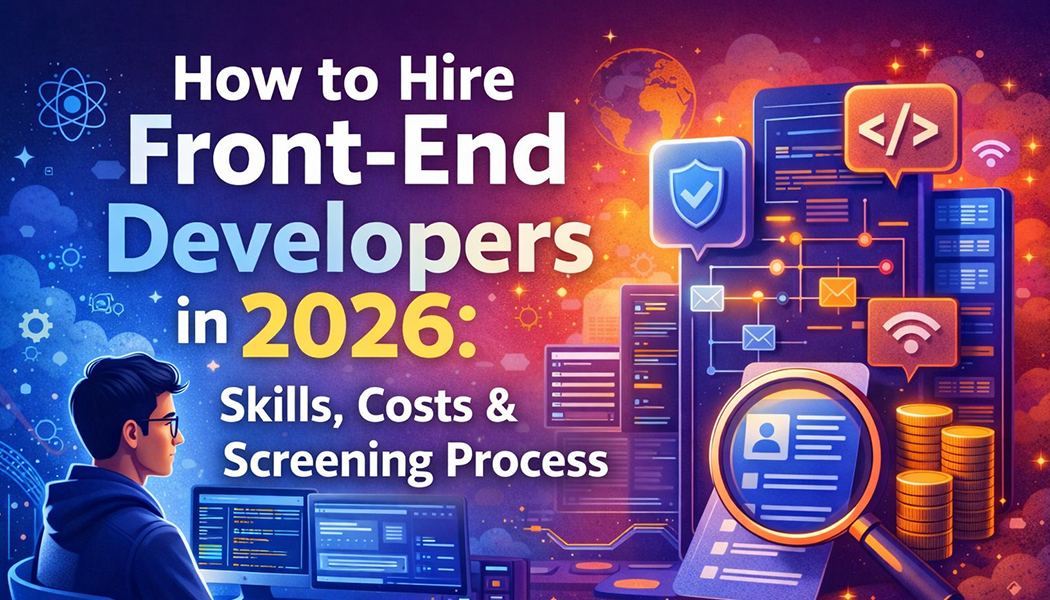
How to Hire Front-End Developers in 2026: Skills, Costs & Screening Process
Hiring the right front-end developer determines how users experience your product. Interfaces define whether users stay, convert, and continue using the software. Even powerful backend architecture cannot compensate for slow, inconsistent, or poorly implemented UI.
Companies that successfully hire front-end developers usually follow three core principles:
• They clearly define the skills required for modern UI development
• They understand realistic hiring costs across global markets
• They evaluate candidates through structured technical screening
This guide explains how to hire front-end developers in 2026, what skills to prioritize, how much developers cost, and how to assess candidates properly.
Why Front-End Developers Have Become Critical Product Roles
The design systems that translate into actual digital products are created by front-end developers. The role of front-end developer connects the visual aspect of a design and the logic of how it will function for the user.
The influence of a front-end developer's role in changes to the following metrics of the product:
- UX (user experience) and clarity of the UI (user interface).
- Load performance of the application and speed of response.
- Compatible with all device types.
- Compliance with accessibility guidelines.
- Consistency between all browsers.
Front-end implementations that are poorly designed will lead to a high bounce rate and decreased engagement with the overall product. A delay in the interface loading or responding to input will result in a loss of conversion and negatively impact how a user perceives the product.
For this reason, many companies work with specialized teams providing front end development services. Experienced engineers ensure that design concepts translate into stable, scalable, and high-performance interfaces.
Core Skills Front-End Developers Must Have in 2026
Front-end development evolves constantly. Modern engineers must combine strong technical fundamentals with experience in modern frameworks and design collaboration.
Hiring managers should evaluate candidates across several skill categories.
Strong Fundamentals in Web Technologies
Web technologies form the basis of all front-end development.
Front end Developers should possess a thorough understanding of HTML 5, CSS 3, and modern JavaScript, which also determine how browsers will render a page or interact with users.
An experienced Front end Developer will also have expertise in semantic markup, browser compatibility, responsive layout strategies, and JavaScript execution.
When a developer is knowledgeable about the browser rendering pipeline, they can optimize their code for performance and prevent delays in a given user interface.
Ultimately, solid fundamentals will always be worth more than current framework fashions.
Experience with Modern Front-End Frameworks
A large number of today's apps depend on using frameworks that enable scalable user interface architectures.
React has become and continues to be one of the most used frameworks used to build complex web applications. Vue is generally preferred when creating quick, light-weight user interfaces; whereas, Angular is more commonly found within enterprise-level apps that require strict compliance with architectural standards and long-term maintainability.
Many teams use additional frameworks such as Next.js to facilitate server-side rendering (SSR) and improve the SEO performance of their apps.
It is important to have knowledge about component architecture, state management patterns, routing strategies, and also consider creating a modular user interface design.
Responsive and Mobile-First Development
Responsive layout for digital products needs to be available on a range of devices and screen sizes.
Developers should have experience with implementing responsive layouts using CSS Grid, Flexbox, and adaptive breakpoints, with the idea of mobile-first development still being an important aspect of modern front-end architecture.
A good engineer will ensure that interfaces are functional and visually similar across smartphones, tablets, laptops/large screens.
Another benefit of a responsive build is improved accessibility and search visibility.
Performance Optimization
Users are used to very quick application responses. Because of that, one of the largest parts of front-end engineering is optimizing performance.
Developers can enhance speed with methods such as code splitting, lazy loading, compressing assets and efficiently interacting with APIs. Developers also monitor the rendering of elements to minimize unnecessary reflows and optimize the responsiveness of the application.
Performance improvements typically lead to increased retention rates and enhanced engagement level of users.
Ability to Work with Designers
Product designers work closely with front-end developers through a collaborative environment to ensure that all interfaces look and feel exactly as intended for the end user.
Web developers often use software programs like Figma or Adobe XD as design tools and work with designers to interpret their design systems so they can create visual elements that will then be reused as UI components.
Great engineers are able to preserve visual consistency throughout the entire application and also keep a scalable and maintainable code base.
How Much It Costs to Hire Front-End Developers in 2026
The cost of hiring a developer can differ based on experience level, the complexity of the project, and the geographic area being considered.
Developers based in North America typically charge the most, with senior level engineer rates often falling between 90–160 USD per hour.
Western European based developers will charge within the range of 70–120 USD/hour.
Eastern European nations have become some of the best countries to outsource software development to. Their companies provide very beneficial levels of technical knowledge, while charging 40–80 USD/hour for development work.
Many developers from Asian countries may charge from 30–70 USD for their work based on how much experience they have.
Companies utilize distributed development teams to help balance out the costs and levels of expertise; by utilizing distributed development teams, they can have access to a large pool of qualified developers without having to pay for a large in-house team.
Hiring Models for Front-End Developers
Organizations usually choose one of three hiring approaches depending on product needs and growth stage.
Building an In-House Development Team
Bringing on full-time engineering talent creates/creates stability in the long-term and deeper expertise of the product.
By providing internal developers with a strong understanding of the product vision, internal developers will create a more integrated relationship with developers, making communication easier.
It will help in making sure that all development decisions stay in control of the company. The downside is that recruiting experienced engineers can take a long time (often more than six months), and recruiting experienced engineers.
Salaries/benefits, along with recruiting costs, contribute to increased operational costs to companies. This model generally works best in companies with more established, stable development pipelines.
Hiring Freelance Developers
Freelancers can assist companies on short-term basis by completing projects like developing landing pages, fixing UI issues, or developing a small feature. Companies benefit from this type of working relationship because they are able to quickly add resources as needed and maintain flexibility with their resource pool. This type of arrangement can be especially useful for start-up companies looking for occasional front-end expertise.
Freelancers frequently work on many projects at one time, and it may be difficult to guarantee their availability to continue working with the company over an extended period when developing complex software.
Typically, freelancers do not replace a dedicated software development team when building large products or software applications.
Working with Development Agencies
Agencies work with pre-constituted teams consisting of engineers, designers, project managers, and testers to help companies quickly bring their products to market and lower the cost of hiring new employees. They provide established development frameworks and technical leadership, allowing new or developing businesses to achieve a combination of development speed, skill, and timeline predictability.
Step-by-Step Screening Process for Front-End Developers
Hiring front-end engineers should follow a structured evaluation process. This helps reduce hiring mistakes and ensures that candidates truly possess the required skills.
Step 1: Analyze Portfolio and Past Projects
Looking to build a real interface? The portfolio of a developer will reveal how they built their real interfaces.
A hiring manager should look for layout complexity, responsive design and overall interface structure.
Utilizing code repositories such as GitHub also gives great insight into coding practices, documentation style and collaboration history.
In addition, projects that demonstrate well thought out UI architecture indicate strong engineering ability.
Step 2: Conduct Technical Interviews
Through technical interviews, a developer's understanding of theory can be evaluated. The big-ticket items are usually the foundational aspects of JavaScript, large-scale application design, CSS layout methods, and communication with APIs.
Rather than coding technologies, a developer should express how they solved an actual challenge on their interface.
Step 3: Assign a Practical Coding Task
By providing developers with real-world problems, this practical assignment will help expose the developer to practical application of their skills.
For example, if the project consisted of creating a simple interface using React or developing a responsive component, this will give the developer an opportunity to show you how they would approach the project using good code quality, logical project structure and sound logical problem-solving skills.
Step 4: Evaluate Communication and Collaboration
Front-end developers collaborate on a variety of teams. To do their jobs well, they need to effectively communicate with designers, back-end developers, and product managers. Good communication skills also help to lower the potential for miscommunication during the development process and to improve team coordination throughout the project. Front-end developers that are able to communicate their technical thought processes are typically able to transition into established teams more easily than those who cannot.
Step 5: Assess Team Compatibility
Cultural compatibility matters as much as technical expertise.
Developers should demonstrate ownership, openness to feedback, and a problem-solving mindset. Teams with strong collaboration dynamics consistently deliver better results.
Common Mistakes When Hiring Front-End Developers
There are common challenges that many organisations face when it comes to hiring new employees. Some of these challenges include:
Focusing too much on frameworks when hiring (as opposed to hiring someone with good foundational programming skills)
Not considering design understanding (front-end developers need to properly interpret design systems, otherwise they won't provide visual consistency)
Some teams do not complete coding tests and rely on interviews to evaluate candidates' skills. This means that there is an increased risk of hiring a candidate whose skill level does not meet the hiring manager's expectations.
Lastly, employers often make rushed hiring decisions and as a result will incur costly recruitment errors.
When Outsourcing Front-End Development Makes Sense
Many companies choose to outsource their front-end development as a strategy for growth.
Companies use this strategy if they need to speed up their time to market, get specialized engineering skills, or grow their team size quickly.
An experienced development partner will have an established workflow and will have both technical leadership and a predictable delivery time for completed projects.
This gives the company the ability to focus more on its business strategy and product growth while experienced engineers focus on the interface architecture and the implementation of the product.
Conclusion
If you want to hire front end developers in 2026, it is important that you have a plan in place. You should know the impact that front-end engineering has had on users and how they interact with digital products.
Most companies that hire successfully focus on three main points: having solid technical fundamentals as a priority, knowing what the realistic costs of hiring someone will be, and having a thorough screening process in place.
By executing these items, companies can create a dependable front end development team capable of creating an extremely fast, intuitive, and scalable user interface experience.
For many companies, working alongside experienced front-end development professionals can make a great deal of difference when it comes to streamlining the hiring process and speeding up the product development cycle.