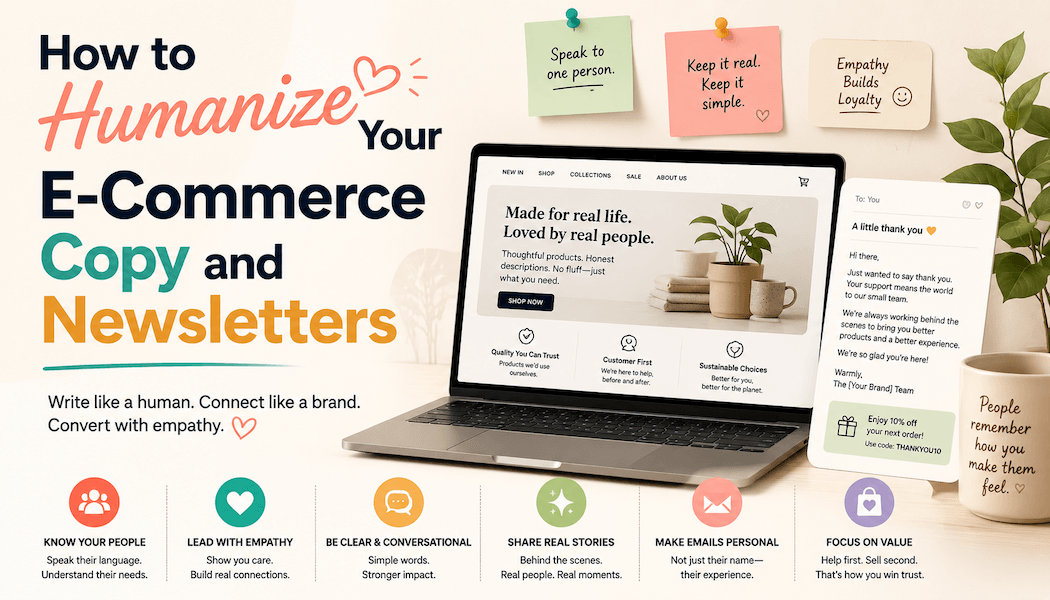
How to Humanize Your E-Commerce Copy and Newsletters
Customers want to buy from people, not software. If your product descriptions sound like a technical manual, you are losing sales. People buy based on emotion and justify with logic. Robotic copy kills that emotional connection before it even starts. You need to bridge the gap between a cold screen and a warm conversation. This guide will show you how to transform stiff text into engaging, brand-aligned content that resonates with your audience.
The first step in this process involves understanding how your brand sounds. You cannot humanize your copy if you do not know who is supposed to be talking. Think about your brand as a person. Is this person funny, serious, or perhaps a bit rebellious? Once you define these traits, you can start applying them to every sentence you write. This consistency builds trust because customers feel like they are getting to know a real personality over time.

When you start drafting, you might find that your initial thoughts come out a bit dry. This is normal. Many writers use an AI Humanizer to help smooth out the rough edges of their first drafts. These tools can take a list of facts and turn them into a narrative that flows naturally. It helps you move away from bullet points and toward a story that highlights why your product actually matters to the person reading it.
Using a humanize ai free no limit tool allows you to experiment with different tones without worrying about restrictions. You can test how a playful tone sounds compared to a more professional one. This experimentation is vital for e-commerce because different products might require slightly different approaches. A luxury watch needs a different voice than a pair of colorful socks, but both should still feel like they were written by a human who cares about the quality.
Step 1: Define Your Brand Personality
Start by listing five adjectives that describe your brand. If your brand was a guest at a dinner party, how would they behave? Would they be the life of the party or the one sharing deep insights in the corner? Write these traits down and keep them visible while you work. This list acts as your North Star. Every time you write a newsletter or a product description, check it against these adjectives.
If your adjectives are friendly, helpful, and energetic, your copy should use active verbs and exclamation points sparingly. If your adjectives are sophisticated, calm, and reliable, your sentences should be longer and more rhythmic. Avoid trying to be everything to everyone. A focused personality is much more memorable than a generic one that tries to please every single person who visits your site.
Step 2: Draft the Core Message
Before you worry about the fluff, get the facts right. What does the product do? What problem does it solve? Write a simple, boring draft first. Do not worry about being creative yet. Just make sure the information is accurate. For a newsletter, decide on the one main action you want the reader to take. Do you want them to click a link, use a discount code, or read a blog post?
Once you have the facts, look for the "so what" factor. If a shirt is made of organic cotton, the "so what" is that it feels incredibly soft against the skin and lasts for years. If a newsletter offers a 10 percent discount, the "so what" is that the reader can finally treat themselves to that item they have been eyeing. Focus on the benefit to the customer rather than the feature of the product.
Step 3: Apply the Human Touch
Now it is time to rewrite that boring draft using your brand voice. Replace corporate jargon with words you would use in a real conversation. Instead of saying "utilize," say "use." Instead of "purchase," say "buy" or "grab." Small changes in word choice make a massive difference in how a reader perceives your brand. You want to sound like a helpful friend giving a recommendation.
Read your copy out loud. If you find yourself tripping over a sentence or running out of breath, the sentence is too long or too complex. Human speech is naturally rhythmic and varied. Use short sentences for impact and longer sentences for explanation. This variety keeps the reader engaged and makes the text feel less like a wall of words and more like a dialogue.
Step 4: Personalize Your Newsletters
Newsletters are personal by nature because they land in an inbox. Use the recipient's name, but do not stop there. Segment your list so you are sending relevant content to the right people. If someone only buys men's shoes, do not send them a newsletter about high heels. Humanizing your newsletter means showing the customer that you know who they are and what they like.
The subject line is the most important part of your newsletter. It should sound like it came from a person, not a marketing department. Avoid using all caps or too many emojis. A simple, intriguing subject line often performs better than one that looks like an advertisement. Think about the emails you actually open from your friends and try to mimic that level of directness and honesty.
Step 5: Test and Refine
The final step is to see what works. Use A/B testing for your subject lines and product descriptions. You might find that your audience responds better to humor than you expected. Or you might find that they prefer a very straightforward, helpful tone. Data is the best way to refine your human voice over time. It tells you what resonates and what falls flat.
Check your customer service inquiries and reviews. The language your customers use is the language you should be using. If they keep calling your product "cozy," start using that word in your descriptions. Using their own vocabulary back to them is the ultimate way to show that you are listening. It creates a feedback loop that makes your brand feel deeply connected to its community.
Tips and Best Practices
To keep your copy fresh and human, follow these simple guidelines. They will help you maintain your voice even as your business grows.
* Use "You" and "I": This creates an immediate connection between the writer and the reader.
* Tell a Story: Instead of listing features, describe a scenario where the product makes life better.
* Be Specific: General claims like "high quality" are boring. Describe the stitching or the weight of the fabric instead.
* Show Empathy: Acknowledge the customer's pain points before offering your product as a solution.
* Use Contractions: Words like "don't" and "can't" sound more natural than "do not" and "cannot."
* Avoid Over-Explaining: Trust your audience to understand your meaning without hitting them over the head with it.
Common Mistakes to Avoid
Even experienced writers fall into traps that make their copy sound robotic. Watch out for these common errors.
| Element | Robotic Style | Humanized Style |
| Tone | Formal and distant | Warm and inviting |
| Focus | Technical specifications | Customer benefits |
| Sentence Structure | Repetitive and stiff | Varied and rhythmic |
| Vocabulary | Corporate jargon | Simple and clear |
| Call to Action | Click here to purchase | Grab yours today |
One big mistake is being too formal. Many business owners think they need to sound "professional" to be taken seriously. In reality, being too formal makes you sound unapproachable. You can be professional while still being friendly and relatable. Another mistake is using too many adjectives. Let your nouns and verbs do the heavy lifting. If a product is great, describe what it does rather than just calling it "great."
Do not ignore the power of white space. A giant block of text is intimidating and looks like a legal document. Break your copy into small paragraphs. Use bullet points for lists. Make it easy for the customer to scan the page and find the information they need. If they have to work too hard to read your copy, they will simply leave your site.
Conclusion
Humanizing your e-commerce copy is not about being perfect. It is about being real. When you move away from robotic, generic descriptions, you give your customers a reason to care about your brand. You turn a simple transaction into a relationship. By following these steps, you can ensure that your brand voice remains authentic while still driving the results you need.
Start small by updating your most popular product descriptions. Then, move on to your newsletter templates. Over time, you will develop a natural feel for what sounds like your brand and what sounds like a machine. Your customers will notice the difference, and your sales will likely reflect that new connection. Keep practicing, keep testing, and always remember that there is a real person on the other side of the screen.