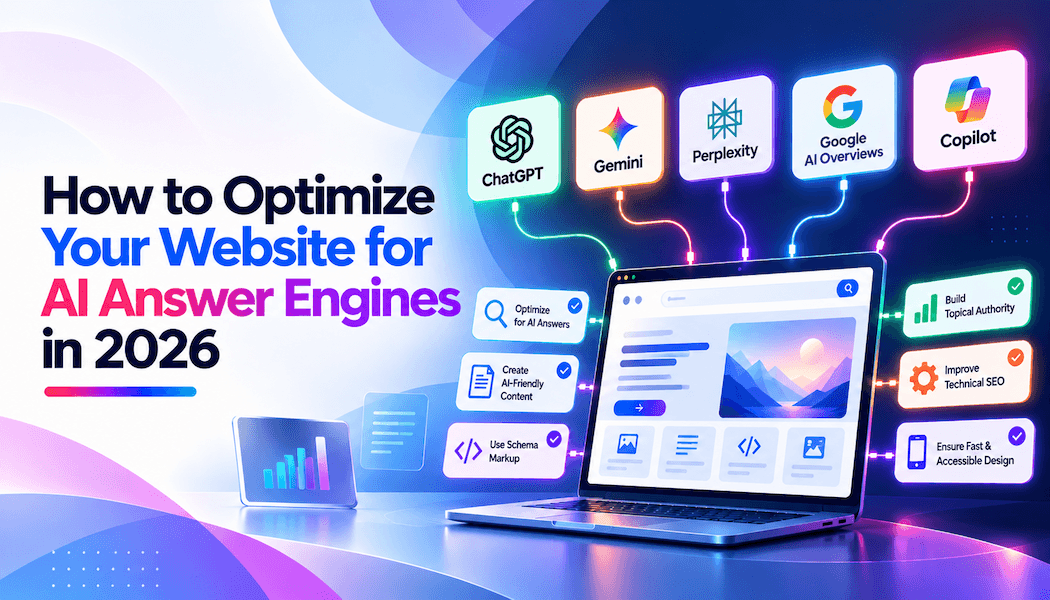
How to Optimize Your Website for AI Answer Engines in 2026
As people increasingly ask AI tools direct questions and expect concise, contextual answers, brands need to think beyond traditional search results. Answer Engine Optimization (AEO) helps make useful information easier to find, understand, and potentially reference in AI-powered answers.
People are changing how they discover information online. Instead of always browsing a list of search results, they may ask ChatGPT, Perplexity, Gemini, or other AI-powered tools to compare products, explain a concept, or recommend a solution. These experiences place greater emphasis on direct answers, context, and information that can be interpreted across multiple sources.
This shift has brought Answer Engine Optimization (AEO) into focus. AEO is the practice of structuring and improving digital content so that answer-focused search experiences can understand it and may use it when responding to relevant questions. It complements sound website design, useful content, technical accessibility, and established SEO practices rather than replacing them.
For teams planning an AEO strategy, an AI visibility platform can help investigate how a brand appears in selected AI search experiences and identify topics that may need stronger content or clearer answers.
1. Start With the Questions Your Audience Actually Asks
AEO begins with understanding user intent. People often ask complete questions in conversational language: “Which project management tool is best for a small team?”, “How does website accessibility work?”, or “What should I consider before choosing a web design agency?”
Research questions from customer support conversations, sales calls, community discussions, site search, product reviews, and keyword research. Group them by intent, such as learning, comparing options, solving a problem, or making a purchase.
Build pages that answer a clear set of related questions instead of publishing many thin pages targeting tiny keyword variations. A useful guide can cover the main question, explain relevant considerations, provide examples, and direct readers to deeper resources.
- Identify the audience and the problem behind each question.
- Separate informational questions from comparison and purchase questions.
- Prioritize questions that align with your real expertise and offerings.
- Use customer language naturally in headings and page copy.
2. Put a Clear, Direct Answer Near the Top
When a page addresses a specific question, make the answer easy to locate. Start with a concise response, then explain the reasoning, details, limitations, and examples. This structure helps busy readers and gives automated systems a clearer passage to interpret.
For example, a page answering “What is AEO?” could begin with a short definition before explaining how answer engines work, which content formats may help, and how a business can measure progress.
Direct answers should be accurate and complete enough to stand on their own. Avoid vague introductions that delay the useful information, but do not oversimplify subjects that require nuance or safety context.
Useful formats include short definitions, numbered steps, comparison tables, troubleshooting guides, FAQs, and concise summaries. Choose the format that genuinely fits the question rather than adding FAQ sections to every page by default.
3. Build Helpful Content Around Entities and Context
Answer engines need to interpret not just individual keywords but also the people, organizations, products, concepts, and relationships discussed on a page. Clear context helps readers understand what a statement refers to and can make the subject easier for systems to interpret.
Use consistent names for your brand, products, services, and key concepts. Explain specialized terms when they first appear, and avoid ambiguous wording that forces readers to guess what “it,” “they,” or “the solution” refers to.
For example, instead of repeatedly writing “our tool helps improve it,” explain which tool is being discussed and what it helps users evaluate. Include relevant examples and link to supporting documentation when useful.
Do not stuff pages with repeated phrases or lists of unrelated entities. The goal is meaningful context, not keyword repetition. Content should read naturally and answer the user's question thoroughly.
4. Demonstrate Expertise and Make Claims Verifiable
AI answer experiences may draw on information from multiple sources, so credibility matters. Publish content that reflects real knowledge, practical experience, and careful research rather than generic statements written only to attract visibility.
Explain how recommendations were developed, provide examples from actual workflows where possible, and cite authoritative references for important factual claims. Clearly distinguish evidence, opinion, estimates, and product claims.
Keep author biographies, company details, contact information, and product documentation accurate. Add publication or update dates when they help readers judge freshness, and revisit pages when standards, products, or recommendations change.
- Use first-hand examples or original research when available.
- Support important claims with relevant, trustworthy references.
- Identify authors and explain relevant expertise.
- Correct outdated information instead of simply adding new paragraphs.
- Avoid invented statistics, unsupported guarantees, and exaggerated claims.
5. Structure Pages So Information Is Easy to Extract
Good content structure benefits both human readers and automated interpretation. Use one clear main heading, descriptive subheadings, short paragraphs where appropriate, and lists for steps or related items.
Use semantic HTML elements correctly. Headings should reflect the page hierarchy; lists should use list markup; tables should be reserved for genuinely tabular comparisons; and links should have descriptive anchor text. Avoid placing essential explanations only inside images or decorative graphics.
Structured data, such as relevant Schema.org markup in JSON-LD, can provide explicit information about a page's content type and entities. For example, Article markup may describe an article's headline, author, and publication date. The markup must match visible content and follow the relevant search platform's guidelines.
Structured data is not a shortcut to AI citations. It does not guarantee that an answer engine will select or mention a page. Use it where appropriate as one part of a clear, accessible publishing system.
6. Make Important Content Accessible to Crawlers
Even excellent answers may not be discoverable if the relevant page cannot be accessed or interpreted. Review technical fundamentals such as indexability, robots.txt rules, canonical URLs, redirects, internal links, and XML sitemaps.
Check that important content is available in the rendered page and does not depend entirely on an interaction that crawlers cannot use. Ensure key pages return the correct HTTP status and that internal links point to valid destinations.
Different AI products and search services may use different crawlers, retrieval systems, and access policies. Review official documentation for the services relevant to your audience before making crawler-specific changes. Do not assume that allowing one crawler guarantees access to all AI platforms, and do not block a crawler without understanding the potential consequences.
Performance and accessibility also contribute to a reliable experience. Optimize large assets, maintain mobile usability, provide keyboard support, and use meaningful alternative text for informative images. These measures improve the website for visitors while strengthening its technical foundation.
7. Use FAQs and Comparison Content When They Help
Frequently asked questions can be useful when customers repeatedly need answers about a product, service, process, or policy. Place each question beside a clear, accurate response and link to a more detailed explanation when needed.
Comparison pages can also serve users who are evaluating alternatives. Explain the criteria, identify who each option may suit, and disclose limitations or trade-offs. Avoid presenting biased comparisons as objective research.
FAQ content should not be created simply because it is assumed to unlock special AI visibility. Search features and eligibility rules vary, and structured FAQ markup does not guarantee a rich result or AI citation. Choose formats based on user needs first.
8. Measure AEO Progress With a Repeatable Process
AEO measurement is more complex than checking a single ranking. AI responses can vary by prompt wording, location, model, product version, and time. Treat individual observations as directional evidence, not a permanent ranking position.
Create a representative set of questions that real customers might ask. Test them consistently across the AI experiences relevant to your market, recording whether your brand appears, which pages are referenced when citations are available, and whether the description of your business is accurate.
Combine these observations with website analytics, referral traffic, conversions, branded search trends, and feedback from sales or support teams. This wider view helps distinguish visibility signals from business outcomes.
- Choose a focused set of relevant customer questions.
- Record a baseline of brand mentions and cited pages where available.
- Identify missing answers, weak explanations, and inaccurate brand details.
- Prioritize changes by user value, business relevance, and effort.
- Repeat the checks and document what changed over time.
An AI visibility audit can be a practical starting point for identifying potential gaps and deciding which pages or topics deserve closer review. Treat audit findings as leads to investigate, then validate them against your own content, analytics, and business priorities.
Conclusion
Answer Engine Optimization is best approached as a content and discoverability discipline, not a collection of tricks for influencing AI systems. The strongest foundations are straightforward: understand real customer questions, provide direct and accurate answers, demonstrate expertise, organize information clearly, and make important pages technically accessible.
Use semantic HTML and appropriate structured data to describe your content, maintain consistent brand information, and measure AI visibility with repeatable tests. No tactic can guarantee that a particular answer engine will cite a page, so avoid promises of instant inclusion or guaranteed recommendations.
By focusing on useful answers and trustworthy information, businesses can make their websites more helpful for people while improving their readiness for evolving AI-powered discovery experiences.