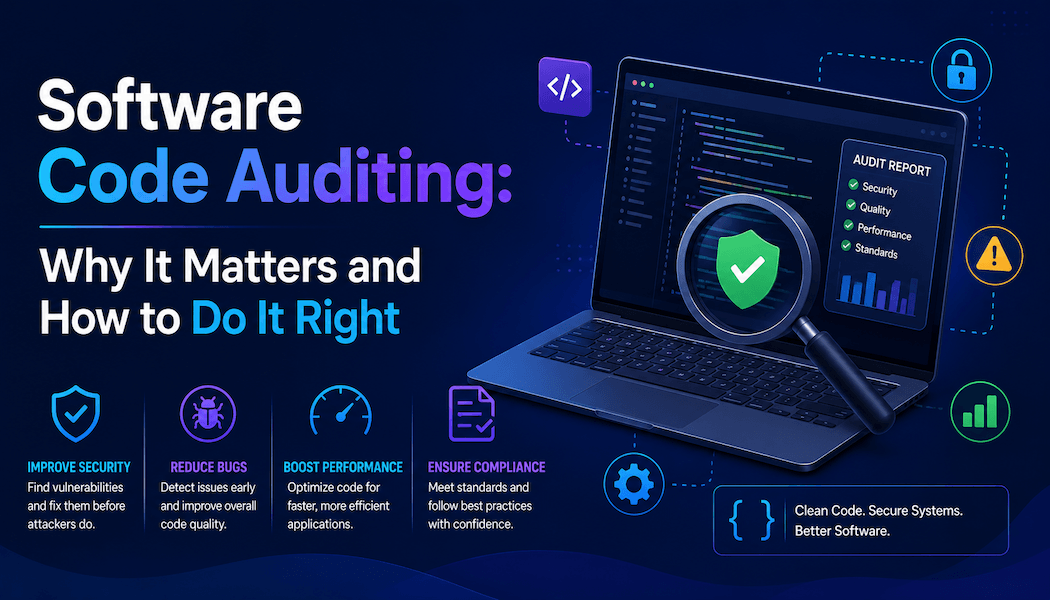
Software Code Auditing: Why It Matters and How to Do It Right
Code audits help detect security risks early. They reveal vulnerabilities in authentication, data handling, and system configuration before these issues lead to breaches or data loss.
They reduce long-term maintenance costs. Early detection of architectural flaws and technical debt prevents expensive fixes after deployment and lowers ongoing support effort.
They improve system performance and stability. By identifying inefficient logic, slow queries, and resource bottlenecks, audits help systems run faster and more reliably.
Software code auditing gives companies a clear and objective view of how their product behaves beyond the surface level. Many teams rely on testing and monitoring, but these approaches often miss structural issues hidden inside the codebase.
A structured audit fills this gap. It exposes risks, highlights inefficiencies, and helps teams make confident technical decisions. In many cases, companies turn to professional code audit services to get an unbiased evaluation and a clear roadmap for improvement.
What is software code auditing?
A software code audit is a systematic review of source code that evaluates its security, performance, and maintainability. The goal is not just to find bugs. The goal is to understand whether the system can support growth without introducing risk.
Audits are commonly used when teams inherit legacy systems, prepare for scaling, or integrate new technologies. They also play a key role in meeting compliance requirements.
According to the OWASP Foundation, insecure code remains one of the main causes of application vulnerabilities. Many issues stem from simple mistakes such as improper input validation or outdated dependencies.
Why code auditing matters in modern development
Software systems continue to be developed at an increasing rate. The addition of additional features, integrations, and updates introduces complexity. If this complexity is not controlled, it becomes a source of technical debt.
Small problems build up over time without being noticed. For instance, a database that responds slowly can result in accumulating technical debt; an outdated library can lead to technical debt building up; and so forth. When this type of issue goes uncorrected over time, it reduces the reliability of the application and increases the cost of maintaining it.
Auditing an application's code produces a complete "state of the system" picture. An audit report will enable teams to determine what is properly functioning, what is not functioning, and what needs modification or repair. Understanding this "state of the system" is critical for determining whether to scale or refactor an application.
What issues are typically found during a code audit
The highest severity issues are typically identified as security vulnerabilities. Authentication issues, unprotected endpoints, and improper data processing are common examples of direct impact on people using the technology, or on organizations using the technology. These issues are most often unseen until something goes wrong.
The second-most common issue is performance problems. Ineffective database queries, blocking operations (such as waiting for a lock to be released), and memory leaks are all performance issues that slow down the application and incur additional cost to the underlying infrastructure.
Architecture defects (i.e., resultant from systems evolving without a clear architectural model) are found in systems that continue to be built in a tightly coupled manner; Subjecting a tightly "coupled" component(s) will be difficult to modify, thus restricting the system's ability to scale; An audit can assist in identifying these constraints and create a plan to remediate them.
Maintainability issues are often delay development; Poorly named fields, no documentation, and/or unclear business logic increase the time to onboard new developers and subsequently slow the time to delivery. Fixing these issues will improve the productivity of the team.
How to perform a software code audit
The first step of a code audit is to establish a clear objective. This could be security, performance, or scalability. Each of these objectives will require its own focused needs.
Secondly, an audit should include reviewing the architecture and all dependencies, including all frameworks, third-party services, and integrations. Outdated components can often introduce hidden risks.
Automated audit tools like SonarQube or Snyk can help perform an initial assessment quickly by flagging common security vulnerabilities and/or poor code quality. However, these tools are useful, but they have limited scope.
The most valuable insight from a code audit will come from manually reviewing the code. Experienced engineers will look at the business logic, the workflow, and any edge cases in order to find issues that automated tools will miss.
The final deliverable should be a detailed report. The report should define what issues exist, where they exist, and why they are important. It should also provide instructions on how to fix each issue. Without actionable recommendations, a code audit is not worth performing.
Tools that support code auditing
In order to perform an effective code audit, one must possess both appropriate tooling and expertise. Static analysis tools can be used to identify code quality issues, while security scanning tools can uncover potential vulnerabilities in dependencies. Performance tools can help identify bottlenecks due to high load.
Therefore, no single tool is sufficient alone; maximum value is created by adding expert analysis and context to the use of multiple tools.
When should you run a code audit?
A good time to conduct a code audit is prior to making significant decisions. Before a launch. Prior to scaling up your business. Before introducing new technologies.
Auditing your code is critical if your system has poor performance or is hard to maintain. Regular audits help developers find ways to prevent errors, rather than just fix them.
Key takeaway
Code review/checking of software is more than just a technical activity. It’s also a strategic method of improving the quality of products and the minimisation of risk.
Companies that routinely engage in audits by their development teams build systems that are easier to maintain, more secure to grow and more dependable for their end-users. This will affect a company’s success and its bottom line in a competitive marketplace.