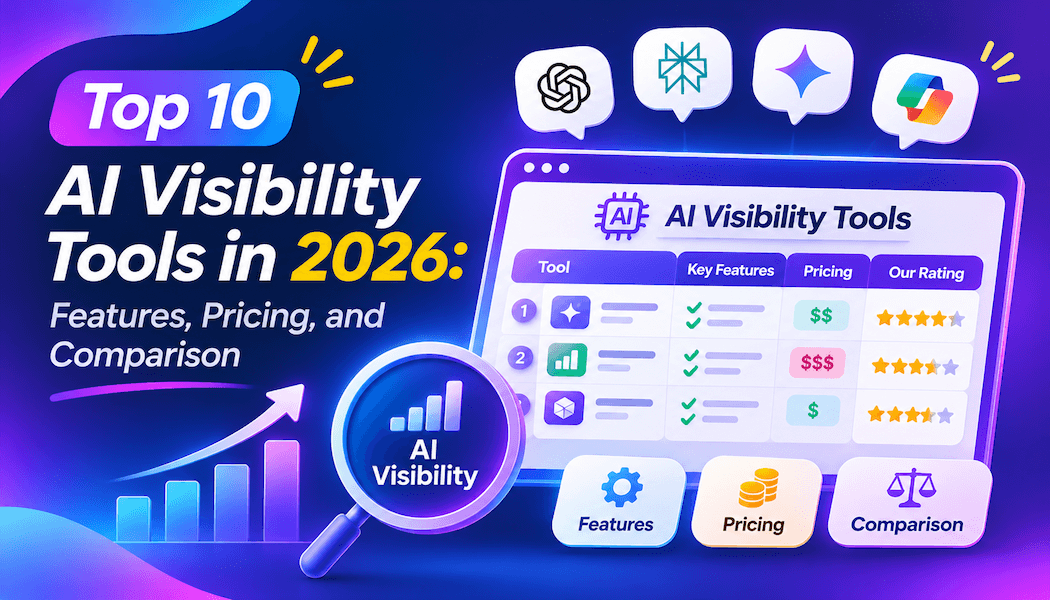
Top 10 AI Visibility Tools in 2026: Features, Pricing, and Comparison
The way people search for information is changing quickly. Not long ago, customers would open Google, compare several websites, read reviews, and then decide which product or service to choose. Today, many people are starting that journey with AI-powered platforms such as ChatGPT, Gemini, and Perplexity.
Instead of browsing multiple search results, users can simply ask an AI assistant to recommend a product, compare software, find a service provider, or explain which company is best for a particular requirement.
For businesses, this creates a new challenge: Is your brand appearing when potential customers ask AI platforms questions related to your industry?
Traditional SEO tools help businesses understand keyword rankings, organic traffic, and backlinks. However, these metrics do not always explain how a brand appears in AI-generated answers. A company might rank well in Google but rarely receive recommendations from AI assistants. At the same time, a competitor with a smaller website might appear regularly in relevant AI conversations.
This is why AI visibility tools are becoming an important part of modern digital marketing.
These platforms help businesses monitor brand mentions, analyze AI-generated responses, compare competitors, track customer prompts, and identify opportunities to improve their online presence.
For agencies, SEO professionals, and in-house marketing teams, choosing the right platform can make AI search monitoring more organized and measurable.
In this guide, we compare ten AI visibility tools worth exploring in 2026, including their main features, pricing considerations, strengths, and ideal use cases.
What Are AI Visibility Tools?
AI visibility tools help businesses understand how their brands, products, and services appear across AI-powered search experiences.
For example, imagine someone asks ChatGPT:
"What are the best project management tools for small businesses?"
The AI assistant might recommend five different products. If your company offers project management software but does not appear in the response, you may be missing an opportunity to reach a potential customer.
AI visibility platforms help investigate questions like:
-
How frequently does an AI platform mention your brand?
-
Which competitors appear in recommendations?
-
What prompts generate brand mentions?
-
Which websites and sources are referenced in AI answers?
-
Does AI describe your business and services accurately?
-
How does your brand visibility change over time?
Some platforms focus mainly on monitoring and reporting, while others also provide recommendations, website audits, or optimization features.
The important difference is that AI visibility measurement looks beyond traditional keyword positions. It examines how brands are represented within AI-generated answers.
Why AI Visibility Matters in 2026
AI-powered search is becoming another important discovery channel. Customers use conversational questions to research products, explore alternatives, compare companies, and make purchasing decisions.
For marketing teams, this means that understanding brand visibility requires looking at more than traditional search rankings.
There are three important reasons to consider AI visibility monitoring.
Brand discovery: Your company needs to be discoverable when potential customers ask relevant questions through AI assistants.
Competitor research: AI-generated recommendations can reveal which competing brands are receiving attention and where your business may have visibility gaps.
Marketing strategy: AI visibility insights can help teams identify content opportunities, improve website information, and develop a stronger digital presence.
AI visibility does not replace SEO. Instead, it adds another layer of measurement to an existing digital marketing strategy.
Top 10 AI Visibility Tools in 2026
The following platforms offer different approaches to AI visibility monitoring. Some are dedicated AI search platforms, while others extend established SEO and marketing products with AI visibility features.
1. ApexaRank AI
ApexaRank.ai is an AI visibility platform designed to help businesses understand how their brands appear across AI-powered search experiences.
For businesses entering the AI search space, one of the first challenges is knowing where they currently stand. They need to understand whether AI platforms mention their brand, which competitors receive recommendations, and where improvements may be needed.
ApexaRank.ai helps businesses evaluate their AI search presence and identify opportunities to improve brand visibility.
One useful starting point is its free AI visibility audit, which gives businesses an opportunity to assess their current presence before deciding on a broader monitoring strategy.
Key features:
-
AI visibility auditing.
-
Brand presence analysis across supported AI platforms.
-
Competitor visibility insights.
-
Identification of potential visibility gaps.
-
Actionable recommendations for improving AI search presence.
Pricing: A free AI visibility audit is available. Check the official website for current platform plans and pricing.
Pros:
-
Provides a starting point for businesses new to AI visibility.
-
Focuses on brand presence and improvement opportunities.
-
Useful for agencies and marketing professionals evaluating client visibility.
Best for: Businesses, digital marketing agencies, SEO professionals, and marketing teams looking to understand and improve their AI search presence.
Start with a free AI visibility audit to check how your brand appears in AI search. Businesses looking for a broader solution can explore the AI Visibility platform.
2. Profound
Profound is an AI search analytics platform designed for brands that need deeper insights into their visibility across AI-generated answers.
For larger organizations, AI visibility monitoring involves more than checking whether a company name appears in a response. Marketing teams may need to understand brand representation, competitor recommendations, prompt performance, and the sources influencing AI-generated answers.
Profound focuses on this type of analysis and provides capabilities for organizations looking to understand their presence across AI search experiences.
Key features:
-
AI search visibility analytics.
-
Brand mention monitoring.
-
Competitor analysis.
-
Prompt and response research.
-
Reporting and performance insights.
Pricing: Profound offers trial access, while its enterprise pricing is generally customized. Contact the provider for a quote and current plan details.
Pros:
-
Designed for advanced brand visibility research.
-
Useful for larger marketing operations.
-
Supports deeper analysis of AI-generated responses.
Best for: Enterprise marketing teams and established brands requiring advanced AI search analytics.
3. Peec AI
Peec AI focuses on monitoring how brands appear across AI-powered search platforms.
One challenge with AI search is that results can vary depending on how a question is written. A business might appear when users ask for the best products in a category but disappear when they ask about pricing, alternatives, or specific features.
Peec AI helps marketing teams monitor these differences and understand how their brands compare with competitors.
Key features:
-
AI visibility tracking.
-
Brand mention monitoring.
-
Competitor comparisons.
-
Prompt-based research.
-
Performance reporting.
Pricing: Paid plans are available at different levels depending on usage and requirements. Check the official pricing page for current amounts and included limits.
Pros:
-
Focuses on AI search monitoring.
-
Useful for competitor research.
-
Suitable for marketing teams that need structured visibility reporting.
Best for: Marketing agencies and businesses that want to monitor brand visibility across AI search platforms.
4. AthenaHQ
AthenaHQ is an AI visibility and optimization platform that helps businesses understand how their brands are represented in AI-generated answers.
For marketing teams, the context of a brand mention is important. A company might appear in a response without being recommended, or an AI assistant might provide incomplete information about its services.
AthenaHQ is worth considering for teams that want to investigate brand representation and identify potential optimization opportunities.
Key features:
-
AI search visibility analysis.
-
Brand and competitor monitoring.
-
Prompt-level insights.
-
Reporting and analytics.
-
Optimization capabilities.
Pricing: AthenaHQ has offered a limited free tier, with paid plans and enterprise options. Its published Starter pricing has been around $295 per month; confirm current pricing and credit limits before purchasing.
Pros:
-
Combines visibility analysis with optimization capabilities.
-
Useful for teams looking beyond basic brand mentions.
-
Offers an entry point for testing the platform.
Best for: Marketing teams and agencies interested in AI visibility analysis and optimization.
5. Otterly.AI
Otterly.AI is an AI search monitoring platform that helps businesses understand how their brands appear in AI-generated responses.
For small businesses and agencies, it can be difficult to manually check every important customer question across several AI platforms. A monitoring tool makes it easier to organize prompt research and review brand visibility over time.
Otterly.AI focuses on tracking brand mentions and understanding how companies are represented in AI search experiences.
Key features:
-
AI search monitoring.
-
Brand mention tracking.
-
Competitor visibility analysis.
-
Prompt monitoring.
-
Reporting and export features.
Pricing: Published Lite pricing has started at approximately $29 per month, with higher plans for additional prompts and capabilities. Check the official pricing page for current limits and add-ons.
Pros:
-
Relatively accessible starting price.
-
Focused on AI search monitoring.
-
Useful for regular brand and competitor checks.
Best for: Small and medium-sized businesses, consultants, and agencies starting with AI visibility tracking.
6. Rankscale
Rankscale is an AI visibility platform that focuses on measuring brand presence across AI search engines.
For marketing professionals, establishing a baseline is an important first step. Without an initial measurement, it can be difficult to understand whether a brand is improving or losing visibility over time.
Rankscale offers tools for monitoring brand visibility, researching prompts, and analyzing competitors.
Key features:
-
AI visibility measurement.
-
Brand and competitor tracking.
-
Prompt-based analysis.
-
AI response and citation insights.
-
Page audits and reporting dashboards.
Pricing: Rankscale has published a credit-based pricing model, with an Essentials option starting around $20 per month on annual billing and a Pro plan around $99 per month. Higher tiers are available for greater usage.
Pros:
-
Credit-based plans offer different usage levels.
-
Provides visibility and competitor insights.
-
Useful for teams that need more detailed reporting.
Best for: Agencies, consultants, and marketing teams looking for flexible AI visibility tracking.
7. Scrunch AI
Scrunch AI focuses on helping brands understand and improve their discoverability across AI-powered search experiences.
AI platforms need to understand what a business offers, who its customers are, and how its products or services relate to different questions. Website content, structure, and brand information can all play a role in making that information easier to interpret.
Scrunch AI is relevant to businesses exploring AI search optimization and brand representation.
Key features:
-
AI visibility monitoring.
-
Brand representation analysis.
-
AI search optimization capabilities.
-
Competitor research.
-
Monitoring and reporting.
Pricing: Published Core pricing has been around $250 per month on annual billing, with higher plans and enterprise options. Confirm the latest package details directly with the provider.
Pros:
-
Combines AI visibility insights with optimization-oriented capabilities.
-
Relevant to brands investing in AI discoverability.
-
Offers options for more advanced requirements.
Best for: Established brands, marketing teams, and agencies working on AI search optimization.
8. Ahrefs Brand Radar
Ahrefs is widely known for SEO, backlink analysis, keyword research, and competitive intelligence. Brand Radar extends its capabilities into AI brand visibility research.
It helps businesses understand how brands appear across AI search experiences and identify the sources and competitors influencing their online presence.
For agencies already using Ahrefs, Brand Radar can complement existing SEO research.
Key features:
-
AI brand visibility research.
-
Brand mention analysis.
-
Competitor comparisons.
-
AI prompt research.
-
Discovery of cited pages and domains.
Pricing: Ahrefs publishes Brand Radar and custom prompt options separately. Brand Radar AI access has been listed from approximately $199 per month, while custom prompt packages have separate pricing. Some AI research features are also included in eligible Ahrefs subscriptions.
Pros:
-
Combines AI brand research with an established SEO ecosystem.
-
Useful for competitor and source research.
-
Offers access to a large prompt research database.
Best for: SEO agencies, consultants, and marketing teams already using Ahrefs.
9. Semrush AI Visibility Toolkit
Semrush has expanded its traditional SEO capabilities to include AI visibility measurement.
The AI Visibility Toolkit helps businesses monitor brand mentions, explore prompts, compare competitors, and understand their presence across supported AI search experiences.
This is particularly useful for teams that want to bring AI visibility research into their existing digital marketing workflow.
Key features:
-
AI visibility reports.
-
Brand performance analysis.
-
Custom prompt tracking.
-
Competitor research.
-
AI readiness site audits.
-
AI search reporting.
Pricing: The published Base plan has been listed at $99 per month per domain with annual billing. It includes tracking for 25 custom prompts and analysis across supported AI platforms. Confirm current billing terms before subscribing.
Pros:
-
Combines AI visibility and traditional marketing research.
-
Useful for existing Semrush customers.
-
Includes competitor and prompt research features.
Best for: SEO agencies, marketing consultants, and businesses already working with Semrush.
10. SE Visible by SE Ranking
SE Visible is an AI visibility tracking solution from SE Ranking, designed to help businesses understand their presence in AI-generated search results.
For agencies, the ability to track multiple prompts and clients is important. Teams need a consistent way to monitor brand mentions, compare competitors, and present findings to clients.
SE Visible is worth considering for agencies that want to add AI visibility monitoring to an established SEO workflow.
Key features:
-
AI visibility tracking.
-
Prompt monitoring.
-
Brand and competitor analysis.
-
AI search performance reporting.
-
Agency-oriented plan options.
Pricing: Published plans have included entry options around $89 per month, with higher tiers for additional prompts and agency requirements. Check the current pricing page for exact limits and billing conditions.
Pros:
-
Designed around AI visibility monitoring.
-
Relevant to SEO and digital marketing agencies.
-
Offers different usage levels for different team requirements.
Best for: SEO agencies and marketing teams looking to combine AI visibility tracking with their broader SEO services.
AI Visibility Tools Comparison: Features and Pricing
Choosing a platform becomes easier when the main differences are viewed together.
The following table provides a quick comparison of the ten tools.
| Platform | Main focus | Pricing overview | Best suited for |
|---|---|---|---|
| ApexaRank AI | AI visibility audits and actionable insights | Free audit; check website for plans | Businesses and agencies |
| Profound | Advanced AI search analytics | Trial and custom enterprise pricing | Enterprise brands |
| Peec AI | AI brand monitoring | Paid plans; check current pricing | Marketing teams |
| AthenaHQ | AI visibility and optimization | Free tier; Starter around $295/month | Agencies and businesses |
| Otterly.AI | AI search monitoring | Starts around $29/month | Small businesses |
| Rankscale | Visibility tracking and reporting | From around $20/month annually | Agencies and consultants |
| Scrunch AI | AI visibility and optimization | Core around $250/month annually | Established brands |
| Ahrefs Brand Radar | Brand and prompt research | Brand Radar AI from around $199/month | SEO professionals |
| Semrush AI Visibility | AI visibility and competitor research | $99/month per domain, annual billing | SEO agencies |
| SE Visible | AI visibility tracking | Published entry plans around $89/month | SEO and marketing agencies |
Pricing is indicative, based on publicly available plan information reviewed for this comparison. Prices, currencies, billing conditions, included prompts, credits, and AI platform coverage can change. Some providers use customized or usage-based pricing. Always verify the current details on the official pricing page before purchasing.
How to Choose the Right AI Visibility Tool
The most expensive platform is not automatically the best option. The right choice depends on what your business wants to measure and how frequently you need the information.
Before selecting a platform, consider these factors.
1. Supported AI Platforms
Check which AI platforms are included in the plan. Depending on your audience, you may need coverage across ChatGPT, Gemini, Perplexity, Google AI Overviews, Microsoft Copilot, Claude, or other AI search experiences.
Do not assume every provider includes all platforms in its entry-level plan.
2. Prompt Tracking Limits
Prompts represent the questions you want to monitor. A small business may only need a focused set of important customer questions, while a large agency may need hundreds of prompts across several clients.
Check how many prompts are included and whether additional prompts require an upgrade.
3. Competitor Analysis
A useful AI visibility platform should help you understand which competing brands appear in relevant responses.
This information can reveal content gaps, differences in brand positioning, and opportunities to improve your website and online presence.
4. Reporting and Client Sharing
For agencies, reporting is especially important. Look for dashboards, export options, scheduled reports, and white-label capabilities if client-facing reporting is part of your service.
5. Actionable Recommendations
A visibility score is useful, but it does not automatically explain what to do next.
Look for platforms that help identify content opportunities, website improvements, competitor gaps, and other practical next steps.
6. Pricing and Scalability
Consider the total cost rather than only the advertised starting price.
Additional prompts, AI platforms, brands, users, locations, and reporting features may increase the subscription cost. Agencies should estimate the cost of managing their full client portfolio before making a decision.
How Marketing Teams Can Turn AI Visibility Data Into Action
Collecting AI visibility data is only the beginning. The real value comes from using the findings to improve marketing activities.
AI visibility is closely connected to broader website optimization strategies. Businesses should not focus only on tracking brand mentions; they should also improve website content, search performance, and user experience. Exploring different AI SEO tools can help marketing teams identify optimization opportunities and build a stronger foundation for organic and AI-powered search visibility.
Here are a few practical ways to get started.
Build a list of real customer questions. Identify the questions people ask before choosing a product or service. Include comparison questions, product-related searches, pricing questions, and industry-specific topics.
Review competitor recommendations. If competing brands appear more frequently, investigate what makes their information useful and relevant. Look for missing topics, unclear product descriptions, and opportunities to publish better resources.
Improve important website pages. Make sure your product and service pages explain what your business offers, who it helps, and why customers should consider it. Use descriptive headings and clear, useful information.
Publish original content. Detailed guides, case studies, comparisons, expert insights, and practical explanations can make your website more valuable to readers.
Monitor brand accuracy. Review how AI platforms describe your company. If information is incomplete or outdated, improve the relevant pages and ensure your business information is consistent across reputable sources.
Measure progress over time. AI responses can vary. Track important prompts regularly and compare results over a consistent period rather than relying on a single check.
There is no guaranteed method for making an AI platform recommend a particular brand. However, useful content, clear brand information, and consistent monitoring can help businesses build a stronger foundation for AI discoverability.
Final Thoughts
AI search is changing how customers discover products, compare services, and evaluate brands. For businesses and marketing teams, understanding this change is becoming an important part of digital strategy.
Platforms such as ApexaRank.ai, Profound, Peec AI, AthenaHQ, Otterly.AI, Rankscale, Scrunch AI, Ahrefs Brand Radar, Semrush AI Visibility Toolkit, and SE Visible offer different approaches to AI visibility monitoring.
Some are better suited to enterprise analytics, while others provide more accessible options for smaller businesses and agencies. The right platform depends on your budget, reporting needs, supported AI platforms, prompt limits, and the number of brands you manage.
If you are just getting started, begin with an AI visibility audit. Identify where your brand appears, which competitors receive recommendations, and which customer questions represent the biggest opportunities.
From there, focus on improving your website content, strengthening brand information, and monitoring relevant prompts regularly.
The goal is not simply to collect more AI visibility data. It is to understand how customers discover your brand and use that knowledge to make smarter marketing decisions.