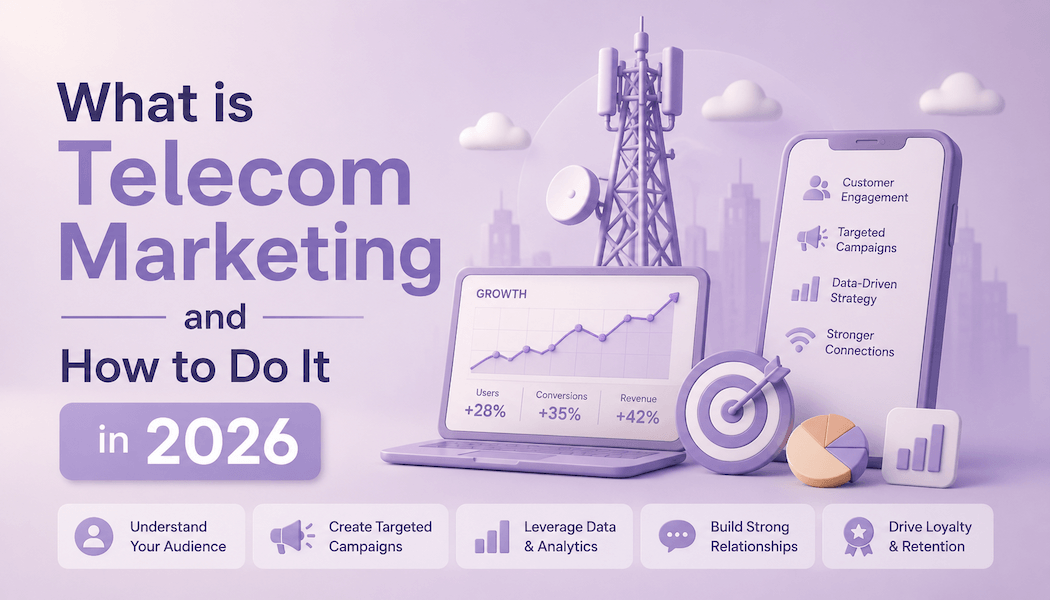
What is Telecom Marketing and How to Do It in 2026
Telecom is under a lot of pressure in 2026. Traditional SIM business models are no longer generating enough profit. Average revenue per user is expected to keep falling through 2028 across mobile, broadband, and voice services. Markets across the US, UK, and much of Western Europe are already saturated, and consolidation is quietly reshaping who even counts as a competitor.
But even during these changes, innovation does occur, and marketers arm themselves with better tools to safeguard against overall revenue decline. AI-driven personalization, eSIM provisioning, and RCS messaging aren't emerging trends anymore; they are now baseline expectations.
But let’s have a better look to see how telecom marketing is adapting to new realities in 2026.
What Is Telecom Marketing?
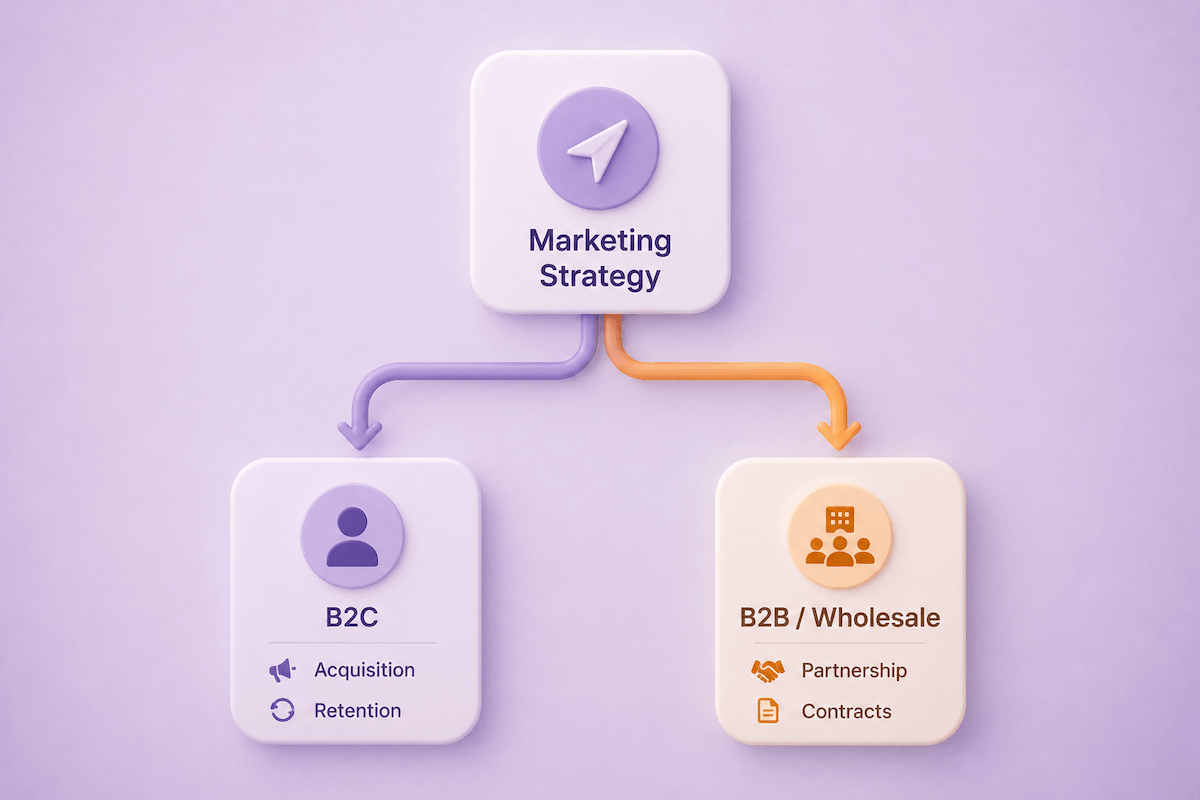
In a broader sense, telecom marketing is a set of strategies a business uses to attract, convert, and retain customers. It usually includes mobile, broadband, landline, TV, and, nowadays, cloud and IoT connectivity.
Any strategy governs the use of channels used to attract clients. It blends traditional ones like TV advertising and sponsorship with digital tactics like SEO, paid search, email, and social. The strategies themselves can be of two types:
- B2C telecom marketing targets individual subscribers. The goals are acquisition, average revenue per user, and retention, and the tactics are built around plans, bundles, and loyalty programs.
- B2B and wholesale telecom marketing targets other businesses: MVNOs, resellers, enterprise clients, and platforms building on top of a carrier's network. The goals shift toward partnership value, integration ease, and long-term contract retention.’
Regardless of the strategy itself, telecom marketing pursues three main goals: drive customer acquisition, increase average revenue per user (ARPU), and promote retention and loyalty.
Core Marketing Channels: A Brief Overview
A lot of telecom marketing still runs through a consistent set of channels, commonly used by almost all teams:
- SEO and content marketing. Captures people actively searching for plans, coverage, or comparisons
- Paid search and paid social. Reaches the same audience faster, at a cost per click that keeps rising as competition intensifies
- Email. One of the highest-performing channels in telecom specifically, since billing and account communications already give brands a reason to be in a subscriber's inbox
- Social media. Handles two jobs at once: real-time customer support and brand visibility
- Sponsorship. Sports teams and major cultural events help carriers stay top of mind in a market where technical differences between providers are hard for most people to notice
Some of the newer emerging channels include messengers, like Telegram, WeChat, or even WhatsApp. Specialized group chats could help improve brand awareness among a relevant audience.
What’s Actually Changing in 2026?
In 2026, four things are actively shaping marketing strategy adjustments in telecom.
eSIMs as a Marketing Asset
The general perception for eSIMs is that they are a threat to incumbent carriers, opening the door to neobanks and dedicated eSIM providers entering the connectivity space. That's true, but it undersells the flip side. For the platforms and mobile data providers on the eSIM side, instant digital provisioning is itself a selling point. No physical logistics, no waiting for a SIM to arrive, activation in minutes rather than days.
AI-Driven Personalization
Personalized offers based on usage patterns, predictive churn modeling, and AI-assisted customer support are already standard practice at larger carriers, discussed across most existing telecom marketing coverage. The opportunity in 2026 isn't adopting AI personalization; it's doing it with enough transparency that customers trust it rather than find it invasive.
AEO is as Important as SEO
As more searches get answered directly inside ChatGPT, Gemini, and Perplexity rather than through a traditional search results page, telecom brands need their content structured to be picked up and cited by these tools, not just ranked by Google.
RCS is Taking Over
Rich Communication Services (RCS) is a new messaging protocol offering a higher degree of customization. You can share high-resolution images, videos, and other media through the internet the same way you’d send an SMS. This means higher-conversion shopping experiences, better trust building, and better performance with deeper customer data, and marketing teams can better personalize for the audience.
B2B and Wholesale Telecom Marketing
Lots of content skips over B2B, but it’s just as important as B2C. And while things are more or less clear with the latter, selling to businesses requires some elaboration.
This is the world of MVNOs, resellers, travel platforms, fintechs, and enterprise brands that need connectivity as a feature of their own product, not their core business. A neobank offering global data, a travel app bundling in connectivity, a fintech adding an eSIM feature for international customers- all of these are B2B buyers operating on different terms than consumer acquisition. The goals shift from subscriber acquisition cost and churn to partnership value, integration speed, and contract retention over a longer sales cycle.
White-label eSIM platforms sit at the center of this shift. Instead of building connectivity infrastructure from scratch, a business can integrate a white-label eSIM solution and launch its own branded offering fast, without the CAPEX burden traditional carriers face. Integration with such platforms is usually done through partnership programs, which can include app development or even simple API integrations.
Measuring Success: A CAC/LTV Framework
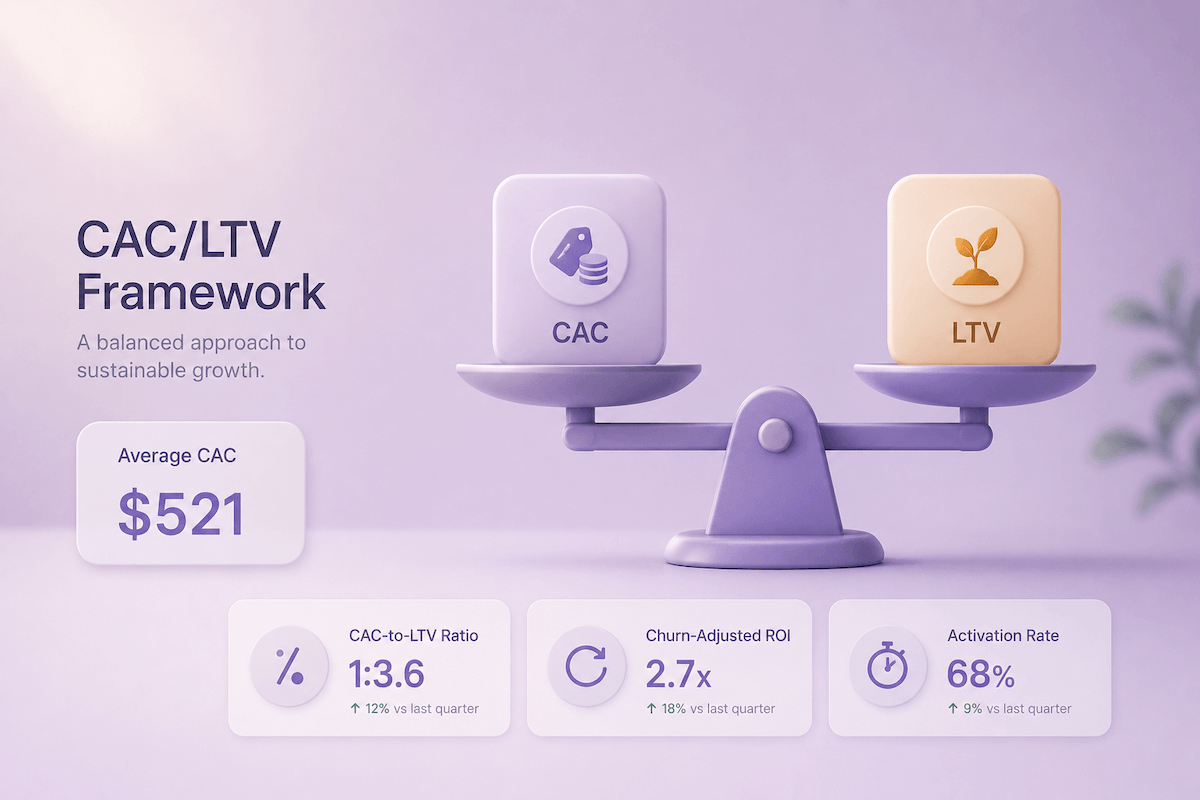
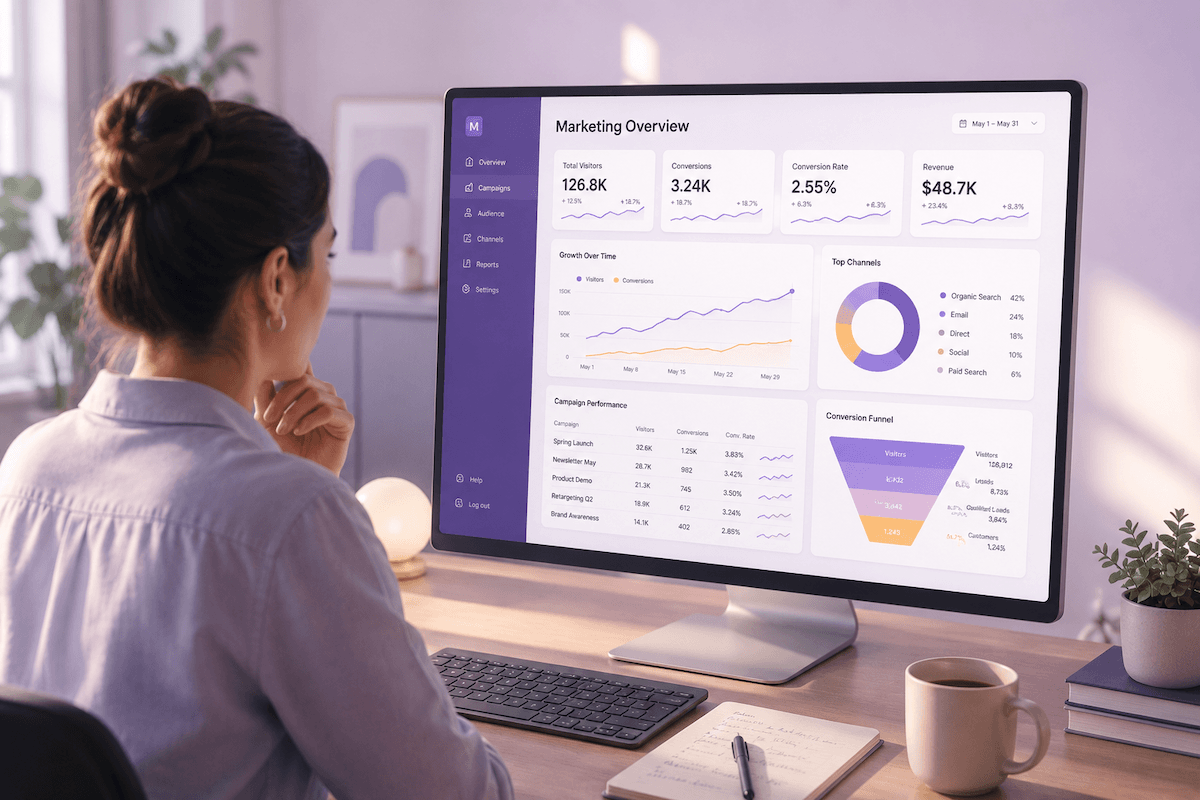
After you figure out the B2B and B2C strategy, metrics are the logical next step. Telecom marketing generates plenty of numbers that actually matter. They come down to a simple comparison: what it costs to acquire a customer against what that customer is worth over time.
Customer acquisition cost (CAC) covers everything spent to win a subscriber, including ad spend, promotions, device subsidies, and any commission paid to affiliates or price comparison sites. In telecom specifically, this number tends to run high (can be as steep as $521).
Lifetime value (LTV) is what that customer generates across their tenure, based on average revenue per user and how long they typically stay before churning. This is where telecom marketing differs from most other industries: with ARPU under pressure and expected to keep declining through 2028, LTV is getting squeezed from both directions, shrinking revenue per customer and persistent churn.
A useful framework tracks three numbers together rather than in isolation:
- CAC-to-LTV ratio: whether acquisition spend is sustainable given what a customer is actually worth
- Churn-adjusted ROI: campaign performance measured against how long acquired customers actually stick around, not just signups
- Activation rate and time-to-activate: increasingly relevant with eSIM and digital onboarding, where speed to first use is itself a conversion metric
A Step-by-Step Framework for 2026
We’ve discussed everything related to telecom marketing in 2026, but how should you put it all together? Here’s how you actually sequence all the presented information:
- Define your audience split. Decide upfront whether a given campaign is targeting consumers, B2B/wholesale partners, or both, since the goals, channels, and sales cycle differ enough that treating them the same wastes budget on either side.
- Map channels to funnel stage, not just to digital versus traditional. SEO and content work at the top of the funnel; paid search and social convert active intent; email and app engagement handle retention. Assign each channel a job instead of running all of them at once with no clear purpose.
- Build compliance in from the start. Telemarketing rules, opt-in requirements for SMS and RCS, and data privacy standards around usage data aren't afterthoughts. Campaigns built without them get rebuilt later at a higher cost.
- Instrument for CAC, LTV, and churn from day one. Set up tracking before a campaign launches, not after, so acquisition spend can be measured against actual retention rather than signups alone.
- Pilot before scaling. Whether it's AI-driven personalization, an eSIM onboarding flow, or a shift toward RCS messaging, test on a limited segment first. Telecom's acquisition costs are too high to learn what doesn't work at full scale.
Closing Thoughts
Telecom marketing in 2026 sits under real pressure: ARPU in decline, markets saturated, consolidation reshaping who's even competing. But the discipline itself has more room to work with than most existing coverage suggests. eSIM is a selling point as much as a disruption. B2B and wholesale connectivity is a market of its own, not an afterthought to consumer acquisition. And measuring success means tracking CAC against LTV and churn, not counting signups.
None of this requires abandoning the fundamentals. SEO, email, paid channels, and sponsorship still do the work they've always done. What's changed is what sits on top of them and how deliberately a marketer sequences the work rather than running every tactic at once.
The brands that do this well in 2026 won't necessarily spend more. They'll just be clearer about who they're marketing to and what they're actually measuring.