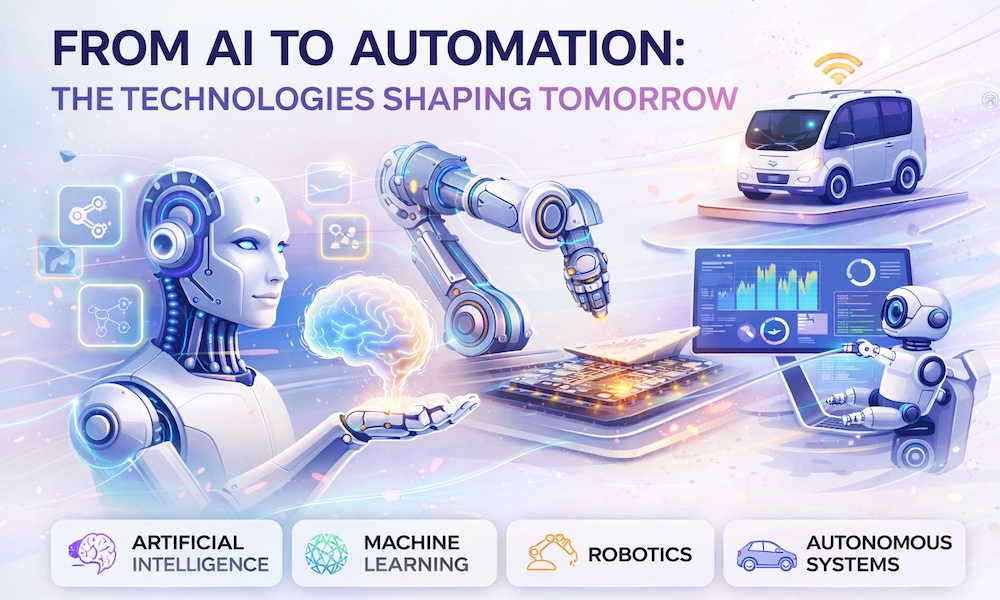
From AI to Automation: The Technologies Shaping Tomorrow
Technological innovation is not just a fancy buzzword anymore it’s the defining heartbeat of our time. Every industry, from healthcare to logistics, is waking up to a new era where artificial intelligence and automation aren’t distant possibilities but lived realities. The boundaries between human ingenuity and machine capability are becoming more fluid with every passing day. This convergence isn’t about replacing humans, it's about amplifying what we can do, rethinking how we work, and redesigning society’s blueprint for progress.
The Rise of Thinking Machines
Artificial Intelligence (AI) has matured far beyond algorithms crunching numbers or bots sending canned responses. Today, AI learns, adapts, and even creates. Machine learning models can predict diseases before symptoms appear, while generative AI crafts music, art, and stories that challenge our own imagination. In business, AI systems analyze consumer behavior in real time, helping companies anticipate needs rather than react to them. What’s truly groundbreaking is how these technologies personalize experiences intuitively and redefining customer engagement from transactional to emotional.
Take healthcare, for example. AI algorithms now scan thousands of medical images in seconds, spotting anomalies that might take human eyes hours or occasionally miss altogether. In education, adaptive learning platforms analyze how each student learns best and adjust instructions accordingly. The beauty of AI lies not in mimicry but mastery the ability to interpret, refine, and optimize processes at a speed and scale previously unimaginable.
Automation: Beyond Assembly Lines
While AI represents the “thinking” aspect, automation carries the “doing” force behind progress. Traditional automation was about machinery repeating tasks relentlessly and factory arms assembling cars or conveyor belts packaging goods. But today’s automation transcends physical production lines. Software bots now perform administrative duties, freeing teams from drudgery to focus on creative, strategic work.
RPA (Robotic Process Automation) is quietly revolutionizing back offices, automating data transfers, invoice processing, and report generation. Imagine a workplace where your calendar syncs itself, your reports format automatically, and your emails organize by priority all without you lifting a finger. The result isn’t cold efficiency but creative liberation. Automation, in its most empowering form, doesn’t remove humans; it removes monotony.
Convergence: When AI Empowers Automation
When artificial intelligence merges with automation, you get intelligent automation, a transformation that’s propelling entire industries forward. AI helps machines make nuanced decisions, while automation executes them flawlessly. In logistics, autonomous drones and vehicles use AI to calculate optimal routes and deliver goods faster. In finance, automated systems detect fraud in milliseconds, informed by AI’s pattern recognition. The symbiosis forms a feedback loop where each process learns and adapts continuously.
This intelligent automation is the foundation of emerging concepts like “self-healing” networks and digital infrastructures that diagnose and repair problems automatically. Think of it as giving technology the reflexes of a living organism: anticipate, detect, act, and improve.
The Ethical Frontier
However, technological progress invites profound questions. As AI and automation become intertwined with daily life, issues surrounding bias, transparency, and job displacement demand attention. If algorithms influence hiring or lending, how do we ensure fairness? As factories automate large-scale processes, how do we retrain workers for a digitized economy?
Ethical AI isn’t a contradiction, it's a responsibility. The future relies on balance: developing AI systems that are explainable, accountable, and aligned with human values. Transparent data governance, global policy collaboration, and digital literacy will shape whether this technological renaissance enhances equality or deepens divides.
The Human Advantage
Despite headlines about robots “taking over,” creativity, empathy, and intuition remain uniquely human. The blend of human insight with machine precision is where the true transformation lies. Imagine an architect using AI to simulate design possibilities instantly or a teacher using data insights to adapt lessons for struggling students. When humans and machines collaborate, the result isn’t diminished humanity, it's magnified capability.
In the coming decade, professions won’t disappear; they’ll evolve. Roles like AI ethicist, automation designer, and digital wellbeing specialist will emerge. Success won’t depend solely on technical skill but on adaptability, curiosity, and emotional intelligence and the traits that no algorithm can replicate.
Tomorrow’s Blueprint
From AI-driven creativity to self-operating factories, the path forward is undeniably complex yet brimming with promise. We’re crafting not just smarter machines but a smarter society is one where technology serves people rather than the other way around. The fusion of artificial intelligence and automation will redefine what’s possible, not merely in convenience but in capability, compassion, and connection.
If the 20th century was defined by industrial innovation, the 21st will be remembered for intelligent collaboration, the era where humans and machines co-authored the next chapter of progress. The future isn’t waiting but it’s already being coded, one algorithm and one automated motion at a time.