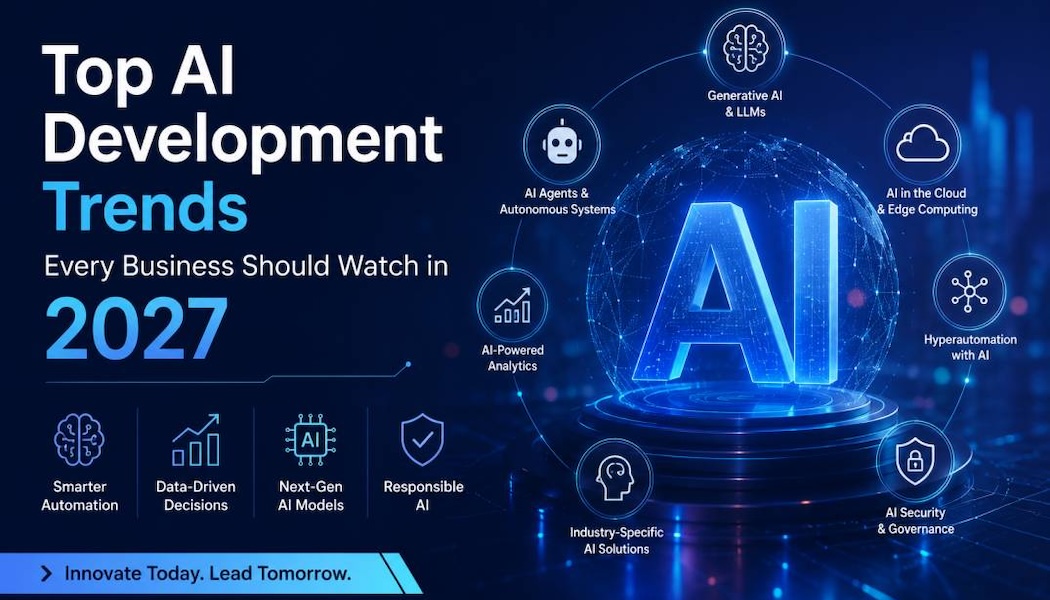
Top AI Development Trends Every Business Should Watch in 2027
Artificial Intelligence development trends are moving past experimentation. Over the last few years, businesses have moved from asking “How can we use AI?” to “How can we redesign our operations around AI ?” and it feels like the question keeps getting a little more serious.
By 2027 , the companies getting the most value from AI will not necessarily be the ones using the most advanced models, or even the shiniest versions of them. It’s more likely they’ll be the ones that build usable AI systems which are aligned with business goals, customer expectations, data strategies, and day to day operational workflows.
The future of AI development will dial back on standalone tools and instead emphasize intelligent ecosystems. These ecosystems should be able to reason, work together, automate the process steps, and help with better decision-making too.
Here are the key AI development trends businesses should keep an eye on as they prepare for the future of AI development.
1. AI Agents Will Become the New Enterprise Workforce Layer
A big one among the AI trends 2027 will be the growth of AI agents that can sort of go off on their own and finish multi-step tasks, without constantly asking for nudges.
Instead of classic AI assistants that just answer a prompt, agentic AI systems can map out a plan, reach out for information, make calls within certain limits, and then carry out the whole workflow.
In practice this means businesses are already poking around with AI agents for customer support, software development, sales operations, research, and even internal knowledge management, you know, the place where stuff quietly lives.
McKinsey’s “State of AI 2025” report says 62% of organisations surveyed were already experimenting with AI agents, but a lot of them were still pretty early, like, figuring out how to scale them across the entire enterprise.
By 2027, more companies will lean into building specialised AI agents for particular departments, rather than betting on one general purpose system that has to do everything.
Examples may include:
- AI sales assistants that analyse leads and recommend actions
- AI finance agents that detect anomalies in transactions
- AI HR agents that support employee queries
- AI development agents that assist engineers throughout the software lifecycle
The focus will shift from AI answering questions to AI completing meaningful business processes.
2. Enterprise AI Will Move From Pilots to Real Business Transformation
A lot of organisations have already tested AI in some form, and yeah it worked, at least in parts . The real obstacle now seems to be scaling it up.
What’s coming next with the future of AI development won’t be defined just by models or shiny demos, but by how well companies weave AI into their core workflows, not just using it as an extra productivity layer, you know.
McKinsey’s research points out that AI adoption is already quite broad, yet many organisations are still stuck in experimentation, or they’re running pilots for a while. Only a smaller set has actually delivered enterprise-level results that stick, in the long run.
By 2027, the enterprises that will truly succeed tend to focus on things like:
- Reworking workflows around AI capabilities, and not the other way around
- Linking AI systems to business data across teams
- Judging AI performance via revenue, efficiency, and customer experience outcomes
- Establishing internal AI governance frameworks, early enough
That whole thing should end up pushing demand higher for specialised AI software development services, where a company can more or less design and build tailored AI solutions instead of merely adopting off-the-shelf platforms and then calling it done, like everything is fine.
3. Multimodal AI Will Redefine Customer Experiences
AI is getting more capable at juggling a mix of information types, like text plus images, audio and video, plus structured data too. Because of that, multimodal AI is one of those important innovation trends, so businesses will likely use it to craft richer customer interactions, and more personalised ones too.
For example:
- Retail companies can combine customer conversations, product images, and purchase history to improve recommendations.
- Healthcare organisations can analyse medical images along with patient records.
- Educational platforms can kind of blend voice, reading behaviour, and performance metrics so they can personalise learning in a way that actually feels more tailored.
The shift is going to be from text based AI chats to something more natural, like those human-like experiences that feel a bit smoother, sometimes, you know.
For businesses getting ready for 2027, they will need AI systems that can understand context across multiple data formats, and not only one, in a single lane or whatever.
Also Read : How AI Chatbots Are Transforming Customer Support and Sales
4. Smaller and More Efficient AI Models Will Gain Adoption
Large language models have dominated AI discussions, but the future of AI development will also focus on efficiency. Businesses are increasingly looking for AI models that are:
- Faster to deploy
- More affordable
- Easier to customise
- More secure for private data
Smaller AI models, usually built for specific business needs, will start to feel like a more real alternative for companies that do not require huge general purpose systems.
This shift is going to be extra important in sectors dealing with sensitive material, like finance, healthcare, legal services, and even government organisation fields.
So instead of asking, “Which is the largest AI model ?”, businesses will more and more ask “Which AI model fits best for this particular business problem?”
5. Responsible AI and Governance Will Become Business Priorities
As AI gets more and more tangled into day to day decision-making, organisations will really need better governance systems , so it doesn’t just run loose.
Accuracy, transparency, privacy and security will turn into essential building blocks inside enterprise AI strategies, not like optional nice stuff.
The AI Index Report 2025 actually pointed to more and more focus on responsible AI practices , as organisations push broader AI adoption across multiple industries.
By 2027 , businesses should have frameworks for stuff like
- Data privacy management
- AI model monitoring
- Bias detection
- Human oversight
- Compliance requirements
And companies that lay down responsible AI foundations early on will be in a stronger position , because regulations and customer expectations keep shifting.
Also Read : AI Productivity for Lean Startup Development Teams
6. AI-Powered Software Development Will Become Mainstream
Software development, in itself, is being reshaped by AI.
Developers are more and more leaning on AI tools for code generation, testing, debugging, documentation , and even for ongoing application maintenance. Still, the future won’t be only about AI writing code faster. It will be more like AI becoming a real integrated development partner, not just a helper on the side.
Those upcoming AI-driven development environments will help teams:
- understand complicated codebases,
- spot possible security issues,
- automate the repetitive engineering chores,
- lift software quality,
- and speed up product development cycles.
Research on how generative AI is being adopted across software engineering suggests developers are already seeing productivity gains, but they’re also pointing to the need for validation, stronger security habits, and better governance.
And for businesses that want to build AI-powered products, they’ll likely lean on seasoned AI Software Development Services partners to create solutions that are scalable, secure, and actually tuned to business goals.
7. Personalised AI Experiences Will Become a Competitive Advantage
Customers are becoming accustomed to personalized digital experiences. AI will take this expectation further.
By 2027 , companies will be using AI to craft shifting experiences, based on individual preferences, behaviour, and what’s happening in real time context.
You can already see shades of it in things like:
- personalised shopping assistants
- AI-driven financial recommendations,
- adaptive learning platforms
- intelligent customer service systems
The firms that really do well will use AI to get closer to understanding customers, not just automate interactions, like a basic conveyor.
Prepare Your Business for AI Trends 2027
The biggest mistake businesses can make is thinking AI is only a tech upgrade, like that is the whole story.
The organizations that get the most out of AI usually do not just “buy tools” and call it done. They treat AI as a real strategic capability, and it shows up in what they do day to day. They invest in high quality data, they build teams with the right skills, they adopt responsible AI practices and they choose solutions that are shaped around actual business problems, not shiny features.
The next wave of AI won’t be described only by models that are smarter. It will be described by smarter implementation, the way it gets put to work in the business, how it’s governed, how it’s measured, how it actually lands.
With experienced tech partners like WeblineIndia assisting in AI driven transformation, organizations can shift from just experimenting with AI to generating real business impact, in a more meaningful way.
So businesses that start preparing today will be in a better position to use AI as a driver of innovation, efficiency, and durable long-term growth in 2027 and beyond.